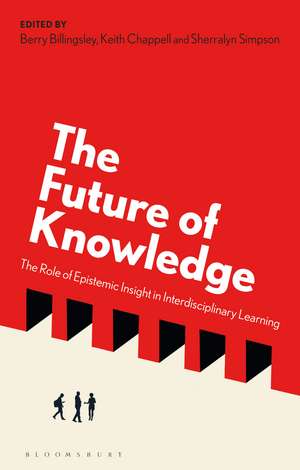
The Future of Knowledge: The Role of Epistemic Insight in Interdisciplinary Learning
Editat de Professor Berry Billingsley, Keith Chappell, Sherralyn Simpsonen Limba Engleză Paperback – 3 oct 2024
How do we know what to trust in an online world rife with misinformation?
How can we confront our mental health crises?
How can we overcome polarization on issues of critical importance to our shared existence?
How can we work together with those who see the world differently to us?
Confronting these questions requires us to consider what the 'future of knowledge' might be, including the distinctive roles that disciplines across the sciences, arts and humanities might play. Epistemic insight is the 'knowledge about knowledge' needed to navigate the similarities and differences between disciplines and how they approach these questions differently. However, many education systems operate with a compartmentalized structure that limits the development of epistemic insight and thus our ability to provide students with the 'knowledge about knowledge' they need.
This open access book draws from 10 years of research into how epistemic insight can transform compartmentalized structures of learning. It presents a range of strategies and approaches for how educators, including schoolteachers, teacher educators, lecturers and education policy-makers, can facilitate epistemically insightful educational experiences. This book provides a distinctive contribution to the field of inter/multi/transdisciplinary education and will be of interested to anyone exploring the power and potential of these approaches.
The ebook editions of this book are available open access under a CC BY-NC-ND 4.0 licence on bloomsburycollections.com. Open access was funded by Templeton World Charity Foundation (TWCF).
Preț: 172.80 lei
Preț vechi: 232.50 lei
-26%
Puncte Express: 259
Carte disponibilă
Livrare economică 15-29 mai
Livrare express 01-07 mai pentru 88.67 lei
Specificații
ISBN-13: 9781350383906
ISBN-10: 1350383902
Pagini: 312
Ilustrații: 20 bw illus
Dimensiuni: 138 x 214 x 18 mm
Greutate: 0.4 kg
Editura: Bloomsbury Publishing
Colecția Bloomsbury Academic
Locul publicării:London, United Kingdom
ISBN-10: 1350383902
Pagini: 312
Ilustrații: 20 bw illus
Dimensiuni: 138 x 214 x 18 mm
Greutate: 0.4 kg
Editura: Bloomsbury Publishing
Colecția Bloomsbury Academic
Locul publicării:London, United Kingdom
Cuprins
List of Teacher Resources and Notes
List of Contributors
Preface: The Future of Knowledge, Berry Billingsley, Keith Chappell, and Sherralyn Simpson
Foreword, Renato Opertti
Introduction: Creating the Future of Knowledge in the age of Gen AI, Berry Billingsley
Chapter Summaries and How to Read this Book, Keith Chappell, Berry Billingsley and Sherralyn Simpson
Part I: Epistemic insight, epistemic agency and multidisciplinary enquiries
Statement of Support, Alona Forkosh Baruch
1. Cultivating Epistemic Agents as Critical Consumers of Information, Berry Billingsley and Sean Durbin
Part II: Planning to Teach with Big Questions
Statement of support, Overson Shumba
2. Igniting primary school students' curiosity: Exploring the impact of co-created Epistemic Insight teaching on learner agency, Sherralyn Simpson
3. Big Questions about humanity's place in the cosmos and Epistemic Insight pedagogy among university trainee teachers, Maureen Kanchebele Sinyangwe
4. Big Questions - and their value in extra-curricular activities that teach epistemic insight, Laura Hackett
Part III: What is the Epistemic Insight Future of Knowledge Initiative?
Statement of Support, Richard Cheetham
5. Future Libraries AI Focusing on Motivations to Learn: A Technologist's View, Ted Selker with additional creative input and expert knowledge from Berry Billingsley
6. Research Co-Creation and the Development of Epistemically Insightful Curricula, Finley I. Lawson, Mandy Dhaliwal, Michelle Lawson and Henry Coates
7. How can we educate future generations to effectively respond to global challenges and live sustainably? Developing agentic learners through an epistemically insightful curriculum, Agnieszka J. Gordon and Sherralyn Simpson
Part IV: The Future of Knowledge and Higher Education
Statement of Support, Rama Thirunamachandran
8. Dancing with the Digital: An 'EI' workshop designed to bridge disciplines and spark students' epistemic creativity, Lee Hazeldine, Karl Bentley, Angela Pickard and Allan Callaghan
9. The Nature-Knowledge-Values framework - a pedagogical tool for teaching NOS in tertiary Education, Klaus Colanero and Kai Ming Kiang
Part V: Language, Technology and Inclusivity
Statement of Support, John Bryant
10. Building a Smarter Search Engine, Aryn Litchfield
11. A Sociocultural Understanding of Epistemic Insight: Toward an Imperative of Interdisciplinary Teaching and Learning, Dana L. Zeidler
12. Get ready, steady, allez? ¡Vamos!, Martin Pickett
Part VI: Science, Imagination, Interdisciplinarity and AI
Statement of Support, Nidhal Guessoum
13. Science Education, Interdisciplinarity, and Critical thinking, Nidhal Guessoum
14. Philosophy and Artificial friends, Greg Artus
15. Library Perspective: closing the book, continuing to grow., Keith Chappell
16. Teacher Notes and Resources
Index
List of Contributors
Preface: The Future of Knowledge, Berry Billingsley, Keith Chappell, and Sherralyn Simpson
Foreword, Renato Opertti
Introduction: Creating the Future of Knowledge in the age of Gen AI, Berry Billingsley
Chapter Summaries and How to Read this Book, Keith Chappell, Berry Billingsley and Sherralyn Simpson
Part I: Epistemic insight, epistemic agency and multidisciplinary enquiries
Statement of Support, Alona Forkosh Baruch
1. Cultivating Epistemic Agents as Critical Consumers of Information, Berry Billingsley and Sean Durbin
Part II: Planning to Teach with Big Questions
Statement of support, Overson Shumba
2. Igniting primary school students' curiosity: Exploring the impact of co-created Epistemic Insight teaching on learner agency, Sherralyn Simpson
3. Big Questions about humanity's place in the cosmos and Epistemic Insight pedagogy among university trainee teachers, Maureen Kanchebele Sinyangwe
4. Big Questions - and their value in extra-curricular activities that teach epistemic insight, Laura Hackett
Part III: What is the Epistemic Insight Future of Knowledge Initiative?
Statement of Support, Richard Cheetham
5. Future Libraries AI Focusing on Motivations to Learn: A Technologist's View, Ted Selker with additional creative input and expert knowledge from Berry Billingsley
6. Research Co-Creation and the Development of Epistemically Insightful Curricula, Finley I. Lawson, Mandy Dhaliwal, Michelle Lawson and Henry Coates
7. How can we educate future generations to effectively respond to global challenges and live sustainably? Developing agentic learners through an epistemically insightful curriculum, Agnieszka J. Gordon and Sherralyn Simpson
Part IV: The Future of Knowledge and Higher Education
Statement of Support, Rama Thirunamachandran
8. Dancing with the Digital: An 'EI' workshop designed to bridge disciplines and spark students' epistemic creativity, Lee Hazeldine, Karl Bentley, Angela Pickard and Allan Callaghan
9. The Nature-Knowledge-Values framework - a pedagogical tool for teaching NOS in tertiary Education, Klaus Colanero and Kai Ming Kiang
Part V: Language, Technology and Inclusivity
Statement of Support, John Bryant
10. Building a Smarter Search Engine, Aryn Litchfield
11. A Sociocultural Understanding of Epistemic Insight: Toward an Imperative of Interdisciplinary Teaching and Learning, Dana L. Zeidler
12. Get ready, steady, allez? ¡Vamos!, Martin Pickett
Part VI: Science, Imagination, Interdisciplinarity and AI
Statement of Support, Nidhal Guessoum
13. Science Education, Interdisciplinarity, and Critical thinking, Nidhal Guessoum
14. Philosophy and Artificial friends, Greg Artus
15. Library Perspective: closing the book, continuing to grow., Keith Chappell
16. Teacher Notes and Resources
Index
Recenzii
Having used an Epistemic Insight approach to teaching in schools and Higher Education, I am more than excited to see this book published. There is a carefully crafted narrative where theory and practice are interwoven highlighting how current thinking can be translated into meaningful teaching and learning. Case studies bring this book to life, the structure and tone protects the reader through complex ideas and challenges thinking, but most of all this feels like a book 'for the good'. It gives us ways into discussions with learners around what I would call wicked problems and pertinent to their lives; supporting the teacher in ways to ensure that there is a subject focus as well as one which encourages dialogue and critical thought.
I commend this book to readers. Epistemic insight plays a central role in developing knowledge and skills that are crucial for contemporary times. People tend to learn in isolation and memorise facts and information. Right now, richer approaches to learning are needed which can stimulate curiosity, creativity and critical thinking within and across disciplines. The guides and case studies in this book explore how to embed epistemic insight into teaching, learning and assessment.
Berry Billingsley has been a driving force behind a new movement in education to reconceptualise how schools and other sites of learning should address issues to do with knowledge. She has worked for many years to develop and test innovative teaching strategies that promote epistemic insight. With Keith Chappell and Sherralyn Simpson she has now brought together in this valuable volume an international team of authors to synthesise the fruits of this work and explore its implications for interdisciplinary learning through a range of issues including GenAI and sustainability.
Big Question: Would the world be a better place if everyone had epistemic insight and agency? It will definitely enable students to much better handle the incredible complexity of today's and future challenges. And in the era of AI it will help all of us to become and remain open minded, responsible and resilient local and global citizens. This book combines in-depth research with practical advice and resources. It will enable educators from primary schools to universities to think and work in a far more multidisciplinary and inspiring approach. Thank you!
In an era where persistent exposure to information is the norm, be it legitimate or fake, solicited or not, this provides a perfectly timed resource, that highlights and evidences the value in developing the necessary skills to both interrogate and appreciate the nuances of context in relation to knowledge acquisition and assimilation. Epistemic agency aligns beautifully with the ethos of the International Baccalaureate, but explicit interdisciplinary awareness is invaluable for all future-minded learners to enable their informed decision making, as we are faced with local and global challenges.
This text offers an important insight into the nature of thinking about knowledge and learning - in a world that is fast changing and that offers many problems for children and young people to solve across a range of disciplines developing a way of thinking about problems - an epistemic insight - is a core and important skill as is recognizing that this insight has subject dependent characteristics.
I commend this book to readers. Epistemic insight plays a central role in developing knowledge and skills that are crucial for contemporary times. People tend to learn in isolation and memorise facts and information. Right now, richer approaches to learning are needed which can stimulate curiosity, creativity and critical thinking within and across disciplines. The guides and case studies in this book explore how to embed epistemic insight into teaching, learning and assessment.
Berry Billingsley has been a driving force behind a new movement in education to reconceptualise how schools and other sites of learning should address issues to do with knowledge. She has worked for many years to develop and test innovative teaching strategies that promote epistemic insight. With Keith Chappell and Sherralyn Simpson she has now brought together in this valuable volume an international team of authors to synthesise the fruits of this work and explore its implications for interdisciplinary learning through a range of issues including GenAI and sustainability.
Big Question: Would the world be a better place if everyone had epistemic insight and agency? It will definitely enable students to much better handle the incredible complexity of today's and future challenges. And in the era of AI it will help all of us to become and remain open minded, responsible and resilient local and global citizens. This book combines in-depth research with practical advice and resources. It will enable educators from primary schools to universities to think and work in a far more multidisciplinary and inspiring approach. Thank you!
In an era where persistent exposure to information is the norm, be it legitimate or fake, solicited or not, this provides a perfectly timed resource, that highlights and evidences the value in developing the necessary skills to both interrogate and appreciate the nuances of context in relation to knowledge acquisition and assimilation. Epistemic agency aligns beautifully with the ethos of the International Baccalaureate, but explicit interdisciplinary awareness is invaluable for all future-minded learners to enable their informed decision making, as we are faced with local and global challenges.
This text offers an important insight into the nature of thinking about knowledge and learning - in a world that is fast changing and that offers many problems for children and young people to solve across a range of disciplines developing a way of thinking about problems - an epistemic insight - is a core and important skill as is recognizing that this insight has subject dependent characteristics.