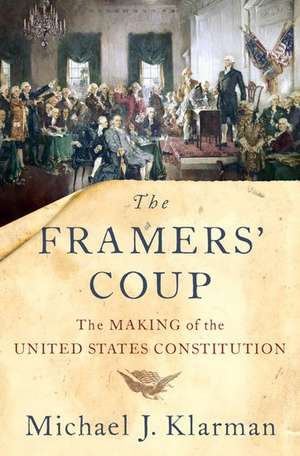
The Framers' Coup: The Making of the United States Constitution
Autor Michael J. Klarmanen Limba Engleză Hardback – 24 noi 2016
Preț: 287.58 lei
Preț vechi: 342.49 lei
-16%
Puncte Express: 431
Carte tipărită la comandă
Livrare economică 04-15 decembrie
Livrare prin curier în România Termenul estimat este afișat lângă disponibilitate.
Transport gratuit de la 400.00 lei Plată online sau ramburs, în funcție de opțiunile comenzii.
Retur gratuit în 14 zile Comandă securizată și suport în română.
Specificații
ISBN-13: 9780199942039
ISBN-10: 019994203X
Pagini: 880
Dimensiuni: 160 x 236 x 58 mm
Greutate: 1.38 kg
Editura: Oxford University Press
Colecția OUP USA
Locul publicării:New York, United States
ISBN-10: 019994203X
Pagini: 880
Dimensiuni: 160 x 236 x 58 mm
Greutate: 1.38 kg
Editura: Oxford University Press
Colecția OUP USA
Locul publicării:New York, United States
V-ar putea interesa
-
 The PrinceNiccolo Machiavelli-28%Preț: 87.33 lei121.03 lei
 -
 The Constitution as Political StructureMartin H. Redish-30%Preț: 846.91 lei1212.96 lei
 -
 The Constitution in the Courts: Law or Politics?Michael J. Perry-20%Preț: 465.89 lei584.33 lei
 -
 The Rehnquist Court: A RetrospectiveMartin H. Belsky-30%Preț: 1354.28 lei1944.14 lei
 -
 Unfinished BusinessMichael J. KlarmanPreț: 229.44 lei
 -
 Brown v. Board of Education and the Civil Rights MovementMichael J. Klarman-15%Preț: 215.78 lei253.57 lei
 -
 -14%Preț: 224.21 lei259.37 lei
 -
 Injustice On Appeal: The United States Courts of Appeals in CrisisWilliam M. Richman-30%Preț: 879.91 lei1260.29 lei
 -
 -32%Preț: 1042.26 lei1529.11 lei
 -
 -29%Preț: 533.87 lei747.26 lei
 -
 Ministers and Parliament: Accountability in Theory and PracticeDiana Woodhouse-31%Preț: 655.97 lei956.90 lei
 -
 -30%Preț: 984.15 lei1405.44 lei
 -
 -22%Preț: 193.93 lei249.86 lei
 -
 Inside the Politics of Self-DeterminationKathleen Gallagher Cunningham-19%Preț: 297.97 lei368.50 lei
 -
 Accountability in the Contemporary ConstitutionNicholas Bamforth-31%Preț: 877.87 lei1263.85 lei
 -
 -27%Preț: 551.47 lei757.42 lei
 -
 The Tough Luck Constitution and the Assault on Healthcare ReformAndrew Koppelman-23%Preț: 137.94 lei179.88 lei
 -
 The PrinceNiccolò MachiavelliPreț: 21.63 lei
 -
 Oppenheim's International Law: Volume 1 PeaceRobert Jennings-32%Preț: 2375.69 lei3483.01 lei
 -
 Ordinary InjusticeAmy BachPreț: 134.31 lei
 -
 The Populist ExplosionJohn B JudisPreț: 98.27 lei
 -
 Lost American PrinciplesSteven L HallPreț: 115.13 lei
 -
 BlueJoe DomanickPreț: 108.32 lei
Recenzii
After more than two centuries, it seemed unlikely that anything new could be said about the drafting and ratification of the United States Constitution. Michael Klarman has managed to do so. He has given us the most thorough account in print of the men and issues that shaped American political culture. It would be conforting to think that the people who wave copies of the Constitution at election rallies would actually read Klarman's provocative book.
Klarman...offers a pragmatic, even quotidian, explanation, taking the reader through the most minute historical detail and presenting quite literally everything anyone interested in the coming-to-be of the US Constitution would possibly want: theory, philosophy, history, theology, religion, politics, economics-and just plain random chance. And he weaves it all together with a master storyteller's ear for just the right phrase and just the right dramatic line. This reviewer is amazed by what the author has accomplished. This is not the first thing he's written, and yet it feels like something one would spend an entire academic career writing. The documentation is astonishing, and is alone worth the price of this (extremely large!) volume. This reviewer had a grand time reading this, and cannot wait to do it again. This is an amazing piece of work....Essential
The central strength of this book is its deep familiarity with primary sources
Klarman...offers a pragmatic, even quotidian, explanation, taking the reader through the most minute historical detail and presenting quite literally everything anyone interested in the coming-to-be of the US Constitution would possibly want: theory, philosophy, history, theology, religion, politics, economics-and just plain random chance. And he weaves it all together with a master storyteller's ear for just the right phrase and just the right dramatic line. This reviewer is amazed by what the author has accomplished. This is not the first thing he's written, and yet it feels like something one would spend an entire academic career writing. The documentation is astonishing, and is alone worth the price of this (extremely large!) volume. This reviewer had a grand time reading this, and cannot wait to do it again. This is an amazing piece of work....Essential
The central strength of this book is its deep familiarity with primary sources
Notă biografică
Michael J. Klarman is Kirkland & Ellis Professor of Law at Harvard Law School and author of the Bancroft Prize-winning From Jim Crow to Civil Rights (OUP).
Cuprins
- Introduction
- Chapter 1: Flaws in the Articles of Confederation
- Lack of a Taxing Power
- Lack of a Commerce Power
- Failed Efforts at Amendment
- Other Flaws in the Articles
- Sectional Conflict
- Chapter 2: Economic Turmoil in the States and the Road to Philadelphia
- Paper Money and Debtor Relief Legislation
- Shays's Rebellion
- The Annapolis Convention
- To the Philadelphia Convention
- Chapter 3: The Constitutional Convention
- Madison's Agenda
- The Virginia Plan
- Expanding the Powers of the National Government
- Establishing the Supremacy of the National Government
- The National Legislature
- Apportioning Representation in the National Legislature
- Other Features of the Senate
- The Executive Branch
- Interpreting the Convention
- Chapter 4: Slavery and the Constitutional Constitution
- Background
- How To Count Slaves in Apportioning National Political Power
- Slavery and Economic Issues
- Other Issues Involving Slavery
- Slavery and Ratification
- Chapter 5: Critics of the Constitution: The Antifederalists
- Preliminaries
- The Legitimacy of the Constitution
- Was Fundamental Reform Necessary?
- Consolidation
- The Taxing Power
- Military Powers
- The Commerce Power and the Treaty-Making Power
- Other Congressional Powers
- The Federal Judiciary
- The House of Representatives
- The Senate
- The President
- Checks and Balances
- Article I, Section 10
- Actual Motivations
- Chapter 6: The Ratifying Contest
- The Nature of the Debate
- The Federalists' Advantages in the Ratifying Contest
- First Steps Toward Ratification
- Running Into Snags in New England
- Maryland and South Carolina
- Virginia
- New York
- North Carolina and Rhode Island
- The Federalists' Great Fears: Conditional Ratification and a Second Convention
- Interpreting Ratification
- Chapter 7: The Bill of Rights
- The Arguments Pro and Con
- Madison's Election to Congress
- Madison and the Bill of Rights in Congress
- Madison's Amendments
- Interpreting the Enactment of the Bill of Rights
- Chapter 8: Conclusion
- Contingency
- Interests
- Hostility Toward Democracy
- Ratification as Ordinary Politics
- Excluding Intermediate Alternatives
- The Decline of Legitimacy Objections
- How the Constitution Did and Did Not Adapt to Democracy
- From the Perspective of Today