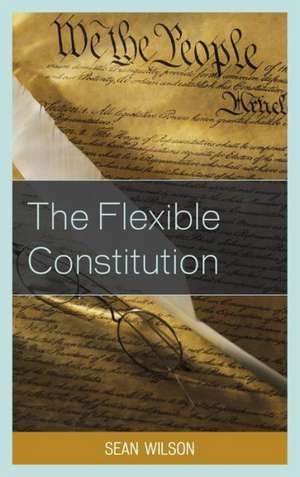
The Flexible Constitution
Autor Sean Wilsonen Limba Engleză Paperback – 13 aug 2014
Preț: 344.70 lei
Preț vechi: 483.54 lei
-29%
Puncte Express: 517
Carte tipărită la comandă
Livrare economică 09-23 noiembrie
Livrare prin curier în România Termenul estimat este afișat lângă disponibilitate.
Transport gratuit de la 400.00 lei Plată online sau ramburs, în funcție de opțiunile comenzii.
Retur gratuit în 14 zile Comandă securizată și suport în română.
Specificații
ISBN-13: 9780739197301
ISBN-10: 0739197304
Pagini: 219
Ilustrații: 11 b/w illustrations; 17 tables
Dimensiuni: 161 x 239 x 23 mm
Greutate: 0.39 kg
Editura: Bloomsbury Publishing
Colecția Lexington Books
Locul publicării:New York, United States
ISBN-10: 0739197304
Pagini: 219
Ilustrații: 11 b/w illustrations; 17 tables
Dimensiuni: 161 x 239 x 23 mm
Greutate: 0.39 kg
Editura: Bloomsbury Publishing
Colecția Lexington Books
Locul publicării:New York, United States
Cuprins
Chapter 1: Wittgenstein, Law and Originalism
Part I: Interpreting the Constitution
Chapter 2: Obeying Flexible Commands
Chapter 3: Is There a Fixed Meaning?
Chapter 4: Public Meaning v. Meaning as Use
Chapter 5: The Flexible Constitution
Chapter 6: Structuralism and Polysemy
Chapter 7: Law as Connoisseur Judgment
Part II: Understanding Originalism
Chapter 8: The Philosophy of Framers' Intent
Chapter 9: Why Framers' Intent is Flawed
Chapter 10: The New Originalism
Chapter 11: The Constitution as Old Society
Chapter 12: Cultural Construction
Chapter 13: What Originalism Really Is
Appendix: The Philosophical Investigation
Part I: Interpreting the Constitution
Chapter 2: Obeying Flexible Commands
Chapter 3: Is There a Fixed Meaning?
Chapter 4: Public Meaning v. Meaning as Use
Chapter 5: The Flexible Constitution
Chapter 6: Structuralism and Polysemy
Chapter 7: Law as Connoisseur Judgment
Part II: Understanding Originalism
Chapter 8: The Philosophy of Framers' Intent
Chapter 9: Why Framers' Intent is Flawed
Chapter 10: The New Originalism
Chapter 11: The Constitution as Old Society
Chapter 12: Cultural Construction
Chapter 13: What Originalism Really Is
Appendix: The Philosophical Investigation
Recenzii
[This is] an excellent book which advances a new Wittgensteinian theory of constitutional interpretation.
From Wittgenstein to connoisseur judgment, this book reimagines basic issues in constitutional interpretation. It suggests new forms for understanding ongoing debates and provides new maps for negotiating them.
In The Flexible Constitution, Sean Wilson provides a welcome rebuttal to the modern originalist movement in constitutional theory. In straightforward and elegant prose, Wilson reminds us that ordinary language-which the Constitution certainly purports to employ-cannot provide the kind of determinate meanings that make a strong form of originalism possible. All in all, the book is a philosophically rigorous counterpoint to the often oversimplified national debate about constitutional interpretation.
Wilson places himself among relatively few, including Brigham, who seem to not simply comprehend Wittgenstein but can explain it masterfully.
The Flexible Constitution brings Wittgenstein's analysis of language-meaning to constitutional theory, showing how many common criticisms of originalism can find their home in that analysis. Its conclusions that constitutional law is best seen through an esthetic lens and that connoisseur judgments are central to determining the constitution's meaning opens a provocative line of inquiry that I hope other scholars will follow.
Sean Wilson's clearly-written and lucidly organized book demonstrates the failings of originalist theory. His major contribution is in his use of the concept of "connoisseur judgment," which he draws from Wittgenstein's aesthetics to show how the ordinary language of the Constitution can and should be interpreted. I find his conclusion compelling: originialism is a distraction from the proper goal of cultivating connoisseur judgment.
From Wittgenstein to connoisseur judgment, this book reimagines basic issues in constitutional interpretation. It suggests new forms for understanding ongoing debates and provides new maps for negotiating them.
In The Flexible Constitution, Sean Wilson provides a welcome rebuttal to the modern originalist movement in constitutional theory. In straightforward and elegant prose, Wilson reminds us that ordinary language-which the Constitution certainly purports to employ-cannot provide the kind of determinate meanings that make a strong form of originalism possible. All in all, the book is a philosophically rigorous counterpoint to the often oversimplified national debate about constitutional interpretation.
Wilson places himself among relatively few, including Brigham, who seem to not simply comprehend Wittgenstein but can explain it masterfully.
The Flexible Constitution brings Wittgenstein's analysis of language-meaning to constitutional theory, showing how many common criticisms of originalism can find their home in that analysis. Its conclusions that constitutional law is best seen through an esthetic lens and that connoisseur judgments are central to determining the constitution's meaning opens a provocative line of inquiry that I hope other scholars will follow.
Sean Wilson's clearly-written and lucidly organized book demonstrates the failings of originalist theory. His major contribution is in his use of the concept of "connoisseur judgment," which he draws from Wittgenstein's aesthetics to show how the ordinary language of the Constitution can and should be interpreted. I find his conclusion compelling: originialism is a distraction from the proper goal of cultivating connoisseur judgment.