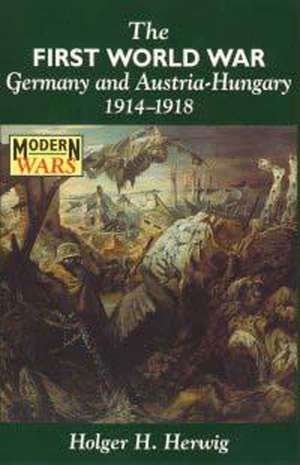
The First World War: Germany and Austria-Hungary 1914-1918: Modern Wars
Autor Holger H. Herwigen Limba Engleză Paperback – 29 noi 1996
Notăm cu interes apariția celei de-a doua ediții a lucrării The First World War, un volum care reușește să recalibreze istoriografia Marelui Război prin mutarea centrului de greutate de la perspectiva Aliaților către mecanismele interne ale Puterilor Centrale. Structura materialului urmărește o progresie riguroasă, debutând cu analiza originilor diplomatice în capitolul „Now or Never” și culminând cu prăbușirea imperiilor Hohenzollern și Habsburg. Metodologia lui Holger H. Herwig se bazează pe o cercetare de arhivă exhaustivă, integrând istoria militară pură cu analiza transformărilor sociale profunde, precum emergența forței de muncă feminine în industriile de război.
Suntem de părere că această ediție aduce clarificări esențiale asupra conceptului de „război industrializat”, detaliind modul în care eșecurile de pe frontul de est și vest au fost dublate de o criză de supraviețuire la nivelul populației civile. Cartea extinde cadrul propus de Imperial Germany and the Great War, 1914–1918 de Roger Chickering prin includerea perspectivei austro-ungare, oferind astfel o imagine completă a blocului central. Dacă în The Marne, 1914, autorul se concentra pe un moment de cotitură tactică, aici Holger H. Herwig livrează o sinteză strategică a întregului conflict, similară ca anvergură cu abordările din The Oxford Illustrated History of the First World War, dar cu o focalizare mult mai specifică pe dinamica dintre Berlin și Viena. Analiza mobilizării este profundă, evidențiind cum „miza finală” din 1918 a dus la o catastrofă ce a redefinit secolul XX.
Preț: 293.62 lei
Preț vechi: 383.57 lei
-23%
Carte tipărită la comandă
Livrare economică 30 noiembrie-14 decembrie
Specificații
ISBN-10: 0340573481
Pagini: 512
Dimensiuni: 148 x 228 x 32 mm
Greutate: 0.74 kg
Editura: Bloomsbury Publishing
Colecția Bloomsbury Academic
Seria Modern Wars
Locul publicării:London, United Kingdom
V-ar putea interesa
-
 War in a European BorderlandMark L von HagenPreț: 219.62 lei
 -
 Myths & Legends of the First World WarJames Hayward-27%Preț: 66.14 lei91.14 lei
 -
 An Illustrated Introduction to the First World WarPhil CarradicePreț: 113.23 lei
 -
 Preț: 202.94 lei
 -
 Civilization, 1914-1917Georges DuhamelPreț: 170.45 lei
 -
 The First World War as a Clash of CulturesFred Bridgham-23%Preț: 818.08 lei1062.44 lei
 -
 The Vest Pocket Kodak & the First World WarJon CookseyPreț: 58.33 lei
 -
 The First World War in the Middle EastKristian Coates Ulrichsen-22%Preț: 187.10 lei239.37 lei
 -
 -22%Preț: 57.48 lei74.03 lei
De ce să citești această carte
Această lucrare este esențială pentru cercetătorii și studenții la istorie care doresc să înțeleagă Primul Război Mondial dincolo de narativul învingătorilor. Cititorul câștigă o perspectivă documentată asupra modului în care Germania și Austro-Ungaria au gestionat efortul de război total și impactul devastator al militarizării societății. Este resursa definitivă pentru înțelegerea prăbușirii celor două imperii centrale.
Despre autor
Holger H. Herwig este profesor de istorie și deține Catedra de Cercetare în Studii Militare și Strategice la Universitatea din Calgary, Canada. Expert recunoscut în istoria militară germană, acesta a semnat lucrări de referință precum The Destruction of the Bismarck și a colaborat la volume enciclopedice de prestigiu. Opera sa se distinge prin rigoarea utilizării surselor primare, explorând teme care variază de la bătălii decisive în The Marne, 1914, până la ambițiile imperiale în America Latină prezentate în Germany`s Vision of Empire in Venezuela, 1871–1914. Experiența sa academică oferă o profunzime analitică rară în studiul conflictelor moderne.
Descriere
sowed some of the seeds of another worldwide conflagration 20 years
later. Yet, until now, there has been no comprehensive treatment of how
Germany and Austria-Hungary - two of the key belligerents - conducted
the war and what defeat meant to them.
How did the
Hohenzollern and Habsburg empires conceive of and conduct 'total war'?
What impact did the prolonged fighting have on their societies? Drawing
on his own archival research over the past decade, Holger Herwig
analyses why Vienna opted for war in 1914 and why Berlin took the
calculated risk to back that decision.
The war plans and
military campaigns on both Eastern and Western fronts are examined in
detail and key battles, some of the bloodiest and most wasteful in
military history, are narrated and analysed.
On the home
front, the mobilization of the civilian populations behind the war
effort had profound social consequences. The militarization of the key
war-related industries led to an industrial women's labour force
emerging in both countries, deeply affecting the role of women in
Germanic society.
''The great seminal catastrophe of the
twentieth century', as American statesman George F Kennan described the
war, has had no shortage of accounts seen chiefly from Allied
perspectives. In using Vienna and Berlin as his vantage points, Herwig
has comprehensively shown for the first time the other side of that
prodigiously wasteful conflict.
Recenzii
'A comprehensive study...we have needed for some time...one cannot but admire the breathtaking scope of [Herwig's] scholarship. A brilliant work by one of the real giants in the field. An absolute must read for anyone with even a passing interest in the subject.'
'In making extensive use of achive material in Germany and Austria... [Herwig] is able to destroy effectively the myth of a well-run German war machine.'
'...the most thorough and readable one-volume history of the war so far available.'
'[Herwig] makes comprehensive use of archival sources....[He] combines this original scholarship with comprehensive synthesis of a generation's worth of specialized research. When clear organization and lucid prose are added to the mix, the result is a definitive analytical overview of the Central Powers at war.'
'Historian Herwig draws primarily on German and Austro-Hungarian archival sources (many of which have become accessible only in the last decade) to analyze the surprising weaknesses and blundering of those two powers. Following an informative preface by series editor and historian Hew Strachan and an introduction by the author, Herwig presents a terse narrative of the war's course. Chapter notes and an extensive bibliography contain a large number of German and Austrian official sources, while black-and-white maps illustrate major battles and campaigns.'
Cuprins
Introduction
1. Origins: 'Now or Never'
2. The Plans of War
3. The Great Gamble, 1914
4. Towards Industrialized War, 1915
5. Dual Defeats: From the Meuse to the Sereth, 1916
6. The Long-War Reality, 1915-16
7. Survival
8. A Sea-Change, 1917
9. The Last Levy, 1917-18
10. Operation Michael: The 'Last Card'
11. Defeat, 1918-19
Bibliography
Index
Caracteristici
Notă biografică
Holger H. Herwig is Professor of History at the University of Calgary, Canada.