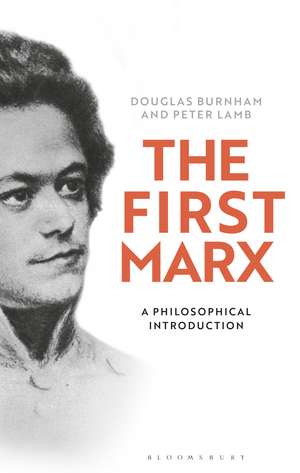
The First Marx: A Philosophical Introduction
Autor Peter Lamb, Professor Douglas Burnhamen Limba Engleză Hardback – 15 noi 2018
Arguments regarding revolutionary change, contradiction and other topics such as production, alienation and emancipation contribute to a powerful analysis in the early works of Marx, one which is worthy of discussion on its own merits. This analysis is distributed among a range of books, papers, letters and other writings, and is gathered here for the first time. Marx's work of the period was driven by his commitment to emancipation. Moreover, as is discussed in the conclusion to this book, his emancipatory philosophy continues to have resonance today. This new book presents Marx in a unique, new light and will be indispensable reading for all studying and following his work.
Preț: 772.52 lei
Preț vechi: 1021.70 lei
-24%
Puncte Express: 1159
Carte tipărită la comandă
Livrare economică 30 noiembrie-14 decembrie
Livrare prin curier în România Termenul estimat este afișat lângă disponibilitate.
Transport gratuit pentru acest produs Plată online sau ramburs, în funcție de opțiunile comenzii.
Retur gratuit în 14 zile Comandă securizată și suport în română.
Specificații
ISBN-13: 9781350026865
ISBN-10: 1350026867
Pagini: 240
Dimensiuni: 160 x 236 x 20 mm
Greutate: 0.51 kg
Editura: Bloomsbury Publishing
Colecția Bloomsbury Academic
Locul publicării:London, United Kingdom
ISBN-10: 1350026867
Pagini: 240
Dimensiuni: 160 x 236 x 20 mm
Greutate: 0.51 kg
Editura: Bloomsbury Publishing
Colecția Bloomsbury Academic
Locul publicării:London, United Kingdom
Cuprins
preface
acknowledgements
1. Introduction
2. Production
3. Alienation
4. Exploitation
5. Change
6. Emancipation
7. Conclusions
bibliography
index
acknowledgements
1. Introduction
2. Production
3. Alienation
4. Exploitation
5. Change
6. Emancipation
7. Conclusions
bibliography
index
Recenzii
In The First Marx, Douglas Burnham and Peter Lamb diligently and brilliantly build a temporally resonant Marx out of his early writings, and garner his splintered insights to work as a distinct political philosophy. They have equally productively and generatively applied Marxian ideas to the contemporary human condition in ways that open the door to future research and scholarship on Marx. The First Marx will long endure as a must-have primer for both early and advanced students and scholars of Marx.
The authors present a serious and often well-argued analysis of the political philosophy of the young Marx.
Much more than a study of the Marx's early writings, The First Marx draws on an unusually wide array of primary source materials. Burnham and Lamb construct a first political philosophy for Marx that reflects the power and sweep of his critical thinking. Thematic chapters provide new insights into alienation, exploitation, emancipation and other concepts that Marx developed philosophically. In this book we are presented with a coherent picture that biographical studies do not achieve. The early Marx did not know that he would become the later Marx, and Burnham and Lamb have done us a service in stopping the clock at a crucial point.
The First Marx fills a gap in the literature on Marx by taking Marx's early work, seriously as a complete philosophical system. It is an invaluable resource for understanding key terms in Marxism such as "alienation," and would lend itself to discussion of humanism as well as the importance of Marx's early work as foundational to the entire concept of social construction.
The authors present a serious and often well-argued analysis of the political philosophy of the young Marx.
Much more than a study of the Marx's early writings, The First Marx draws on an unusually wide array of primary source materials. Burnham and Lamb construct a first political philosophy for Marx that reflects the power and sweep of his critical thinking. Thematic chapters provide new insights into alienation, exploitation, emancipation and other concepts that Marx developed philosophically. In this book we are presented with a coherent picture that biographical studies do not achieve. The early Marx did not know that he would become the later Marx, and Burnham and Lamb have done us a service in stopping the clock at a crucial point.
The First Marx fills a gap in the literature on Marx by taking Marx's early work, seriously as a complete philosophical system. It is an invaluable resource for understanding key terms in Marxism such as "alienation," and would lend itself to discussion of humanism as well as the importance of Marx's early work as foundational to the entire concept of social construction.