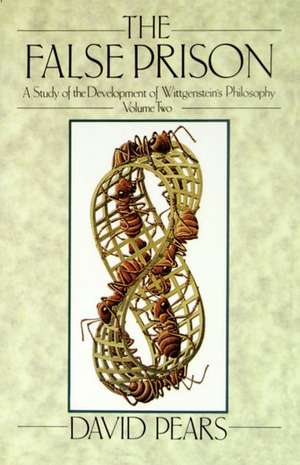
The False Prison: Volume Two
Autor David Pearsen Limba Engleză Paperback – 10 noi 1988
This is the first of two volumes which describe the development of Wittgenstein's philosophy from the Tracatus to his later writings. Part I of this volume is a survey of the whole of his work; Part II is a detailed examination of the central ideas for his early system. The second volume will cover later philosophy.The book fills a gap in the literature on Wittgenstein between brief introductions and detailed commentaries. Although necessarily selective, the doctrines and ideas chosen for detailed discussion are those which reveal the general structure of Wittgenstein's work. David Pears has taken full account of the origins of Wittgenstein's philosophy and its relation to the philosophies of his predecessors and contemporaries. But the author's main emphasis is on the internal organization of Wittgenstein's thought. Philosophy students concentrate on the details of his work but often find it difficult to see their place in the general pattern. This book presents the general and the particular within a relatively constant framework, thereby making Wittgenstein's thought more accessible to students of philosophy and to non-specialists.
Preț: 388.74 lei
Preț vechi: 473.05 lei
-18%
Puncte Express: 583
Carte tipărită la comandă
Livrare economică 04-15 decembrie
Livrare prin curier în România Termenul estimat este afișat lângă disponibilitate.
Transport gratuit de la 400.00 lei Plată online sau ramburs, în funcție de opțiunile comenzii.
Retur gratuit în 14 zile Comandă securizată și suport în română.
Specificații
ISBN-13: 9780198244868
ISBN-10: 019824486X
Pagini: 340
Dimensiuni: 137 x 216 x 21 mm
Greutate: 0.48 kg
Editura: OUP OXFORD
Colecția OUP Oxford
Locul publicării:Oxford, United Kingdom
ISBN-10: 019824486X
Pagini: 340
Dimensiuni: 137 x 216 x 21 mm
Greutate: 0.48 kg
Editura: OUP OXFORD
Colecția OUP Oxford
Locul publicării:Oxford, United Kingdom
V-ar putea interesa
-
 The Mind of God and the Works of ManEdward Craig-27%Preț: 349.49 lei476.92 lei
 -
 -26%Preț: 353.34 lei479.19 lei
 -
 Leibniz's 'New System': and associated contemporary textsR. S. Woolhouse-18%Preț: 363.00 lei443.26 lei
 -
 Entity and Identity: And other essaysP. F. Strawson-18%Preț: 371.44 lei453.11 lei
 -
 -20%Preț: 295.46 lei367.21 lei
 -
 -12%Preț: 362.44 lei412.35 lei
 -
 Knowledge and Reality: Selected EssaysColin McGinn-17%Preț: 350.60 lei423.85 lei
 -
 -27%Preț: 358.21 lei491.20 lei
 -
 Metaethics after MooreTerry Horgan-20%Preț: 491.06 lei612.86 lei
 -
 DerridaBenoît PeetersPreț: 228.64 lei
 -
 Life Lessons from BergsonMichael FoleyPreț: 56.06 lei
 -
 Being and EventAlain Badiou-18%Preț: 177.90 lei215.80 lei
 -
 Heidegger and the Place of EthicsDr Michael Lewis-16%Preț: 277.29 lei329.16 lei
 -
 The Rhetorical Foundations Of SocietyErnesto LaclauPreț: 158.59 lei
 -
 Agamben and Indifference: A Critical OverviewWilliam Watkin-22%Preț: 347.23 lei444.73 lei
 -
 -16%Preț: 353.21 lei421.84 lei
Recenzii
'magisterial study ... Pears is of course an exceptionally well-qualified guide to theTractatus' Time Literary Supplement
'He has an unerring sense for what is central in Wittgenstein's investigations and an enviable gift for reconstructing Wittgenstein's thought by projecting himself into a problem as it presented itself to Wittgenstein, but without sacrificing his independence. The depth and density of his interpretation contrast sharply with most other efforts. His book is elegantly and imaginatively written, with an unrivalled sympathy for and rare mastery of its subject.'Malcolm Budd, TLS
'lucid and careful treatment'Times Higher Education Supplement
'This book provides a detailed and perceptive account of both the continuities and discontinuities in the development of Wittgenstein's later treatment of the ego, sensation and rule-following.'David Stern, University of Iowa, Canadian Philosophical Reviews
'The clarity of the exposition and the detail with which the arguments are untangled makes this an excellent book for student use.'Rom Harré, International Studies in Philosophy
'He has an unerring sense for what is central in Wittgenstein's investigations and an enviable gift for reconstructing Wittgenstein's thought by projecting himself into a problem as it presented itself to Wittgenstein, but without sacrificing his independence. The depth and density of his interpretation contrast sharply with most other efforts. His book is elegantly and imaginatively written, with an unrivalled sympathy for and rare mastery of its subject.'Malcolm Budd, TLS
'lucid and careful treatment'Times Higher Education Supplement
'This book provides a detailed and perceptive account of both the continuities and discontinuities in the development of Wittgenstein's later treatment of the ego, sensation and rule-following.'David Stern, University of Iowa, Canadian Philosophical Reviews
'The clarity of the exposition and the detail with which the arguments are untangled makes this an excellent book for student use.'Rom Harré, International Studies in Philosophy