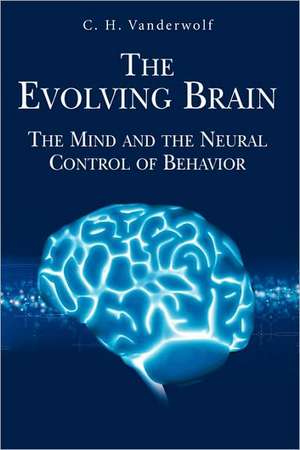
The Evolving Brain
Autor C. H. Vanderwolfen Limba Engleză Paperback – 29 oct 2010
În lucrarea The Evolving Brain, C. H. Vanderwolf propune o restructurare radicală a metodologiei cercetării în neuroștiințele cognitive. Structura materialului este concepută pentru a demonta premisa că organizarea funcțională a creierului urmează categoriile filosofice clasice. Autorul organizează argumentația pornind de la o perspectivă istorică asupra conceptelor de minte și comportament, avansând apoi către baze biologice concrete: origini umane, instincte și, în final, mecanismele neurale specifice locomoției și controlului motor voluntar. Descoperim aici o critică severă a modului în care neuroștiința modernă a adoptat necritic taxonomii psihologice precum memoria, atenția sau motivația, despre care C. H. Vanderwolf afirmă că își au originea în speculațiile lui Platon și Aristotel, nu în observația biologică. Putem afirma că volumul funcționează ca un manifest pentru o neuroștiință bazată pe etologie, sugerând că studiul comportamentului animal este singura cale viabilă pentru a înțelege arhitectura neurală umană. Această abordare extinde cadrul propus de An Odyssey Through the Brain, Behavior and the Mind de același autor, unde se demonstra deja că activitatea electrică a creierului nu este organizată conform conceptelor psihologice convenționale. Spre deosebire de Brain, Behaviour and Evolution de David A. Oakley, care utilizează perspectiva evoluționistă pentru a clarifica problemele tradiționale ale psihologiei, The Evolving Brain merge mai departe, punând sub semnul întrebării însăși validitatea acestor probleme. Tonul este unul academic, precis, eliminând orice ambiguitate în favoarea unei analize riguroase a controlului neural asupra comportamentului.
Preț: 634.13 lei
Preț vechi: 746.03 lei
-15%
Carte tipărită la comandă
Livrare economică 07-21 decembrie
Specificații
ISBN-10: 1441941703
Pagini: 116
Ilustrații: IX, 104 p.
Dimensiuni: 155 x 235 x 7 mm
Greutate: 0.19 kg
Ediția:Softcover reprint of hardcover 1st edition 2007
Editura: Springer
Locul publicării:New York, NY, United States
V-ar putea interesa
-
 Dyslexia, Learning, and the BrainRoderick I. Nicolson-5%Preț: 291.00 lei306.32 lei
 -
 A-Z of Neurological PracticeAndrew J Larner-5%Preț: 409.47 lei431.02 lei
 -
 -19%Preț: 133.56 lei165.56 lei
 -
 -19%Preț: 119.88 lei147.54 lei
 -
 -20%Preț: 123.65 lei154.96 lei
 -
 Clinical Autonomic DysfunctionJoseph Colombo-5%Preț: 1651.46 lei1738.38 lei
 -
 Atlas of Muscle Innervation ZonesMarco Barbero-5%Preț: 1136.24 lei1196.05 lei
 -
 Perinatal Neurology and NeurosurgeryRa Thompson-5%Preț: 353.21 lei371.81 lei
Public țintă
Professional/practitionerDe ce să citești această carte
Recomandăm această carte profesioniștilor din neuroștiințe și psihologie experimentală care doresc să își reevalueze fundamentele teoretice. Cititorul câștigă o perspectivă critică asupra limitărilor psihologiei tradiționale, primind în schimb un model de analiză ancorat în biologia evoluționistă și controlul motor. Este o lectură esențială pentru a înțelege de ce studiul mișcării și al comportamentului animal este crucial pentru descifrarea minții umane.
Cuprins
Recenzii
"Vanderwolf … critiques current approaches to the study of the neural basis of mind, particularly as they apply to psychological processes such as perception, attention, motivation, emotion, memory, and cognition. … Vanderwolf reminds those interested in the field of the brain, behaviour, and the mind that works best when it rests on objective data. Summing Up: Recommended. Upper-division undergraduates through faculty." (C. R. Timmons, CHOICE, Vol. 44 (11), July, 2007)
Textul de pe ultima copertă
C. H. Vanderwolf, Ph.D., DSC., is a Professor Emeritus in the Department of Psychology and Graduate Program in Neuroscience at the University of Western Ontario, London, Ontario, Canada.