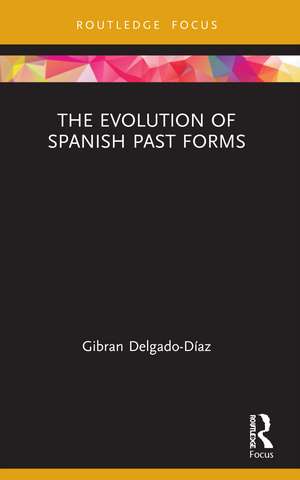
The Evolution of Spanish Past Forms: Routledge Studies in Hispanic and Lusophone Linguistics
Autor Gibran Delgado-Díazen Limba Engleză Paperback – 29 aug 2022
With examples from Medieval Spanish, Golden Age Spanish, and Modern Spanish literary works, this book demonstrates how language is dynamic and susceptible to change. The past forms considered here include the preterit, the imperfect, the imperfect progressive with estar (temporal to be), the present perfect, the imperfect progressive with other auxiliary verbs, the preterit progressive with estar, and the preterit progressive with other auxiliary verbs.
This book will be of interest to scholars and graduate students investigating tense and aspect phenomena in Spanish and other languages, grammaticalization processes, and language variation and change.
Din seria Routledge Studies in Hispanic and Lusophone Linguistics
-
 Preț: 436.23 lei
 -
 Preț: 416.85 lei
 -
 Preț: 431.12 lei
 -
 Preț: 380.94 lei
 -
 Preț: 410.99 lei
 -
 Preț: 430.87 lei
 - 19%
 Preț: 456.33 lei
 -
 Preț: 446.14 lei
 -
 Preț: 395.27 lei
 -
 Preț: 436.27 lei
 - 19%
 Preț: 456.98 lei
 -
 Preț: 435.38 lei
 -
 Preț: 410.99 lei
 -
 Preț: 431.27 lei
 - 18%
 Preț: 1152.85 lei
 -
 Preț: 420.66 lei
 -
 Preț: 433.20 lei
 -
 Preț: 432.83 lei
 - 18%
 Preț: 1123.09 lei
 -
 Preț: 459.18 lei
 -
 Preț: 417.29 lei
 -
 Preț: 453.80 lei
 -
 Preț: 447.30 lei
 - 18%
 Preț: 1340.08 lei
 -
 Preț: 436.23 lei
 -
 Preț: 415.97 lei
 - 18%
 Preț: 1302.64 lei
 -
 Preț: 471.24 lei
Preț: 212.99 lei
Puncte Express: 319
Carte indisponibilă temporar
Livrare prin curier în România Termenul estimat este afișat lângă disponibilitate.
Transport gratuit de la 400.00 lei Plată online sau ramburs, în funcție de opțiunile comenzii.
Retur gratuit în 14 zile Comandă securizată și suport în română.
Specificații
ISBN-13: 9780367715540
ISBN-10: 0367715546
Pagini: 150
Ilustrații: 34
Dimensiuni: 138 x 216 x 12 mm
Greutate: 0.22 kg
Ediția:1
Editura: Taylor & Francis
Colecția Routledge
Seria Routledge Studies in Hispanic and Lusophone Linguistics
Locul publicării:Oxford, United Kingdom
ISBN-10: 0367715546
Pagini: 150
Ilustrații: 34
Dimensiuni: 138 x 216 x 12 mm
Greutate: 0.22 kg
Ediția:1
Editura: Taylor & Francis
Colecția Routledge
Seria Routledge Studies in Hispanic and Lusophone Linguistics
Locul publicării:Oxford, United Kingdom
Public țintă
PostgraduateCuprins
1. Introduction 2. Grammaticalization Theory 3. Previous studies on Spanish past forms 4. The study 5. Results 6. Discussion and conclusions
Notă biografică
Gibran Delgado-Díaz teaches Spanish Linguistics at University of Puerto Rico, Mayagüez, P.R.
Descriere
The Evolution of Spanish Past Forms examines how Spanish past forms have changed diachronically.