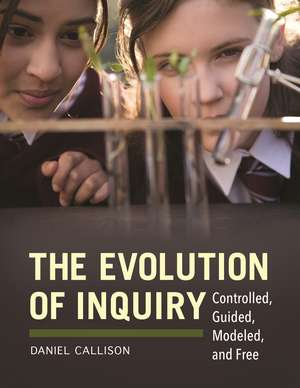
The Evolution of Inquiry: Controlled, Guided, Modeled, and Free
Autor Daniel Callisonen Limba Engleză Paperback – 26 mai 2015
Information inquiry is a basic skill for those who examine information as a science, and its principles can be applied across the K-12 curriculum. Built around reflective reviews of more than two dozen articles from School Library (Media Activities) Monthly, this helpful book shows the evolution, adoption, and application of the inquiry learning process to the school library teaching/learning environment. Four levels of inquiry-controlled, guided, open, and free-are explored in association with the emerging national Common Core curriculum and the Standards for the 21st-Century Learner from the American Association of School Librarians.
With the growing interest in the concept of inquiry and inquiry learning, you may find yourself needing to distinguish between the existing models and their applications. To help you do that, the book provides you with rich, historical context that clarifies the models, and it also projects future applications of inquiry and learner-centered teaching through school information literacy programs. These new applications, such as graphic inquiry, argumentation for inquiry, and the student as information scientist, offer tangible examples you can use to enrich the expanding information literacy curriculum.
Preț: 272.78 lei
Preț vechi: 411.59 lei
-34%
Puncte Express: 409
Carte tipărită la comandă
Livrare economică 30 noiembrie-14 decembrie
Livrare prin curier în România Termenul estimat este afișat lângă disponibilitate.
Transport gratuit de la 400.00 lei Plată online sau ramburs, în funcție de opțiunile comenzii.
Retur gratuit în 14 zile Comandă securizată și suport în română.
Specificații
ISBN-13: 9781610693868
ISBN-10: 1610693868
Pagini: 272
Dimensiuni: 216 x 279 x 20 mm
Greutate: 0.74 kg
Editura: Bloomsbury Publishing
Colecția Libraries Unlimited
Locul publicării:New York, United States
ISBN-10: 1610693868
Pagini: 272
Dimensiuni: 216 x 279 x 20 mm
Greutate: 0.74 kg
Editura: Bloomsbury Publishing
Colecția Libraries Unlimited
Locul publicării:New York, United States
V-ar putea interesa
-
 -8%Preț: 434.73 lei472.54 lei
 -
 Teacher Leadership and Behaviour ManagementBill Rogers-15%Preț: 537.45 lei632.29 lei
 -
 Drawing with ChildrenMona BrookesPreț: 139.69 lei
 -
 School as a JourneyTorin M. FinserPreț: 131.45 lei
 -
 Higher Order Thinking SkillsR Bruce WilliamsPreț: 203.35 lei
 -
 Looking Forward to Monday MorningDiane HodgesPreț: 269.13 lei
 -
 Preț: 249.31 lei
 -
 Motivating Learners in the ClassroomGavin ReidPreț: 399.79 lei
 -
 -8%Preț: 429.27 lei466.60 lei
 -
 Working with ParaprofessionalsJulie SausenPreț: 125.74 lei
 -
 -19%Preț: 263.36 lei326.34 lei
 -
 Teaching Business Education 14-19Martin JephcotePreț: 381.40 lei
Cuprins
CONTENTS
Preface
Acknowledgments
SECTION I: INQUIRY: CONTROLLED, GUIDED, MODELED, AND FREE
Chapter 1 : Key Artifacts Reflecting Progression and Evolution Toward Inquiry
Chapter 2 : Evolution of Controlled Inquiry
Chapter 3: Guided, Modeled, and Mentored Inquiry Enhanced by Cognitive Apprenticeship
Chapter 4: Free Inquiry and Student-Centered Learning
Chapter 5: Various Perceptions of Inquiry
SECTION II: INFORMATION INQUIRY: LEARNING PRACTICES FROM SCHOOL LIBRARY MONTHLY
Bibliography of Inquiry Articles from School Library Monthly 1997û2014
Callison, D. and A. Lamb. "Authentic Learning"
Callison, D. "The Student Information Scientist, Part I"
Callison, D. "The Student Information Scientist, Part 2"
Lamb, A. and D. Callison. "Graphic Inquiry for All Learners"
SECTION III: INFORMATION INQUIRY ACROSS THE CURRICULUM: ARTICLES FROM SCHOOL LIBRARY MONTHLY
Chapter 6: Inquiry in Science and Math
Chapter 7: Inquiry in Language Arts
Chapter 8: Inquiry in History
Chapter 9: Inquiry and the Argument Curriculum
Chapter 10: Inquiry and Communication
SECTION IV: ADDITIONAL RESEARCH REVIEWS
Chapter 11: Challenges & Opportunities for Collaboration, Expanded Roles, and Future Facilities
Chapter 12: Research on Inquiry Learning and Teaching Techniques
Chapter 13: Student Online Searching and Evaluating Information
Chapter 14: A Timeline for the Progression Through Information Literacy to Inquiry
Index
Preface
Acknowledgments
SECTION I: INQUIRY: CONTROLLED, GUIDED, MODELED, AND FREE
Chapter 1 : Key Artifacts Reflecting Progression and Evolution Toward Inquiry
Chapter 2 : Evolution of Controlled Inquiry
Chapter 3: Guided, Modeled, and Mentored Inquiry Enhanced by Cognitive Apprenticeship
Chapter 4: Free Inquiry and Student-Centered Learning
Chapter 5: Various Perceptions of Inquiry
SECTION II: INFORMATION INQUIRY: LEARNING PRACTICES FROM SCHOOL LIBRARY MONTHLY
Bibliography of Inquiry Articles from School Library Monthly 1997û2014
Callison, D. and A. Lamb. "Authentic Learning"
Callison, D. "The Student Information Scientist, Part I"
Callison, D. "The Student Information Scientist, Part 2"
Lamb, A. and D. Callison. "Graphic Inquiry for All Learners"
SECTION III: INFORMATION INQUIRY ACROSS THE CURRICULUM: ARTICLES FROM SCHOOL LIBRARY MONTHLY
Chapter 6: Inquiry in Science and Math
Chapter 7: Inquiry in Language Arts
Chapter 8: Inquiry in History
Chapter 9: Inquiry and the Argument Curriculum
Chapter 10: Inquiry and Communication
SECTION IV: ADDITIONAL RESEARCH REVIEWS
Chapter 11: Challenges & Opportunities for Collaboration, Expanded Roles, and Future Facilities
Chapter 12: Research on Inquiry Learning and Teaching Techniques
Chapter 13: Student Online Searching and Evaluating Information
Chapter 14: A Timeline for the Progression Through Information Literacy to Inquiry
Index
Recenzii
Overall, The Evolution of Inquiry is a labour of love showcasing a lifetime of work from an academic and teacher of teachers. In reading this you will gain an understanding of the relevance of inquiry to libraries and media literacy and see the importance of implementing inquiry-based learning in library programs so we can teach our students the important skill of 'how to think rather than what to think.' (p. 34)
We wish that other discipline experts would recognize the expertise that Daniel recounts in this book. Perhaps it will stand as evidence of our expertise alongside those outside our discipline who claim that area as their own. An important theoretical addition to the literature.
Overall, Callison presents the reader with a historical and comprehensive review of the various education and school library models integral to the concepts of inquiry. The work creates a strong argument for why school librarians can and should be involved in 'the scaffold building toward greater independent learning' (11). Drawing parallels to the author's statement that 'inquiry requires students to be active rather than passive learners' (57), the contents of The Evolution of Inquiry do not lead readers through a controlled story but represent an admirable lifetime of research, which can be interpreted and utilized by those willing to free their minds from the constraints of the library profession.
We wish that other discipline experts would recognize the expertise that Daniel recounts in this book. Perhaps it will stand as evidence of our expertise alongside those outside our discipline who claim that area as their own. An important theoretical addition to the literature.
Overall, Callison presents the reader with a historical and comprehensive review of the various education and school library models integral to the concepts of inquiry. The work creates a strong argument for why school librarians can and should be involved in 'the scaffold building toward greater independent learning' (11). Drawing parallels to the author's statement that 'inquiry requires students to be active rather than passive learners' (57), the contents of The Evolution of Inquiry do not lead readers through a controlled story but represent an admirable lifetime of research, which can be interpreted and utilized by those willing to free their minds from the constraints of the library profession.