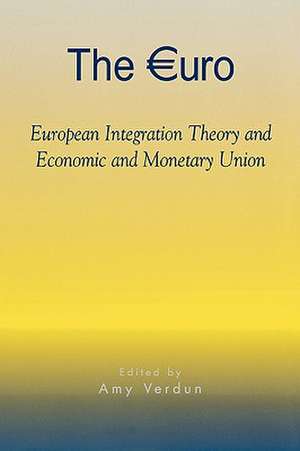
The Euro: European Integration Theory and Economic and Monetary Union: Governance in Europe Series
Editat de Amy Verdun Contribuţii de William M. Chandler, Osvaldo Croci, Patrick M. Crowley, Kenneth Dyson, R. Amy Elman, David Howarth, Erik Jones, Peter H. Loedel, Lucio Picci, F. A.W.J. Esch, Dieter Wolf, Lloy Wylieen Limba Engleză Paperback – 11 mar 2002











Preț: 352.04 lei
Preț vechi: 461.65 lei
-24%
Puncte Express: 528
Carte tipărită la comandă
Livrare economică 08-22 decembrie
Livrare prin curier în România Termenul estimat este afișat lângă disponibilitate.
Transport gratuit de la 400.00 lei Plată online sau ramburs, în funcție de opțiunile comenzii.
Retur gratuit în 14 zile Comandă securizată și suport în română.
Specificații
ISBN-13: 9780742518841
ISBN-10: 0742518841
Pagini: 304
Dimensiuni: 148 x 229 x 17 mm
Greutate: 0.39 kg
Ediția:0296
Editura: Bloomsbury Publishing
Colecția Rowman & Littlefield
Seria Governance in Europe Series
Locul publicării:New York, United States
ISBN-10: 0742518841
Pagini: 304
Dimensiuni: 148 x 229 x 17 mm
Greutate: 0.39 kg
Ediția:0296
Editura: Bloomsbury Publishing
Colecția Rowman & Littlefield
Seria Governance in Europe Series
Locul publicării:New York, United States
V-ar putea interesa
-
 -30%Preț: 964.71 lei1379.97 lei
 -
 -30%Preț: 831.12 lei1189.69 lei
 -
 -17%Preț: 380.20 lei456.20 lei
 -
 -30%Preț: 847.93 lei1213.59 lei
 -
 The Concept of the Rule of Law and the European Court of Human RightsGeranne Lautenbach-31%Preț: 996.91 lei1447.54 lei
 -
 The European Court of Human Rights between Law and PoliticsJonas Christoffersen-22%Preț: 349.16 lei449.31 lei
 -
 The EU Common Security and Defence PolicyPanos Koutrakos-31%Preț: 981.22 lei1431.16 lei
 -
 The Crisis of the European UnionJürgen HabermasPreț: 399.99 lei
 -
 The European Union and Military Force: Governance and StrategyPer M. Norheim-Martinsen-14%Preț: 681.21 lei792.10 lei
 -
 Why Europe Matters: The Case for the European UnionJohn McCormick-21%Preț: 163.77 lei206.53 lei
 -
 -25%Preț: 49.49 lei65.73 lei
 -
 -41%Preț: 80.01 lei134.49 lei
 -
 The European Union: An IntroductionMark Corner-14%Preț: 166.24 lei194.11 lei
 -
 -27%Preț: 760.37 lei1041.60 lei
Cuprins
Chapter 1 Introduction: European Integration, Theories and Global Change
Part 2 The Explanatory Power of Intergration Theories: Examining Economic and Monetary Union
Chapter 3 Merging Neofunctionalism and Intergovernmentalism: Lessons from EMU
Chapter 4 Neofunctionalism and Intergovernmentalism Amalgamated: The Case of EMU
Chapter 5 Why States Want EMU: Developing a Theory on National Preferences
Part 6 Theorising Monetary Integration: Ideas and Identities
Chapter 7 EMU: A Neoliberal Construction
Chapter 8 EMU as Europeanisation: Convergence, Diversity, and Contingency
Chapter 9 The Gendered Limitations of European Citizenship and Monetary Integration
Part 10 Institutions and Accountability
Chapter 11 Multilevel Governance and the Independence of the European Central Bank
Chapter 12 Macroeconomic Preferences and Europe's Democratic Deficit
Chapter 13 The Shape of Things to Come: The EU's Post-EMU Institutional Architechture
Part 14 Country Studies
Chapter 15 EMU, Integration Theories, and the Annoying Complexities of French Policy-making
Chapter 16 German Influence in Shaping EMU: Still a Tamed Power?
Chapter 17 European Monetary Integration and Integration Theory: Insights from the Italian Case
Part 18 Conclusion: Lessons from Economic and Monetary Union for Theorising European Integration
Part 2 The Explanatory Power of Intergration Theories: Examining Economic and Monetary Union
Chapter 3 Merging Neofunctionalism and Intergovernmentalism: Lessons from EMU
Chapter 4 Neofunctionalism and Intergovernmentalism Amalgamated: The Case of EMU
Chapter 5 Why States Want EMU: Developing a Theory on National Preferences
Part 6 Theorising Monetary Integration: Ideas and Identities
Chapter 7 EMU: A Neoliberal Construction
Chapter 8 EMU as Europeanisation: Convergence, Diversity, and Contingency
Chapter 9 The Gendered Limitations of European Citizenship and Monetary Integration
Part 10 Institutions and Accountability
Chapter 11 Multilevel Governance and the Independence of the European Central Bank
Chapter 12 Macroeconomic Preferences and Europe's Democratic Deficit
Chapter 13 The Shape of Things to Come: The EU's Post-EMU Institutional Architechture
Part 14 Country Studies
Chapter 15 EMU, Integration Theories, and the Annoying Complexities of French Policy-making
Chapter 16 German Influence in Shaping EMU: Still a Tamed Power?
Chapter 17 European Monetary Integration and Integration Theory: Insights from the Italian Case
Part 18 Conclusion: Lessons from Economic and Monetary Union for Theorising European Integration
Recenzii
An accomplished set of papers that span a range of theoretical perspectives and together provide a novel and useful commentary on one of the most intriguing developments in the international political economy-European monetary union.
A worthy contribution to the understanding of European integration in general and EMU in particular.
A broad and accessible introduction to the EMU maze that guides us through contending theories and evaluates their relevance. The authors give expert, often iconoclastic, critiques to inspire us on our journey. Policy experts and academic analysts alike will benefit from reading this volume, while students and the lay reader will find it readily opens up the maze to them as well.
A worthy contribution to the understanding of European integration in general and EMU in particular.
A broad and accessible introduction to the EMU maze that guides us through contending theories and evaluates their relevance. The authors give expert, often iconoclastic, critiques to inspire us on our journey. Policy experts and academic analysts alike will benefit from reading this volume, while students and the lay reader will find it readily opens up the maze to them as well.