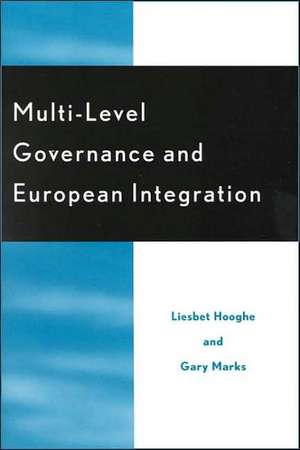
Multi-Level Governance and European Integration: Governance in Europe Series
Autor Liesbet Hooghe, Gary Marksen Limba Engleză Paperback – 21 mar 2001
European politics has been reshaped in recent decades by a dual process of centralization and decentralization. At the same time that authority in many policy areas has shifted to the suprantional level of the European Union, so national governments have given subnational regions within countries more say over the lives of their citizens. At the forefront of scholars who characterize this dual process as Omulti-level governance, OLiesbet Hooghe and Gary Marks argue that its emergence in the second half of the twentieth century is a watershed in the political development of Europe. Hooghe and Marks explain why multi-level governance has taken place and how it shapes conflict in national and European political arenas. Drawing on a rich body of original research, the book is at the same time written in a clear and accessible style for undergraduates and non-experts





Preț: 307.34 lei
Preț vechi: 386.12 lei
-20%
Carte tipărită la comandă
Livrare economică 09-23 iunie
Specificații
ISBN-10: 0742510204
Pagini: 272
Dimensiuni: 153 x 229 x 15 mm
Greutate: 0.37 kg
Ediția:0272
Editura: Bloomsbury Publishing
Colecția Rowman & Littlefield
Seria Governance in Europe Series
Locul publicării:New York, United States
V-ar putea interesa
-
 -34%Preț: 611.21 lei919.35 lei
 -
 The Oxford Handbook of the European UnionErik Jones-23%Preț: 293.68 lei381.76 lei
 -
 Slippery Slope: Europe's Troubled FutureGiles Merritt-20%Preț: 114.95 lei143.88 lei
 -
 Uniting Of EuropeErnst HaasPreț: 230.77 lei
 -
 -15%Preț: 439.45 lei517.00 lei
 -
 European Union Foreign Policy in a Changing WorldKaren E SmithPreț: 318.98 lei
 -
 Preț: 340.67 lei
 -
 Europe Recast: A History of European UnionDesmond DinanPreț: 279.29 lei
 -
 EuropeDavid CharterPreț: 28.11 lei
Cuprins
Chapter 2 Multi-level Governance in the European Union
Part 3 Part I: Sources of Multi-level Governance
Chapter 4 A Historical Perspective
Chapter 5 Multiple Identities
Chapter 6 Why National Leaders Diffuse Authority
Part 7 Part II: Multi-Level Governance with the Regions
Chapter 8 Variations in Cohesion Policy
Chapter 9 Cohesion Policy Under Threat
Chapter 10 Channels to Europe
Part 11 Part III:Contestation in a Multi-Level Polity
Chapter 12 The Struggle over European Integration
Chapter 13 Supranationalism Contested in the Commission
Chapter 14 Political Parties Take a Stand
Chapter 15 Bibliography
Chapter 16 Index
Chapter 17 Appendices
Recenzii
Hooghe and Marks have ingeniously expanded multilevel governance as a frame for understanding the dynamic politics of the European Union. This volume, building on their previous work, brings together an assessment of the changing spatial politics of the EU with the analysis of competing fornms of capitalism. In so doing they provoke us to rethink the roles of political institutions in western Europe.
This is a contribution to the de-mystification of the European Union. Rather than emphasizing the sui generis aspect of the EU, Hooghe and Marks argue that politics in the Union can be understood in terms of the ordinary tools of comparative politics. The book is an invitation for area specialists and generalists to join hands in understanding the most exciting current political experiment in the world.
This is a welcome and timely addition to debates on European integration.
The value of this volume is that it demonstrates how political analysis can be employed to understand development of European governance and policy in the context of sub-national forces.
For those who still cannot believe that the once-familiar sovereign European national-state is a thing of the past, the authors of this work clearly, forcefully, and inexorably demonstrate that such indeed is the case. They develop, illustrate, and document the practice in Europe of multi-level governance: decisionmaking that combines the efforts of supranational, national, and subnational (regional) institutions and politicians in such a way that no single level succeeds in dominating the other two. More important, they show incontrovertibly that multi-level governance is an unplanned adaptation to contemporary conditions. Politicians may welcome it as an inescapable
second-best rational solution to problems on their agendas. The work combines restrained argumentation with encyclopedic knowledge of facts, theories and specialized literature.