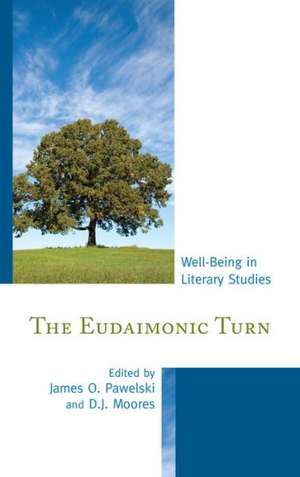
The Eudaimonic Turn: Well-Being in Literary Studies
Editat de James O. Pawelski, D. J. Mooresen Limba Engleză Paperback – 10 iun 2014
Preț: 360.78 lei
Preț vechi: 531.90 lei
-32%
Puncte Express: 541
Carte tipărită la comandă
Livrare economică 17 noiembrie-01 decembrie
Livrare prin curier în România Termenul estimat este afișat lângă disponibilitate.
Transport gratuit de la 400.00 lei Plată online sau ramburs, în funcție de opțiunile comenzii.
Retur gratuit în 14 zile Comandă securizată și suport în română.
Specificații
ISBN-13: 9781611477351
ISBN-10: 1611477352
Pagini: 271
Ilustrații: 2 b/w illustrations;
Dimensiuni: 154 x 229 x 24 mm
Greutate: 0.47 kg
Editura: Bloomsbury Publishing
Colecția Fairleigh Dickinson University Press
Locul publicării:New York, United States
ISBN-10: 1611477352
Pagini: 271
Ilustrații: 2 b/w illustrations;
Dimensiuni: 154 x 229 x 24 mm
Greutate: 0.47 kg
Editura: Bloomsbury Publishing
Colecția Fairleigh Dickinson University Press
Locul publicării:New York, United States
Cuprins
Acknowledgments
Foreword: Adam Potkay
Introduction Part 1: James Pawelski-What Is the Eudaimonic Turn?
Introduction Part 2: D. J. Moores-The Eudaimonic Turn in Literary Studies
1.Charles Altieri-Pound's Challenge to Ranciere's Treatment of the "Aesthetic Regime":
Why Nietzsche is Necessary for a Positive Account of Modernism in the
Arts
2.James Engell-Thoreau and Health: Physician, Naturalist, Metaphysician
3.Erin Lafford and Emma Mason-Falling from Trees: Arborescent Prosody in John Clare's
Tree Elegies
4.John Channing Briggs-Happiness, Catharsis, and the Literary Cure
5.Michael West-Ramblers, Hikers, Vagabonds, and Flâneurs: America's Peripatetic
Romantics and the Rituals of Healthy Walking
6.Paola Baseotto-Spenser's "virtuous . . . discipline" and Human Flourishing
7.Amanpal Garcha-The Choices of Can You Forgive Her?:Literary Realism, Freedom, and
Contentment
8.David Bordelon-The Crosses We Bear: Religion, Readers, and Woman's Intellect in
Augusta Jane Evans' St. Elmo
9.
Foreword: Adam Potkay
Introduction Part 1: James Pawelski-What Is the Eudaimonic Turn?
Introduction Part 2: D. J. Moores-The Eudaimonic Turn in Literary Studies
1.Charles Altieri-Pound's Challenge to Ranciere's Treatment of the "Aesthetic Regime":
Why Nietzsche is Necessary for a Positive Account of Modernism in the
Arts
2.James Engell-Thoreau and Health: Physician, Naturalist, Metaphysician
3.Erin Lafford and Emma Mason-Falling from Trees: Arborescent Prosody in John Clare's
Tree Elegies
4.John Channing Briggs-Happiness, Catharsis, and the Literary Cure
5.Michael West-Ramblers, Hikers, Vagabonds, and Flâneurs: America's Peripatetic
Romantics and the Rituals of Healthy Walking
6.Paola Baseotto-Spenser's "virtuous . . . discipline" and Human Flourishing
7.Amanpal Garcha-The Choices of Can You Forgive Her?:Literary Realism, Freedom, and
Contentment
8.David Bordelon-The Crosses We Bear: Religion, Readers, and Woman's Intellect in
Augusta Jane Evans' St. Elmo
9.
Recenzii
The Eudaimonic Turn represents nothing less than a stunning interdisciplinary achievement. The editors were well partnered... Together, their work demonstrates enormous self-awareness and intellectual humility by simultaneously developing an important new idea in the specifi c discipline of literary studies (an important contribution in its own right) while contextualising it in a much bigger global change process which has never before been so compellingly articulated. Indeed, the legacy of this work is likely to be of historic proportions.... Ultimately, The Eudaimonic Turn: Well-Being in Literary Studies is destined to be a foundational text, first for its contribution to literary studies, but even more so for recognising and articulating the contours of a broader civilisation wide development.