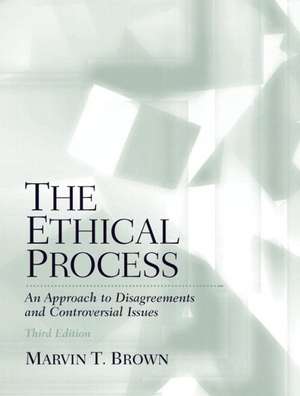
The Ethical Process: An Approach to Disagreements and Controversial Issues
Autor Marvin T. Brownen Limba Engleză Paperback – 30 apr 2002
This hands-on workbook helps learners develop conceptual tools and argumentative strategies to move beyond merely having opinions to discovering and evaluating the information, values, and assumptions that underlie different positions on controversial issues and cases. It shows readers how to move from contentious debates to productive dialogues, and how to increase a group's resources so they can make better decisions. Chapter topics cover an introduction to the ethical process, the resources for the ethical process, understanding alternative points of view, evaluating arguments from different ethical approaches, and the ethical process as an argumentative dialogue. For individuals who want to 1) understand and master the skills needed to engage in ethical reflection and analysis, and 2)experience ethics as a practice to be used when faced with disagreements.
Preț: 482.43 lei
Preț vechi: 595.59 lei
-19%
Carte tipărită la comandă
Livrare economică 23 noiembrie-07 decembrie
Specificații
ISBN-10: 0130988898
Pagini: 88
Dimensiuni: 178 x 232 x 7 mm
Greutate: 0.16 kg
Ediția:Nouă
Editura: Prentice Hall
Locul publicării:Upper Saddle River, United States
V-ar putea interesa
-
 In Praise of DesireNomy Arpaly-31%Preț: 572.21 lei827.53 lei
 -
 The Ajax Dilemma: Justice, Fairness, and RewardsPaul Woodruff-17%Preț: 142.42 lei171.61 lei
 -
 A Sentimentalist Theory of the MindMichael Slote-29%Preț: 503.44 lei704.94 lei
 -
 -12%Preț: 342.10 lei390.52 lei
 -
 Contractualism and the Foundations of MoralityNicholas Southwood-12%Preț: 356.50 lei404.22 lei
 -
 How We Fight: Ethics in WarHelen Frowe-28%Preț: 505.57 lei706.15 lei
 -
 -31%Preț: 629.88 lei911.38 lei
 -
 Human Interests: or Ethics for PhysicalistsJoseph Mendola-31%Preț: 746.38 lei1079.76 lei
 -
 Causation: A Very Short IntroductionStephen Mumford-20%Preț: 56.62 lei70.82 lei
 -
 Oxford Studies in Normative Ethics, Volume 3Mark Timmons-13%Preț: 355.47 lei406.78 lei
 -
 The Human ConditionJohn Kekes-12%Preț: 336.25 lei380.24 lei
 -
 Oxford Studies in Agency and Responsibility, Volume 1David Shoemaker-11%Preț: 345.61 lei387.28 lei
 -
 From Individual to Collective Intentionality: New EssaysSara Rachel Chant-35%Preț: 626.06 lei960.03 lei
 -
 Rational PolemicsRichard Todd DevensPreț: 152.24 lei
 -
 50 Ethics Ideas You Really Need to KnowBen DuprePreț: 95.54 lei
 -
 Assholes: A TheoryAaron James-41%Preț: 68.18 lei114.64 lei
Descriere
This hands-on workbook helps students develop conceptual tools and argumentative strategies to move beyond merely having opinions to discovering and evaluating the information, values, and assumptions that underlie different positions on controversial issues and cases. Moves students from contentious debates to productive dialogues, and how to increase a group's resources so they can make better decisions.
Cuprins
1. Introduction to the Ethical Process.
2. The Resources for the Ethical Process.
3. Understanding Alternative Points of View.
4. Evaluating Arguments from Different Ethical Approaches.
5. The Ethical Process as an Argumentative Dialogue.
Appendix 1: How to Use the Syllogism to Uncover Implicit Value Judgments.
Appendix 2: Argumentative Dialogue on Drug Testing.
Recenzii
"As a supplemental text, its content is superb! The text's emphasis on dialogue rather than debate ...is needed. Other texts do not contain this information. The students found the content of the text extremely helpful in getting to the 'heart' of issues as well as helping them to articulate their analysis more effectively." — Joy Benson, University of Illinois at Springfield
"As a supplemental text, its content is superb! The text's emphasis on dialogue rather than debate ...is needed. Other texts do not contain this information. The students found the content of the text extremely helpful in getting to the 'heart' of issues as well as helping them to articulate their analysis more effectively." - Joy Benson, University of Illinois at Springfield
Textul de pe ultima copertă
New to the Third Edition
- New material on the 'ethic of care'
- Additional material on interpretation
- New material on the nature of disagreement
- Enhanced use of the dialogical approach in previous editions
Caracteristici
- NEW - Stronger integration of descriptive and normative steps—Connects the different stages of Understanding Alternative Points of View and Evaluating Arguments from Different Ethical Approaches.
- Links the steps of understanding and evaluation closer together, and places the worksheet on developing modified proposals at the end of the whole process.
- Links the steps of understanding and evaluation closer together, and places the worksheet on developing modified proposals at the end of the whole process.
- NEW - Expanded and relocated presentation of disagreement (Ch. 1).
- Introduces students to the topic of disagreement as a condition for engaging in the ethical process, and enables students to explore their experiences of, and attitudes toward, disagreement.
- Introduces students to the topic of disagreement as a condition for engaging in the ethical process, and enables students to explore their experiences of, and attitudes toward, disagreement.
- NEW - Revised chapter on the ethical process (Ch. 1).
- Sets the conditions for engaging in the process, and gives students a new assessment page for competence in ethical reflection.
- Sets the conditions for engaging in the process, and gives students a new assessment page for competence in ethical reflection.
- NEW - Expanded chapter on Understanding Alternative Points of View (Ch. 3).
- Gives students a chart for exploring different levels of issues—the individual, organization, and social—and a page that shows an application of these three levels to the issue of business conduct in different cultures.
- Gives students a chart for exploring different levels of issues—the individual, organization, and social—and a page that shows an application of these three levels to the issue of business conduct in different cultures.
- NEW - Expanded treatment of assumptions—Illustrated by displaying the democratic and feudalistic views of social relations.
- Shows students another way of exploring assumptions—through already known world views, and encourages their involvement more than before.
- Shows students another way of exploring assumptions—through already known world views, and encourages their involvement more than before.
- NEW - Emphasis on the relationship between the three ethical approaches and feminist ethics.
- Highlights how a relational perspective strengthens the application of the three ethical approaches.
- Highlights how a relational perspective strengthens the application of the three ethical approaches.
- NEW - Summary of the normative standards of conduct for business and other organizations.
- Illustrates the connections between the three ethical approaches, organizational resources, and the virtues of integrity, fairness, and responsibility.
- Illustrates the connections between the three ethical approaches, organizational resources, and the virtues of integrity, fairness, and responsibility.
- Treatment of ethics as a step-by-step process—Rather than as a set of moral principles.
- Gives students an analysis for cases in accordance with the logic of argumentation.
- Gives students an analysis for cases in accordance with the logic of argumentation.
- Detailed worksheets and several exercises—Guides students through the process of exploration and evaluation of the reasons that support different views on controversial issues.
- Gets students involved in exploring their own views and evaluating them in dialogue with others.
- Gets students involved in exploring their own views and evaluating them in dialogue with others.
- Extensive coverage of the three ethical approaches—Provides comprehensive background material and many aids in applying the approaches to controversial issues.
- Shows how to use the ethical approaches in interpreting the material developed on the worksheets.
- Shows how to use the ethical approaches in interpreting the material developed on the worksheets.
- A demonstration of how to use argument as a form of analysis.
- Presents the logic of argument in a dialogical context that encourages learning rather than posturing.
- Presents the logic of argument in a dialogical context that encourages learning rather than posturing.
- Emphasis on disagreement as a resource for learning—Promotes listening, analyzing, and critical thinking skills.
- Teaches students the skills needed to deal with disagreement in a meaningful manner, so that their responses will not only help them make better decisions but also help them enrich the meaning of addressing controversial issues.
- Teaches students the skills needed to deal with disagreement in a meaningful manner, so that their responses will not only help them make better decisions but also help them enrich the meaning of addressing controversial issues.
- Both descriptive and normative analysis—Begins with students' opinions, explores them, and then uses ethical theory to evaluate the strengths and weaknesses of their everyday arguments.
- Outlines a method to analyze students' current positions and then connects their positions with different ethical traditions—instead of first teaching theory and then trying to apply it to cases.
- Outlines a method to analyze students' current positions and then connects their positions with different ethical traditions—instead of first teaching theory and then trying to apply it to cases.
- Integration of rationality and relationships.
- Discusses the masculine ethic of justice and reason, and the feminine ethic of care and relationship—through a method that combines argument and dialogue.
- Discusses the masculine ethic of justice and reason, and the feminine ethic of care and relationship—through a method that combines argument and dialogue.
- Interwoven theme of the availability of multiple resources for making decisions—e.g., the different types of resources that support proposals—observations, value judgments, and assumptions.
- Assembles the various aspects of human conduct—the context, the agents who must decide, the act of deciding, and the purpose for deciding.
- Assembles the various aspects of human conduct—the context, the agents who must decide, the act of deciding, and the purpose for deciding.