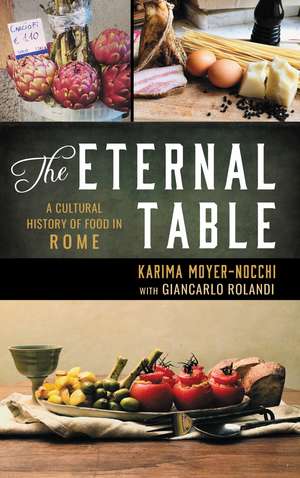
The Eternal Table: A Cultural History of Food in Rome: Big City Food Biographies
Autor Karima Moyer-Nocchi Cu Giancarlo Rolandien Limba Engleză Hardback – 8 mar 2019
Like the city itself, Rome's culinary history is multi-layered, both vertically and horizontally, from migrant shepherds to the senatorial aristocracy, from the papal court to the flow of pilgrims and Grand Tourists, from the House of Savoy and the Kingdom of Italy to Fascism and the rise of the middle classes. The Eternal Table takes the reader on a culinary journey through the city streets, country kitchens, banquets, markets, festivals, osterias, and restaurants illuminating yet another facet of one of the most intriguing cities in the world.







Preț: 274.11 lei
Preț vechi: 355.00 lei
-23%
Puncte Express: 411
Carte tipărită la comandă
Livrare economică 27 noiembrie-11 decembrie
Livrare prin curier în România Termenul estimat este afișat lângă disponibilitate.
Transport gratuit de la 400.00 lei Plată online sau ramburs, în funcție de opțiunile comenzii.
Retur gratuit în 14 zile Comandă securizată și suport în română.
Specificații
ISBN-13: 9781442269743
ISBN-10: 144226974X
Pagini: 266
Ilustrații: 26 b/w photos
Dimensiuni: 154 x 232 x 22 mm
Greutate: 0.5 kg
Editura: Bloomsbury Publishing
Colecția Rowman & Littlefield
Seria Big City Food Biographies
Locul publicării:New York, United States
ISBN-10: 144226974X
Pagini: 266
Ilustrații: 26 b/w photos
Dimensiuni: 154 x 232 x 22 mm
Greutate: 0.5 kg
Editura: Bloomsbury Publishing
Colecția Rowman & Littlefield
Seria Big City Food Biographies
Locul publicării:New York, United States
Cuprins
Chapter 1
, The Roman Terrarium
,
Chapter 2
, Quid Tum-Then What?
,
Chapter 3
, Cooking from Books
,
Chapter 4
, Mobility: The Ins and Outs
,
Chapter 5
, Al Mercato-At the Marketplace
,
Chapter 6
, Er da Magna'-Food: The Cucina Romanesca
,
Chapter 7
, Eating and Drinking Out
,
, The Roman Terrarium
,
Chapter 2
, Quid Tum-Then What?
,
Chapter 3
, Cooking from Books
,
Chapter 4
, Mobility: The Ins and Outs
,
Chapter 5
, Al Mercato-At the Marketplace
,
Chapter 6
, Er da Magna'-Food: The Cucina Romanesca
,
Chapter 7
, Eating and Drinking Out
,
Recenzii
Only a handful of cities worldwide can lay claim to a food tradition as long as Rome's. Yet as Karima Moyer elegantly demonstrates, while the table may have been near-eternal, the vagaries of politics and war, religious belief and migration brought one change after another to the food on that table. Like the city itself, the food is a patchwork that combines the startlingly new with pasts both gladly abandoned and fondly remembered. Fascinating.
Taking the stance that writing on Rome is often "prey to sentiment and idealization," the author adopts a studied approach, including thorough chapters on the area's terrain, historic marketplaces and osterias, and the development of foodstuffs and eating traditions alongside the rise and fall of the Empire. . . . Rome enthusiasts will revel in this well-researched retrospective of a dynamic, ever-evolving city."
While everyone knows that Rome's food is appealing, few know just how interesting it is - but now they can. Karima Moyer-Nocchi's tour de force places Roman cuisine firmly in the city's complex history. She shows that change as much as tradition underlies Roman food, and that immigrants as much as natives have shaped what has been eaten by the humble and the grand alike. A must-read for those interested in the food of Italy and the history of food generally.
Much more than a march through Roman food history, The Eternal Table evocatively describes the tastes of Rome from the bread-and-circuses era to today's globalization. An informed but also light-hearted guide to the surprisingly vigorous cuisine of the city of emperors and popes.
Tackling the history of food and culture of the Eternal City of Rome takes an eternal and ever-changing table as is adeptly laid out in this well-researched book. Karima Moyer-Nocchi expertly examines the role food played in the development of the ancient city and how it continues to effect and influence the changing populations and modern culture.
Taking the stance that writing on Rome is often "prey to sentiment and idealization," the author adopts a studied approach, including thorough chapters on the area's terrain, historic marketplaces and osterias, and the development of foodstuffs and eating traditions alongside the rise and fall of the Empire. . . . Rome enthusiasts will revel in this well-researched retrospective of a dynamic, ever-evolving city."
While everyone knows that Rome's food is appealing, few know just how interesting it is - but now they can. Karima Moyer-Nocchi's tour de force places Roman cuisine firmly in the city's complex history. She shows that change as much as tradition underlies Roman food, and that immigrants as much as natives have shaped what has been eaten by the humble and the grand alike. A must-read for those interested in the food of Italy and the history of food generally.
Much more than a march through Roman food history, The Eternal Table evocatively describes the tastes of Rome from the bread-and-circuses era to today's globalization. An informed but also light-hearted guide to the surprisingly vigorous cuisine of the city of emperors and popes.
Tackling the history of food and culture of the Eternal City of Rome takes an eternal and ever-changing table as is adeptly laid out in this well-researched book. Karima Moyer-Nocchi expertly examines the role food played in the development of the ancient city and how it continues to effect and influence the changing populations and modern culture.