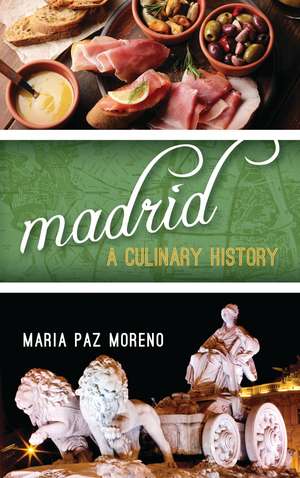
Madrid: A Culinary History: Big City Food Biographies
Autor Maria Paz Morenoen Limba Engleză Hardback – 10 noi 2017
Maria Paz Moreno looks at the gastronomical history of Madrid throughout the ages. She traces the historical origins and evolution of Madrid's cuisine, exploring major trends, most innovative chefs, restaurants and dishes, and telling the story of this fascinating city from the point of view of a food lover. She discusses the diverse influences that have shaped Madrid's cuisine over the centuries, including the introduction of foods from the New World since the 16th century, the transition from famines to abundance during the second part of the 20th century, the revolution of the Michelin-starred young chefs at the beginning of the 21st century, and how madrileños' sense of identity is built through their food. The sense of community created through communal eating experiences is also explored, focusing on the culture of sharing tapas, as well as traditional and avant-garde eating establishments, from restaurants to bars to chocolaterías, and even markets and festivals where food plays an important part. Anyone wishing to know more about the city, the culture, the richness of its food and people, will find a delightful review in these pages.






Preț: 285.41 lei
Preț vechi: 382.22 lei
-25%
Puncte Express: 428
Carte tipărită la comandă
Livrare economică 24 noiembrie-08 decembrie
Livrare prin curier în România Termenul estimat este afișat lângă disponibilitate.
Transport gratuit de la 400.00 lei Plată online sau ramburs, în funcție de opțiunile comenzii.
Retur gratuit în 14 zile Comandă securizată și suport în română.
Specificații
ISBN-13: 9781442266407
ISBN-10: 1442266406
Pagini: 216
Ilustrații: 24 b/w photos; 23 textboxes
Dimensiuni: 154 x 232 x 18 mm
Greutate: 0.46 kg
Editura: Bloomsbury Publishing
Colecția Rowman & Littlefield
Seria Big City Food Biographies
Locul publicării:New York, United States
ISBN-10: 1442266406
Pagini: 216
Ilustrații: 24 b/w photos; 23 textboxes
Dimensiuni: 154 x 232 x 18 mm
Greutate: 0.46 kg
Editura: Bloomsbury Publishing
Colecția Rowman & Littlefield
Seria Big City Food Biographies
Locul publicării:New York, United States
V-ar putea interesa
-
 Fast Food Globalization in the Provincial PhilippinesTy Matejowsky-34%Preț: 522.35 lei789.43 lei
 -
 -18%Preț: 1252.16 lei1527.03 lei
 -
 San Francisco: A Food BiographyErica J. Peters-20%Preț: 368.76 lei462.93 lei
 -
 -25%Preț: 306.46 lei406.97 lei
 -
 -33%Preț: 647.56 lei963.26 lei
 -
 Soup Through the Ages: A Culinary History with Period RecipesVictoria R. RumblePreț: 303.56 lei
 -
 Preț: 301.29 lei
 -
 Preț: 303.11 lei
 -
 Preț: 341.99 lei
 -
 Culinary TourismLucy M LongPreț: 239.99 lei
 -
 Cornbread Nation 5Fred W. SaucemanPreț: 159.40 lei
 -
 The Ecopolitics of Consumption: The Food TradeH. Louise Davis-29%Preț: 602.19 lei842.90 lei
 -
 Beer Culture in Theory and PracticeAdam W Tyma-15%Preț: 681.15 lei801.35 lei
 -
 -32%Preț: 583.24 lei863.98 lei
 -
 Another Boom for Amazonia?Jr. PennPreț: 261.50 lei
 -
 -16%Preț: 242.61 lei287.56 lei
 -
 The Globalization of FoodDavid Inglis-14%Preț: 648.06 lei753.56 lei
 -
 The Globalization of FoodDavid Inglis-23%Preț: 259.32 lei336.59 lei
 -
 The Wild Garden and the Honey BeeMichael DuncanPreț: 101.22 lei
 -
 Le "Triangle laitier" malgacheMaholy Félicien Rabemanambola-15%Preț: 610.69 lei718.46 lei
Cuprins
Contents
Acknowledgements
Introduction
Chapter 1Before Madrid: The Flavors of the Iberian Peninsula
Chapter 2Too Many Kings Spoil the Broth
Chapter 3A New Era of Creative Cuisine
Chapter 4Madrid, A Gastronome's Playground: Markets and Food Retailing through History
Chapter 5Historic Cookbooks
Chapter 6Historic Restaurants, Tabernas and Cafés
Chapter 7Madrid's Traditional Dishes
Notes
Bibliography
Index
Acknowledgements
Introduction
Chapter 1Before Madrid: The Flavors of the Iberian Peninsula
Chapter 2Too Many Kings Spoil the Broth
Chapter 3A New Era of Creative Cuisine
Chapter 4Madrid, A Gastronome's Playground: Markets and Food Retailing through History
Chapter 5Historic Cookbooks
Chapter 6Historic Restaurants, Tabernas and Cafés
Chapter 7Madrid's Traditional Dishes
Notes
Bibliography
Index
Recenzii
Essayist and professor Moreno's comprehensive guidebook, part of the Big City Food Biographies series, covers the historical and contemporary food scene in a city that has become known for its inventive eating and drinking establishments. While the entries about the prehistory of Madrid tend towards the encyclopedic, the author hits her stride when she gets to the last couple of centuries, during which the change in cuisine has accelerated markedly. Illustrated with photos by the author and others, the book's lush descriptions of neighborhood markets and restaurants, with particular emphasis on those that have been serving customers since the nineteenth century and before, will give tourists plenty of places to explore and armchair visitors reasons to envy them. Excerpts from historic cookbooks, including one for stuffing partridges with sardines and another that puts turducken to shame, are entertaining if occasionally appalling....[and] the adventurous will be tempted to experiment with them.
In this enjoyable and educational culinary history, Moreno, a professor of Spanish at the University of Cincinnati, enthusiastically explores the food of Spain's capital. She methodically traces the culinary development of Madrid from the days when the Romans ruled the Iberian Peninsula, popularizing bread, olives, cheese, and roasted meat, to the mid-2000s, when Ferran Adrià and his restaurant, El Bulli, made molecular gastronomy a hit. Moreno provides brief historical sketches of the city, explaining that the cuisine was often influenced by the ruling class of the time: the Arabs introduced phyllo dough and nuts, the Bourbons and Hapsburgs indulged in sweets and pastries, and when Felipe V arrived in 1700, 'he brought with him a French cook.' Moreno describes cookbooks published over the centuries, as well as restaurant menus, both historic and recent, that highlight Madrid's vibrant culinary scene. In vivid detail, she describes markets such as Mercado de San Miguel and Centro Platea ('the largest gastro leisure space in Europe') and introduces readers to Madrid's two oldest restaurants, Lhardy and Sobrino de Botín. In a final chapter, Moreno provides recipes for the city's most characteristic dishes, such as gambas al ajilio (garlic shrimp) and paella. Moreno's informative guide is an excellent preview for those visiting the city.
Part of the Big City Food Biographies series, this book focuses on the culinary history and delights of Madrid, Spain. The first three chapters are a history of food and cuisine in Madrid from its origins up into the twenty-first century. The sixteenth century and the influences of the New World take center stage in this history, along with the transition from famines to abundance that occurred in the second half of the twentieth century. The last four chapters provide details on twenty-first century Madrid with its markets and retail food industry, historic cookbooks, historic restaurants and cafes, and its traditional dishes. Sprinkled throughout with black-and-white photographs of various time periods in Madrid's history in the last two centuries, along with specific recipes and ingredients of famous cuisines, this book illustrates the vibrant food of one of Spain's premier cities.
An original and seminal work of meticulous scholarship, Madrid: A Culinary History will prove to be of special and particular interest to readers who are interested in the cultural history and cuisine and people of the city of Madrid. Enhanced with the inclusion of an eighteen page Bibliography, sixteen pages of Notes, and an eight page Index, Madrid: A Culinary History is unreservedly and wholeheartedly recommended for both community and academic library collections.
All readers will enjoy [the book's] thorough and well-balanced history and engaging anecdotes.
In this captivating book, Paz Moreno guides readers through the exquisite details of Madrid's fascinating food history. From before the establishment of the Hapsburg court in the mid-sixteenth century through today, Paz Moreno provides us with rich details of food trends, market places, cookbooks, and historic dining establishments, including "The Embassy," Madrid's first tea salon and underground sanctuary for Jewish refugees fleeing Nazi-occupied Europe. This is a must read for culinary historians and gastronomes alike!
In this enjoyable and educational culinary history, Moreno, a professor of Spanish at the University of Cincinnati, enthusiastically explores the food of Spain's capital. She methodically traces the culinary development of Madrid from the days when the Romans ruled the Iberian Peninsula, popularizing bread, olives, cheese, and roasted meat, to the mid-2000s, when Ferran Adrià and his restaurant, El Bulli, made molecular gastronomy a hit. Moreno provides brief historical sketches of the city, explaining that the cuisine was often influenced by the ruling class of the time: the Arabs introduced phyllo dough and nuts, the Bourbons and Hapsburgs indulged in sweets and pastries, and when Felipe V arrived in 1700, 'he brought with him a French cook.' Moreno describes cookbooks published over the centuries, as well as restaurant menus, both historic and recent, that highlight Madrid's vibrant culinary scene. In vivid detail, she describes markets such as Mercado de San Miguel and Centro Platea ('the largest gastro leisure space in Europe') and introduces readers to Madrid's two oldest restaurants, Lhardy and Sobrino de Botín. In a final chapter, Moreno provides recipes for the city's most characteristic dishes, such as gambas al ajilio (garlic shrimp) and paella. Moreno's informative guide is an excellent preview for those visiting the city.
Part of the Big City Food Biographies series, this book focuses on the culinary history and delights of Madrid, Spain. The first three chapters are a history of food and cuisine in Madrid from its origins up into the twenty-first century. The sixteenth century and the influences of the New World take center stage in this history, along with the transition from famines to abundance that occurred in the second half of the twentieth century. The last four chapters provide details on twenty-first century Madrid with its markets and retail food industry, historic cookbooks, historic restaurants and cafes, and its traditional dishes. Sprinkled throughout with black-and-white photographs of various time periods in Madrid's history in the last two centuries, along with specific recipes and ingredients of famous cuisines, this book illustrates the vibrant food of one of Spain's premier cities.
An original and seminal work of meticulous scholarship, Madrid: A Culinary History will prove to be of special and particular interest to readers who are interested in the cultural history and cuisine and people of the city of Madrid. Enhanced with the inclusion of an eighteen page Bibliography, sixteen pages of Notes, and an eight page Index, Madrid: A Culinary History is unreservedly and wholeheartedly recommended for both community and academic library collections.
All readers will enjoy [the book's] thorough and well-balanced history and engaging anecdotes.
In this captivating book, Paz Moreno guides readers through the exquisite details of Madrid's fascinating food history. From before the establishment of the Hapsburg court in the mid-sixteenth century through today, Paz Moreno provides us with rich details of food trends, market places, cookbooks, and historic dining establishments, including "The Embassy," Madrid's first tea salon and underground sanctuary for Jewish refugees fleeing Nazi-occupied Europe. This is a must read for culinary historians and gastronomes alike!