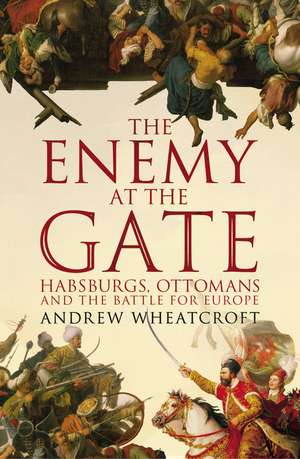
The Enemy at the Gate
Autor Andrew Wheatcroften Limba Engleză Paperback – 6 aug 2009
Observăm în literatura academică dedicată secolului al XVII-lea o tendință de a trata asediul Vienei fie ca pe un eveniment militar izolat, fie printr-o lentilă pur eurocentrică. The Enemy at the Gate de Andrew Wheatcroft vine să completeze această lacună, oferind o analiză echilibrată a rivalității multiseculare dintre Imperiul Otoman și cel Habsburgic. Autorul nu se limitează la cronica bătăliei din 1683, ci reconstruiește contextul mai larg al luptei pentru supremație asupra continentului european, explorând psihologia ambelor tabere — de la ienicerii care asaltau zidurile cu grenade timpurii, până la apărătorii capitalei habsburgice. Remarcăm o rigoare deosebită în descrierea detaliilor tehnice și strategice, volumul funcționând ca o alternativă academică la Vienna 1683 de Simon Millar pentru cursurile de istorie militară și relații internaționale. În timp ce lucrarea lui Millar se concentrează pe dinamica tactică a campaniei, Wheatcroft aduce avantajul unei profunzimi narative care integrează cultura vizuală și mentalitățile religioase ale epocii. Considerăm că acest titlu reprezintă o sinteză a preocupărilor autorului, rafinând temele explorate în The Habsburgs și Infidels. Dacă în lucrările anterioare Wheatcroft analiza structura internă a imperiilor sau rădăcinile animozității dintre creștinism și islam, aici el focalizează aceste energii în momentul critic al asediului. Stilul este dens dar accesibil, evitând simplificările și oferind o perspectivă nuanțată asupra a ceea ce a fost numit „Mărul de Aur” al ambițiilor otomane.
Preț: 119.80 lei
Preț vechi: 145.52 lei
-18%
Carte disponibilă
Livrare economică 13-24 noiembrie
Livrare express 24-30 octombrie pentru 60.05 lei
Specificații
ISBN-10: 1844137414
Pagini: 384
Ilustrații: 16
Dimensiuni: 154 x 236 x 32 mm
Greutate: 0.52 kg
Editura: Random House
Locul publicării:United Kingdom
V-ar putea interesa
-
 Wolf of the PlainsConn IgguldenPreț: 80.56 lei
 -
 Short Stories in FrenchRichard Coward-19%Preț: 63.44 lei78.59 lei
 -
 The Dinosaur's DiaryJulia Donaldson-20%Preț: 45.33 lei56.65 lei
 -
 The New York TrilogyPaul AusterPreț: 115.28 lei
 -
 Preț: 55.37 lei
 -
 A Peace to End All PeaceDavid FromkinPreț: 157.21 lei
 -
 Pediatric Orthopaedic SecretsLynn T. Staheli-5%Preț: 478.93 lei504.14 lei
 -
 WashingtonRon ChernowPreț: 287.81 lei
De ce să citești această carte
Recomandăm această carte studenților la istorie și pasionaților de strategie militară care caută o înțelegere profundă a geopoliticii est-europene. Cititorul câștigă o perspectivă documentată asupra modului în care logistica, tehnologia de asediu și fanatismul religios au modelat granițele Europei moderne. Este o lectură esențială pentru a înțelege fundamentul istoric al tensiunilor dintre Est și Vest, prezentată de un specialist în imagistică și istorie imperială.
Despre autor
Andrew Wheatcroft este un istoric britanic de renume, director al Centrului internațional pentru studii editoriale de la Universitatea din Stirling, Scoția. Este recunoscut pentru abordarea sa inovatoare, fiind printre primii cercetători care au integrat fotografia și cultura vizuală în istoriografia Orientului Mijlociu. Opera sa vastă include titluri de referință precum The Habsburgs și The Ottomans, lucrări care explorează mecanismele puterii imperiale. Expertiza sa în istoria conflictelor este completată de colaborări cu istorici militari precum John Keegan, Wheatcroft fiind o voce autoritară în analiza ciocnirilor de civilizații.
Descriere
Recenzii
“Wheatcroft's real contribution is his illustration of complex Ottoman administrative and military structures. In fact, the book reveals these to have been a main source of Ottoman power; not, as many have suggested, the provocation of fear through terror or oriental savagery. Wheatcroft also adeptly addresses important historiographical questions about Ottoman decline, the dangers of over-reliance on secondary source materials, syncretism of nomadic steppe tradition with Islamic values, and fine contrasts between Ottoman and European military techniques.”
Journal of Military History
“Andrew Wheatcroft writes exciting and provocative books, and The Enemy at the Gate is no exception…. As battle history this book is great…. The descriptions of the fortifications, weapons, tactics, attacks, and counterattacks are vivid and compelling…. Even though the reader knows how the siege will turn out, he/she is eager to turn the next page to see if the next explosion and attack will enable the Turks to get into the city.”
“As Andrew Wheatcroft brilliantly shows in The Enemy at the Gate, the skirmishes and the pitched battles that raged for centuries between Habsburgs and Ottomans, and their numerous vassals on both sides, represented not so much a ‘clash of civilizations' as a collision of empires…. [H]is narrative is thrilling as well as thoughtful, a rare combination.”
Washington Times
“There are two stories here worth telling and well told: the blood-and-thunder tale of the heroic defense of Vienna against the Ottomans in 1683, the surge in morale after the Habsburg victory, and the war to recover Hungary and the Balkans from the Turks. The other story is of the obsessive fear and hatred of the Turks in Christian central Europe, exorcised by the Habsburg victory at Vienna, turning to revenge and reconquest led first by Duke Charles of Lorraine, then by the legendary Prince Eugene of Savoy, ending in exhausted and bankrupt stability.”
Telegraph
“[A] riveting narrative, Andrew Wheatcroft's The Enemy at the Gate…tells the story of the final Habsburg-Ottoman showdown at the gates of Vienna in 1683, one of the genuine turning points in European history.”
The Weekly Standard
“ “[Wheatcroft's] fourth book is primarily a military history of the clashes between the Habsburg and Ottoman Empires in the 17th century, the fruit of more than 20 years researching in the field…. Some of the most suggestive material here is on military organization, equipment, and tactics.”
Victor Davis Hanson, First Things
“Wheatcroft offers a riveting account of the slow, methodical Ottoman approach to Vienna…. [A] masterful account of the siege and battle.”
Michigan War Studies Review
“Wheatcroft displays exceptional awareness of the power of the printed word not only to crystallize and reproduce specific facts or news for a mass audience, but to preserve and especially propagate a particular opinion of a given subject. Throughout, he strives to distinguish between the actual siege of Vienna in 1683 and the one preserved in the Western imagination, noting print's power to distort and undervalue the humanity of the Ottoman Turks.”
Independent
“Andrew Wheatcroft's The Enemy at the Gate: Habsburgs, Ottomans and the Battle for Europe brilliantly reconstructs the climactic conflict between Muslim ‘East' and Christian ‘West', at Vienna in 1683.”
Telegraph
“A masterpiece of historical writing….The story of the siege reads as compellingly as a Dumas novel.”
Literary Review
“Intensely gripping… The Enemy at the Gate is rich and multilayered… Wheatcroft has done us all a service.”
Sunday Telegraph
“A fascinating and compelling story, a clash between a mighty besieging army and one of the major cities of Europe, involving extraordinary efforts and sacrifices on both sides.”
Financial Times
“Ambitious…Wheatcroft is undeniably expert in his field.”
Times Higher Education Supplement
“It is one of the book's strengths that it demonstrates how far Ottomans, Habsburgs and the rest of Europe lived in a common world with borders that were more porous than we usually imagine.”