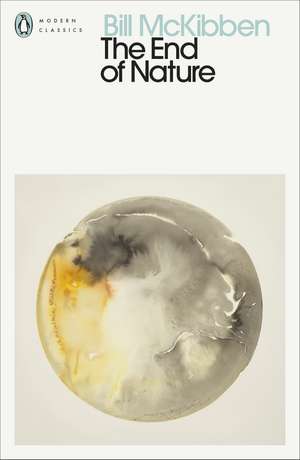
The End of Nature: Penguin Modern Classics
Autor Bill McKibbenen Limba Engleză Paperback – 31 mar 2022
'Nature, we believe, takes forever. It moves with infinite slowness,' begins the first book to bring climate change to public attention.
Interweaving lyrical observations from his life in the Adirondack Mountains with insights from the emerging science, Bill McKibben sets out the central developments not only of the environmental crisis now facing us but also the terms of our response, from policy to the fundamental, philosophical shift in our relationship with the natural world which, he argues, could save us. A moving elegy to nature in its pristine, pre-human wildness, The End of Nature is both a milestone in environmental thought, indispensable to understanding how we arrived here.
Din seria Penguin Modern Classics
-
 Preț: 80.02 lei
-
 Preț: 62.95 lei
-
 Preț: 101.91 lei
-
 Preț: 57.98 lei
-
 Preț: 59.80 lei
- 24%
 Preț: 60.28 lei
- 19%
 Preț: 56.98 lei
- 27%
 Preț: 57.30 lei
- 27%
 Preț: 51.43 lei
- 26%
 Preț: 57.58 lei
- 26%
 Preț: 57.78 lei
- 27%
 Preț: 52.03 lei
-
 Preț: 107.89 lei
- 18%
 Preț: 88.47 lei
- 25%
 Preț: 59.40 lei
- 25%
 Preț: 59.37 lei
- 25%
 Preț: 59.27 lei
- 25%
 Preț: 53.76 lei
- 25%
 Preț: 58.97 lei
- 24%
 Preț: 61.06 lei
- 27%
 Preț: 80.65 lei
- 25%
 Preț: 54.58 lei
- 26%
 Preț: 58.50 lei
- 27%
 Preț: 57.19 lei
- 25%
 Preț: 54.18 lei
- 25%
 Preț: 59.67 lei
- 27%
 Preț: 46.99 lei
- 28%
 Preț: 50.94 lei
- 25%
 Preț: 59.87 lei
- 28%
 Preț: 50.90 lei
- 26%
 Preț: 53.57 lei
- 27%
 Preț: 56.92 lei
- 27%
 Preț: 56.90 lei
- 30%
 Preț: 66.18 lei
- 26%
 Preț: 57.93 lei
- 27%
 Preț: 57.22 lei
- 26%
 Preț: 57.63 lei
- 25%
 Preț: 59.19 lei
- 25%
 Preț: 58.64 lei
- 33%
 Preț: 64.11 lei
- 26%
 Preț: 58.53 lei
- 26%
 Preț: 57.78 lei
- 36%
 Preț: 60.43 lei
- 26%
 Preț: 57.70 lei
- 20%
 Preț: 50.90 lei
- 28%
 Preț: 46.30 lei
- 27%
 Preț: 51.66 lei
- 27%
 Preț: 51.36 lei
- 25%
 Preț: 54.62 lei
- 26%
 Preț: 57.69 lei
Preț: 63.27 lei
Preț vechi: 78.49 lei
-19%
Puncte Express: 95
Carte disponibilă
Livrare economică 19-25 noiembrie
Livrare express 31 octombrie-06 noiembrie pentru 33.17 lei
Livrare prin curier în România Termenul estimat este afișat lângă disponibilitate.
Transport gratuit de la 400.00 lei Plată online sau ramburs, în funcție de opțiunile comenzii.
Retur gratuit în 14 zile Comandă securizată și suport în română.
Specificații
ISBN-13: 9780241514429
ISBN-10: 0241514428
Pagini: 272
Dimensiuni: 128 x 195 x 17 mm
Greutate: 0.17 kg
Editura: Penguin Books
Colecția Penguin Classics
Seria Penguin Modern Classics
Locul publicării:London, United Kingdom
ISBN-10: 0241514428
Pagini: 272
Dimensiuni: 128 x 195 x 17 mm
Greutate: 0.17 kg
Editura: Penguin Books
Colecția Penguin Classics
Seria Penguin Modern Classics
Locul publicării:London, United Kingdom
V-ar putea interesa
-
 Preț: 122.82 lei
-
 An Idea Can Go ExtinctBill McKibben-20%Preț: 28.25 lei35.35 lei
-
 This Can't Be HappeningGeorge Monbiot-19%Preț: 28.79 lei35.50 lei
-
 -12%Preț: 135.62 lei154.15 lei
-
 This Changes EverythingNaomi Klein-17%Preț: 90.82 lei109.17 lei
-
 EaarthBill MckibbenPreț: 123.05 lei
-
 Environmental PhilosophySimon P. JamesPreț: 149.97 lei
-
 -18%Preț: 88.80 lei108.44 lei
-
 Falter: Has the Human Game Begun to Play Itself Out?Bill McKibben-27%Preț: 66.98 lei91.64 lei
-
 Sacred NatureKaren Armstrong-30%Preț: 64.75 lei92.87 lei
-
 SnoSverker SörlinPreț: 124.75 lei
-
 The Memory We Could Be: Overcoming Fear to Create Our Ecological FutureDaniel Macmillen Voskoboynik-15%Preț: 62.94 lei74.18 lei
-
 DuskRobbie ArnottPreț: 122.64 lei
-
 SunbirthAn YuPreț: 108.24 lei
-
 What We Can KnowIan McEwanPreț: 116.06 leiRecomandat
-
 The EndJoel WainwrightPreț: 154.12 lei
-
 -18%Preț: 47.41 lei57.56 lei
-
 Human NatureKate MarvelPreț: 136.91 lei
-
 Love Letter to the EarthThich Nhat Hanh-19%Preț: 80.73 lei99.52 lei
-
 Life on a Little-Known PlanetElizabeth KolbertPreț: 193.02 lei
Notă biografică
Bill McKibben is a writer and environmental activist. His The End of Nature (1989) is considered the first book for a general audience about climate change. He serves as the Schumann Distinguished Scholar in Environmental Studies at Middlebury College, as a fellow of the American Academy of Arts and Sciences, and he has won the Gandhi Peace Prize. He has campaigned on every continent, including Antarctica, for climate action. In recognition of his activism, a new species of woodland gnat - Megophthalmidia mckibbeni - was in 2014 named in his honour.
Recenzii
Part science and part poetry, a sensitive and provocative essay of alarm, a kind of song for the wild, a lament for its loss, and a plea for its restoration
Permeated with the immediacy of the Adirondack Mountains, the trees he can see from his window, the changing seasons, the wild creatures he encounters. An extraordinary book
The fundamental book about the planetary change we are undergoing
McKibben explores the philosophies and technologies that have brought us here, and he shows how final a crossing we have made
Extras
Nature, we believe, takes forever. It moves with infinite slowness throught the many periods of its history, whose names we dimly recall from high school biology - the Devonian, the Triassic, the Cretaceous, the Pleistocene. Ever since Darwin, nature writers have taken pains to stress the incomprehensible length of this path. "So slowly, oh, so slowly have the great changes been brought about," wrote John Burroughs at the turn of the century. "The Orientals try to get a hint of eternity by saying that when the Himalayas have been ground to a powder by allowing a gauze veil t o float against them once in a thousand years, eternity will have only just begun. Our mountains have been pulverized by a process almost as slow." We have been told that man's tenure is as a minute to the earth's day, but it is that vast day which has lodged in our minds. The age of the trilobites began some 600 million years ago. The dinosaurs lived for nearly 140 million years. Since even a million years is utterly unfathomable, the message is: Nothinkg happens quickly. Change takes unimaginable - "geologic"- time.
This idea about time is essentially mistaken. Muddled though they are scientifically, the creationists, believing in the sudden appearance of hte earth some seven thousand years ago, may intuitively understand more about hte progress of time than hte rest of us. For the world as we know it - that is, the world with human beings formed into some sort of civilization, the world in which North America, Europe, and much of the rest of the planet are warm enough to support large human populations - is of quite comprehensible duration. People began to collect in a rudimentary society in the north of Mesopotamia some ten or twelve thousand years ago. Using thirty years as a generation, that is three hundred and thirty to four hundred generations ago. Sitting here at my desk, I can think back five generations in my family - I have seen photos of four. That is, I can think back nearly one-sixtieth of the way to the start of civilization. A skilled geneaologist might get me one-thirtieth of the distance back. And I can conceive of how most of those forebears lived. From the work of archaeologists and from accounts like those in the Bible I have some sense of daily life at least as far back as the time of the pharaohs, which is more than a third of the way. Two hundred and sixty-five generations ago Jericho was a walled city of three thousand souls. Two hundred and sixty-five is a large number, but not in the way that six million is a large number - not inscrutably large.
Or look at it this way: There are plants on this earth as old as civilization. Not species - individual plants. The General Sherman tree in California's Sequoia National Park may be a third as old, about four thousand years. Certain Antarctic lichens date back ten thousand years. A specific creosote plant in the Southwestern desert was estimated recently to be 11,700 years of age.
And within that ten or twelve thousand years of civilization, of course, time is not uniform. The world as we really, really know it dates back to the Industrial Revolution. the world we actually feel comfortable in dates back to perhaps 1945. It was not until after World War II, for instance, that plastics came into widespread use.
In other words, our reassuring sense of a timeless future, which is drawn from that apparently bottomless well of the past, is a delusion. True, evolution, grinding on ever so slowly, has taken billions of years to create us from slime, but that does not mean that time always moves so ponderously. Events, enormous events, can happen quickly. We've known this to be true since Hiroshima, of course, but I don't mean that quickly. I mean that over a year or a decade or a lifetime big and impersonal and dramatic changes can take place. We're now comfortable with the bizarre idea that continents can drift over eons, or that continent can die in an atomic second; even so, normal time seems to us immune to such huge changes. It isn't, though. In the last three decades, for example, the amount of carbon dioxide in the atmosphere has increased more than 10 percent, from about 315 to more than 350 parts per million. In the last decade, an immense "hole" in the ozone layer has opened above the South Pole. In the last half-decade, the percentage of West German forests damaged by acid rain has risen from less than 10 to more than 50. According to the Worldwatch Institute, in 1988 - for perhaps the first time since that starved Pilgrim winter at Plymouth - America ate more food than it grew. Burroughs again: "One summer day, while I was walking along the country rode on the farm where I was born, a section of the stone wall opposite me, and not more than three or four yards distant, suddenly fell down. Amid the general stillness and immobility around me, the effect was quite startling ... It was the sudden summing up of half a century or more of atomic changes in the wall. A grain or two of sand yielded to the pressure of long years, and gravity did the rest."
Descriere
Descriere de la o altă ediție sau format:
A stunning, passionately argued look at what we are doing to damage nature and what this will mean for our collective futures
____________________
'McKibben was one of the first to write clearly about global warming ... his plea for us to adopt a simple life is still profound' - Independent
'A kind of song for the wild, a lament for its loss, and a plea for its restoration' - New York Review of Books
____________________
More than simply a handbook for survival or a doomsday catalogue of scientific prediction, The End of Nature is a plea for radical and life-renewing change.
McKibben argues that our view of nature, its role in our lives and consciousness, has irretrievably altered. He argues passionately that if the world is to survive, we have to rethink this relationship.
What McKibben says is as relevant now as it was when The End of Nature was first published in 1989.