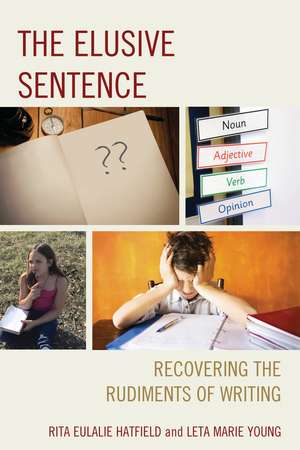
The Elusive Sentence: Recovering the Rudiments of Writing
Autor Rita Eulalie Hatfield, Leta Marie Youngen Limba Engleză Hardback – 8 dec 2015
Preț: 425.31 lei
Preț vechi: 597.61 lei
-29%
Puncte Express: 638
Carte tipărită la comandă
Livrare economică 04-18 decembrie
Livrare prin curier în România Termenul estimat este afișat lângă disponibilitate.
Transport gratuit pentru acest produs Plată online sau ramburs, în funcție de opțiunile comenzii.
Retur gratuit în 14 zile Comandă securizată și suport în română.
Specificații
ISBN-13: 9781475823387
ISBN-10: 147582338X
Pagini: 172
Ilustrații: 15 BW Illustrations, 8 Tables
Dimensiuni: 154 x 232 x 16 mm
Greutate: 0.43 kg
Editura: Bloomsbury Publishing
Colecția Rowman & Littlefield
Locul publicării:New York, United States
ISBN-10: 147582338X
Pagini: 172
Ilustrații: 15 BW Illustrations, 8 Tables
Dimensiuni: 154 x 232 x 16 mm
Greutate: 0.43 kg
Editura: Bloomsbury Publishing
Colecția Rowman & Littlefield
Locul publicării:New York, United States
V-ar putea interesa
-
 KS2 Comprehension Book 1Celia WarrenPreț: 41.21 lei
 -
 KS2 Comprehension Book 3Celia WarrenPreț: 40.65 lei
 -
 KS2 Comprehension Book 4Celia WarrenPreț: 40.55 lei
 -
 Preț: 77.73 lei
 -
 Jolly Phonics Activity Book 1Sara WernhamPreț: 51.19 lei
 -
 Jolly Phonics Activity Book 2Sara WernhamPreț: 51.20 lei
 -
 Preț: 51.15 lei
 -
 Preț: 51.18 lei
 -
 Preț: 51.07 lei
 -
 Grammar 1 Pupil BookSara WernhamPreț: 58.46 lei
 -
 Preț: 36.01 lei
Cuprins
Introduction
Part 1: Language Objective: Sentence-Level Writing Intervention
Why should we teach sentence level writing?
Chapter 1The Problem: Inverted Writing Pedagogy
Chapter 2The Solution: Sentence-Level Writing
Chapter 3Sentence-Level Writing Intervention
Elementary Writing Pedagogy
Chapter 4Linguistic & Musical Syntax
Audiation Theory for Music/Writing
How do we teach sentence-level writing?
Chapter 5Ingham-Webster-Pudewa Method
Dress-Ups
Sample Writing Matrix
Sentence Openers & Decorations
Phrase & Clause Manipulation Diagram
Basic Report/Essay Model
Critique Model & Super Essay Model
Scaffolding Common Core State Standards for Writing
Chapter 6Writers: Middle School, High School, College, & Beyond
Advanced Stylistic Techniques
Chapter 7Sheltered Instruction for Writing
Part 2: Content Objective: Cognitively Differentiated Learning
What is cognitively differentiated learning?
Chapter 8Cognitively Differentiated Learning
Why should we teach academic content through arts-integrated experiences?
Chapter 9Rationale: Teaching through the Arts
Art & Cognition
Chapter 10Arts-Integrated Learning
Rehearsal Effect
Elaboration Effect
Generation Effect
Enactment Effect
Production Effect
Effort After Meaning Effect
Emotional Arousal Effect
Picture Superiority Effect
Chapter 11Arts-Integrated Instruction & Cognition
Writing: Cognitive& Physical Skills
Cognitively Differentiated Teaching & Learning
Teaching & Learning Relationship
Cognitively Differentiated Writing Model
Why should we teach academic content through song?
Chapter 12Song as a Teaching Tool
Balanced Learningthrough Horizontal Differentiation
Chapter 13Operational Definitions
Rationale: Teaching Content through Song
Chapter 14Inherited Dissociated Philosophy
Historical Background of Mnemonic Learning
Chapter 15Neuroscience of Music & Memory
Memory & Music
Music & Mnemonics
Mnemonics & Diverse Learners
Assumptions & Final Thoughts on Mnemonic Song
Chapter 16Method & Practice: Putting It All Together
Cognitively Differentiated Writing Wheel
Sample Weekly Outline
Pictures of Writing Journals
Chapter 17Best Practice for Writing Instruction
Chapter 18Training Teachers for the New Millennium
The Hippocratic Oath for Educators
Chapter 19Final Reflection
Appendix AArts-Integrated Resources
Appendix BWriting Matrix
Appendix CComposition Checksheet
Appendix D Sample Syllabus for College Course
Appendix EWebster's Formulas/Chants for Written Communication
References
Part 1: Language Objective: Sentence-Level Writing Intervention
Why should we teach sentence level writing?
Chapter 1The Problem: Inverted Writing Pedagogy
Chapter 2The Solution: Sentence-Level Writing
Chapter 3Sentence-Level Writing Intervention
Elementary Writing Pedagogy
Chapter 4Linguistic & Musical Syntax
Audiation Theory for Music/Writing
How do we teach sentence-level writing?
Chapter 5Ingham-Webster-Pudewa Method
Dress-Ups
Sample Writing Matrix
Sentence Openers & Decorations
Phrase & Clause Manipulation Diagram
Basic Report/Essay Model
Critique Model & Super Essay Model
Scaffolding Common Core State Standards for Writing
Chapter 6Writers: Middle School, High School, College, & Beyond
Advanced Stylistic Techniques
Chapter 7Sheltered Instruction for Writing
Part 2: Content Objective: Cognitively Differentiated Learning
What is cognitively differentiated learning?
Chapter 8Cognitively Differentiated Learning
Why should we teach academic content through arts-integrated experiences?
Chapter 9Rationale: Teaching through the Arts
Art & Cognition
Chapter 10Arts-Integrated Learning
Rehearsal Effect
Elaboration Effect
Generation Effect
Enactment Effect
Production Effect
Effort After Meaning Effect
Emotional Arousal Effect
Picture Superiority Effect
Chapter 11Arts-Integrated Instruction & Cognition
Writing: Cognitive& Physical Skills
Cognitively Differentiated Teaching & Learning
Teaching & Learning Relationship
Cognitively Differentiated Writing Model
Why should we teach academic content through song?
Chapter 12Song as a Teaching Tool
Balanced Learningthrough Horizontal Differentiation
Chapter 13Operational Definitions
Rationale: Teaching Content through Song
Chapter 14Inherited Dissociated Philosophy
Historical Background of Mnemonic Learning
Chapter 15Neuroscience of Music & Memory
Memory & Music
Music & Mnemonics
Mnemonics & Diverse Learners
Assumptions & Final Thoughts on Mnemonic Song
Chapter 16Method & Practice: Putting It All Together
Cognitively Differentiated Writing Wheel
Sample Weekly Outline
Pictures of Writing Journals
Chapter 17Best Practice for Writing Instruction
Chapter 18Training Teachers for the New Millennium
The Hippocratic Oath for Educators
Chapter 19Final Reflection
Appendix AArts-Integrated Resources
Appendix BWriting Matrix
Appendix CComposition Checksheet
Appendix D Sample Syllabus for College Course
Appendix EWebster's Formulas/Chants for Written Communication
References
Recenzii
A landmark book for teachers, parents and writers of all ages! The practical approach of The Elusive Sentence provides explicit instruction strategies that systematically define sentence structure and style with clarity and precision. With a focus on differentiation, the integration of music, and sheltered instruction, the authors provide a sound structure to support Common Core State Standards.
When great-but old-ideas are overlooked because of a fascination with the newest progressive pedagogy, it requires both careful and determined research to unearth, dust off, and re-present them to the education world. In The Elusive Sentence, Hatfield & Young have done exactly that for the teaching of writing, and just in time, too, as basic composition skills decline to new lows countrywide! Teachers (and teachers of teachers) will find these ideas not only refreshing in their common sense but truly effective.
When great-but old-ideas are overlooked because of a fascination with the newest progressive pedagogy, it requires both careful and determined research to unearth, dust off, and re-present them to the education world. In The Elusive Sentence, Hatfield & Young have done exactly that for the teaching of writing, and just in time, too, as basic composition skills decline to new lows countrywide! Teachers (and teachers of teachers) will find these ideas not only refreshing in their common sense but truly effective.