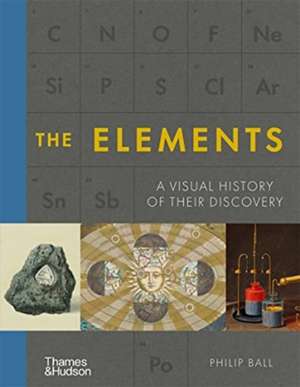
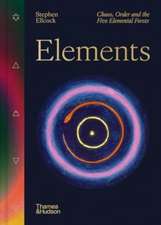
The Elements
Autor Philip Ballen Limba Engleză Hardback – 9 sep 2021
Începând cu analiza conceptelor fundamentale de apă, aer și foc, The Elements ne propune o explorare riguroasă a modului în care am ajuns să înțelegem cărămizile chimice ale universului. Remarcăm modul în care Philip Ball nu se limitează la o simplă enumerare a tabelului periodic, ci construiește o istorie culturală și științifică a materiei. Structura cărții urmărește o progresie logică, de la „Metalele antice” și „Elementele alchimice” până la „Era radiantă” și „Era nucleară”, oferind cititorului o imagine de ansamblu asupra evoluției chimiei ca știință modernă. Această lucrare extinde cadrul propus de The Periodic Table de Eric R. Scerri (din aceeași serie Very Short Introductions) prin accentul pus pe narațiunea istorică și pe includerea erorilor necesare progresului, cum ar fi teoriile despre flogiston sau caloric. În contextul operei sale, The Elements face punte între preocuparea sa pentru istoria culorilor și a alchimiei, vizibilă în Alchemy, și analizele sale despre structura realității. Descoperim aici nu doar succesele cercetării, ci și luptele celor ale căror idei au fost inițial marginalizate. Includerea elementelor teoretice ale grecilor antici, precum eterul, alături de descoperirile recente din acceleratoarele de particule, oferă o perspectivă completă asupra efortului uman de a clasifica natura. Textul este susținut vizual de numeroase diagrame și ilustrații, facilitând înțelegerea unor concepte complexe precum atomismul lui John Dalton sau structura electronică modernă.
Preț: 157.39 lei
Preț vechi: 198.85 lei
-21%
Carte disponibilă
Livrare economică 16-30 noiembrie
Livrare express 31 octombrie-06 noiembrie pentru 101.50 lei
Specificații
ISBN-10: 0500024537
Pagini: 224
Ilustrații: 192 Illustrations, unspecified
Dimensiuni: 196 x 252 x 26 mm
Greutate: 1 kg
Editura: Thames & Hudson
V-ar putea interesa
-
 Periodic TalesHugh Aldersey-WilliamsPreț: 94.11 lei
 -
 The Periodic Table: A Very Short IntroductionEric R. Scerri-19%Preț: 57.68 lei71.12 lei
 -
 -18%Preț: 41.01 lei50.14 leiRecomandat
 -
 -14%Preț: 137.14 lei158.70 lei
 -
 -14%Preț: 65.91 lei76.32 leiRecomandat
 -
 Preț: 270.10 lei
 -
 A Little History of ScienceWilliam BynumPreț: 88.13 lei
 -
 From Alchemy to Chemistry in Picture and StoryArthur Greenberg-8%Preț: 728.13 lei791.44 lei
 -
 ElementsStephen Ellcock-22%Preț: 152.47 lei194.81 lei
 -
 -24%Preț: 66.27 lei86.79 lei
 -
 Chemistry of the ElementsN. N. Greenwood-28%Preț: 431.62 lei600.08 lei
 -
 -26%Preț: 89.94 lei121.56 lei
 -
 The Secret Lives of the ElementsKathryn Harkup-27%Preț: 67.82 lei92.81 lei
 -
 A Short History of Nearly Everything 2.0Bill BrysonPreț: 142.00 lei
 -
 -20%Preț: 121.43 lei151.06 lei
 -
 -26%Preț: 68.21 lei92.63 lei
 -
 Elementary: The Periodic Table ExplainedJames M. Russell-10%Preț: 48.27 lei53.89 lei
 -
 Exploring the ElementsIsabel Thomas-12%Preț: 128.42 lei145.75 lei
 -
 The Periodic Table IllustratedAbbie Headon-16%Preț: 62.05 lei73.68 lei
 -
 -23%Preț: 39.94 lei51.74 lei
De ce să citești această carte
Recomandăm această carte oricărui cititor pasionat de istoria ideilor care dorește să înțeleagă chimia dincolo de formulele abstracte. Câștigați o perspectivă cronologică asupra modului în care s-a format Tabelul Periodic, de la antichitate la era atomică. Este un ghid concis, dar dens în informații factuale, care demonstrează cum greșelile științifice din trecut au pavat drumul către descoperirile de ultimă oră din prezent.
Despre autor
Philip Ball este un scriitor de știință britanic de prestigiu, cu o carieră de peste două decenii ca editor consultant pentru renumita revistă Nature. Lucrările sale sunt recunoscute la nivel internațional, volumul său „Bright Earth” fiind finalist al National Book Critics Circle Award, în timp ce „Critical Mass” a fost recompensat cu Premiul Aventis. Locuiește în Londra și este cunoscut pentru capacitatea sa de a sintetiza subiecte complexe din chimie, fizică și biologie în narațiuni accesibile, explorând frecvent intersecția dintre știință, artă și istoria culturii.
Notă biografică
Cuprins
1. The Classical Elements
2. The Antique Metals
3. Alchemical Elements
4. The New Metals
5. Chemistry's Golden Age
6. Electrical Discoveries
7. The Radiant Age
8. The Nuclear Age
Bibliography and Further Reading
Descriere scurtă
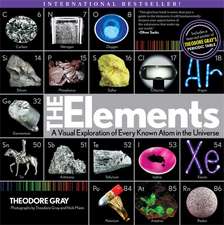
While other books have described the properties of the chemical elements and often delved into their histories, none has done so in this highly visual manner. The closest comparison is Theodore Gray's illustrated book The Elements - but this does not take a historical approach as this does here. The pictorial material for this subject is very rich, including some gorgeous alchemical documents as well as portraits, colour charts, woodcuts of mining, artefacts such as John Dalton's wooden balls, advertisements (for example, for radium 'cures') and postage stamps.
The book contains separate short sections for each element or groups of related elements, which are gathered into several sections to order the sequence into several chronological eras of element discovery. Included are short 'interludes' (or 'feature spreads') presenting important intellectual milestones in how we think about elements.
With 192 illustrations
Descriere
Recenzii
Extras
All the same, it’s a dauntingly long list for new students of chemistry. They might have already heard of elements like carbon and oxygen, but scandium? Praesodymium? Even pronouncing the names of some of these elements can be a challenge, let alone remembering anything about them or finding the motivation to do so.
That’s where history might help. The elements were discovered only very gradually over time—from about 1730, at a surprisingly steady rate of about one every two or three years, with occasional bursts or hiatuses. This happened through no concerted program of seeking (at least not until the past several decades, when any newly discovered elements have had to be deliberately human-made). It was a haphazard business: scientists and technologists might find a previously unknown element in an obscure mineral, say, or by splitting sunlight into a spectrum to seek a telltale gap where some new element has stripped a color from it, or by liquefying and distilling air to find tiny quantities of rare gases. These tales of discovery are like biographies, and they can make the elements seem less like a random collection of obscure nobodies and more like characters in the long and continuing saga of how we have tried to comprehend and manipulate our surroundings. To chemists, they genuinely come to acquire personalities: helpful or recalcitrant, intriguing or dull, friendly or hazardous. That chemists regularly conduct polls of their “favorite elements” can seem unutterably nerdy—until you get to know the elements yourself, in which case you will almost certainly find that you have developed preferences and aversions of your own.
Some elements have proved immensely useful: as crucial ingredients in drugs or other medical agents, for example, or for making new materials that are harder, stronger, shinier, better conductors of electricity, and so on. Some have brightly colored compounds (combinations with other elements) that are valuable as pigments and dyes. Some are sources of energy, or essential nutrients for health, or refrigerants that can keep things colder than deep space. Their properties and uses have even elevated a few elements to privileged inclusion in the cultural lexicon: opportunities are golden, clouds have silver linings, suggestions go down like lead balloons, opponents are crushed with an iron fist, provocateurs are denied the oxygen of publicity. We might speak of the sodium glare of streetlights, of hydrogen bombs, of nickel-and-dime stores, magnesium flares, with little if any understanding of why those particular elements are being invoked. The very notion of an “element” itself connotes a fundamental principle beyond chemistry, for we speak of the elements of law, of mathematics (the topic of the ancient Greek thinker Euclid’s treatise The Elements), of language, of cookery.
All this implies that charting the history of the discovery of the chemical elements is more than an account of the development of chemistry as a science. It also offers us a view of how we have come to understand the natural world, including our own constitution. Furthermore, it shows how this knowledge has accompanied the evolution of our technologies and crafts—and “accompany” is the right word to use, because this narrative challenges the common but inaccurate view that science always moves from discovery to application. Often it is the reverse: practical concerns (such as mining or manufacturing) generate questions and challenges that lead to fresh discoveries. We can see too how scientific discovery is not some impersonal and inexorable process, but depends instead on the motivations, capabilities, and sometimes the idiosyncrasies of individual people: it requires determination, imagination, and ambition as well as insight and—never underestimate this—a substantial dash of good luck.
It’s an unavoidable fact that histories of this kind must dwell, especially in the past several centuries, to a degree that we now rightly find uncomfortable, on the exploits and achievements of men of European heritage. Not only was it very difficult until recent times for women to gain entry into scientific institutions, but even those few who did often faced intense discrimination and prejudice. Marie Curie, for example, who did most of the work in finding the elements radium and polonium at the end of the nineteenth century, was nearly overlooked when the work was rewarded by the 1903 Nobel Prize for Physics. Initially, the award was going to acknowledge only her husband and collaborator Pierre, before, forewarned, he objected. Similarly, Marie-Anne Paulze Lavoisier’s contributions to the work of her husband, the eminent eighteenth-century French chemist Antoine Lavoisier, were long considered little more than wifely duties rather than those of a scientific collaborator. Even as late as the 1950s, the American nuclear chemist Darleane Hoffman, who made vital contributions to the discoveries of new, heavy radioactive elements, was told when she arrived at Los Alamos National Laboratory to lead a new team that there must be some mistake because “We don’t hire women in that division.”
Why, meanwhile, people of color feature rather little in this story is a question fraught with the entire history of Western global dominance and exploitation since early modern times, as well as the prejudices and systematic biases that still lead to their under-representation in the sciences today. It isn’t clear for how much longer the story of element discovery will or, for that matter, can continue—but the rise of scientific excellence in Asia, at least, might lead us to expect as well as to hope that, if it does, then it will feature significantly more cultural richness and diversity.