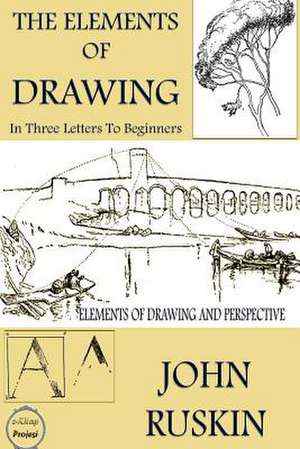
The Elements of Drawing
Autor John Ruskin Ilustrat de Murat Ukrayen Limba Engleză Paperback
Preț: 87.89 lei
Puncte Express: 132
Carte indisponibilă temporar
Livrare prin curier în România Termenul estimat este afișat lângă disponibilitate.
Transport gratuit de la 400.00 lei Plată online sau ramburs, în funcție de opțiunile comenzii.
Retur gratuit în 14 zile Comandă securizată și suport în română.
Specificații
ISBN-13: 9781505239256
ISBN-10: 1505239257
Pagini: 224
Dimensiuni: 156 x 234 x 12 mm
Greutate: 0.32 kg
Editura: CREATESPACE
ISBN-10: 1505239257
Pagini: 224
Dimensiuni: 156 x 234 x 12 mm
Greutate: 0.32 kg
Editura: CREATESPACE
V-ar putea interesa
-
 Lessons for Young ArtistsDavid GentlemanPreț: 144.10 lei
 -
 The Drawing LessonMark CrilleyPreț: 114.84 lei
 -
 On the Art of Drawing: Paintings in OilRobert Fawcett-23%Preț: 64.72 lei83.66 lei
 -
 Ways of DrawingJulian Bell-16%Preț: 200.38 lei238.00 lei
 -
 How To Draw AnythingMark Linley-26%Preț: 58.08 lei78.93 lei
 -
 Drawing Basics and BeyondSorie Kim-16%Preț: 117.27 lei139.59 lei
 -
 Lessons in Classical DrawingJuliette AristidesPreț: 189.28 lei
 -
 Keys to DrawingBert DodsonPreț: 170.26 lei
 -
 The Complete Fundamentals of DrawingBarrington BarberPreț: 154.62 lei
 -
 The Super Cute Drawing BookWilliam PotterPreț: 71.48 lei
 -
 -27%Preț: 58.53 lei79.95 lei
 -
 Drawing on the Right Side of the Brain WorkbookBetty EdwardsPreț: 162.33 lei
 -
 Preț: 71.97 lei
 -
 Portfolio: Beginning DrawingAlain Picard-15%Preț: 83.19 lei97.76 lei
 -
 Preț: 87.50 lei
 -
 -24%Preț: 111.01 lei146.09 lei
 -
 -15%Preț: 107.00 lei126.10 lei
 -
 How to DrawScott Robertson-18%Preț: 242.73 lei295.00 lei
 -
 Learn to See, Learn to DrawDavid Köder-27%Preț: 123.34 lei168.35 lei
 -
 Preț: 109.90 lei
Textul de pe ultima copertă
Can drawing--sound, honest representation of the world as the eye sees it, not tricks with the pencil or a few "effects"--be learned from a book? One of the most gifted draftsmen, who is also one of the greatest art critics and theorists of all time, answers that question with a decided "Yes." He is John Ruskin, the author of this book, a classic in art education as well as a highly effective text for the student and amateur today.
The work is in three parts, cast in the form of letters to a student, successively covering "First Practice," "Sketching from Nature," and "Colour and Composition." Starting with the bare fundamentals (what kind of drawing pen to buy; shading a square evenly), and using the extremely practical method of exercises which the student performs from the very first, Ruskin instructs, advises, guides, counsels, and anticipates problems with sensitivity. The exercises become more difficult, developing greater and greater skills until Ruskin feels his reader is ready for watercolors and finally composition, which he treats in detail as to the laws of principality, repetition, continuity, curvature, radiation, contrast, interchange, consistency, and harmony. All along the way, Ruskin explains, in plain, clear language, the artistic and craftsmanlike "reasons" behind his practical advice--underlying which, of course, is Ruskin's brilliant philosophy of honest, naturally observed art which has so much affected our aesthetic.
Three full-page plates and 48 woodcuts and diagrams (the latter from drawings by the author) show the student what the text describes. An appendix devotes many pages to the art works which may be studied with profit.
Unabridged republication of the text from the Library edition of "The Works of John Ruskin, " 1904.
The work is in three parts, cast in the form of letters to a student, successively covering "First Practice," "Sketching from Nature," and "Colour and Composition." Starting with the bare fundamentals (what kind of drawing pen to buy; shading a square evenly), and using the extremely practical method of exercises which the student performs from the very first, Ruskin instructs, advises, guides, counsels, and anticipates problems with sensitivity. The exercises become more difficult, developing greater and greater skills until Ruskin feels his reader is ready for watercolors and finally composition, which he treats in detail as to the laws of principality, repetition, continuity, curvature, radiation, contrast, interchange, consistency, and harmony. All along the way, Ruskin explains, in plain, clear language, the artistic and craftsmanlike "reasons" behind his practical advice--underlying which, of course, is Ruskin's brilliant philosophy of honest, naturally observed art which has so much affected our aesthetic.
Three full-page plates and 48 woodcuts and diagrams (the latter from drawings by the author) show the student what the text describes. An appendix devotes many pages to the art works which may be studied with profit.
Unabridged republication of the text from the Library edition of "The Works of John Ruskin, " 1904.
Cuprins
LETTER I ON FIRST PRACTICE LETTER II SKETCHING FROM NATURE LETTER III ON COLOUR AND COMPOSITION :- COLOUR COMPOSITION :- 1. THE LAW OF PRINCIPALITY 2. THE LAW OF REPETITION 3. THE LAW OF CONTINUITY 4. THE LAW OF CURVATURE 5. THE LAW OF RADIATION 6. THE LAW OF CONTRAST 7. THE LAW OF INTERCHANGE 8. THE LAW OF CONSISTENCY 9. THE LAW OF HARMONY APPENDIX I ILLUSTRATIVE NOTES APPENDIX II THINGS TO BE STUDIED