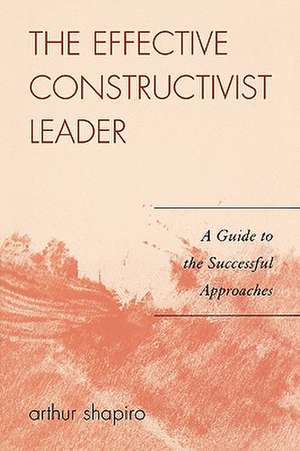
The Effective Constructivist Leader: A Guide to the Successful Approaches
Autor Arthur Shapiroen Limba Engleză Paperback – 13 mar 2008
Preț: 348.50 lei
Preț vechi: 461.84 lei
-25%
Puncte Express: 523
Carte tipărită la comandă
Livrare economică 25 noiembrie-09 decembrie
Livrare prin curier în România Termenul estimat este afișat lângă disponibilitate.
Transport gratuit de la 400.00 lei Plată online sau ramburs, în funcție de opțiunile comenzii.
Retur gratuit în 14 zile Comandă securizată și suport în română.
Specificații
ISBN-13: 9781578867288
ISBN-10: 1578867282
Pagini: 212
Dimensiuni: 157 x 229 x 17 mm
Greutate: 0.34 kg
Editura: Bloomsbury Publishing
Colecția R&L Education
Locul publicării:New York, United States
ISBN-10: 1578867282
Pagini: 212
Dimensiuni: 157 x 229 x 17 mm
Greutate: 0.34 kg
Editura: Bloomsbury Publishing
Colecția R&L Education
Locul publicării:New York, United States
V-ar putea interesa
-
 AmigosEric CarlePreț: 51.33 lei
 -
 Herman the HelperRobert KrausPreț: 50.33 lei
 -
 Ecological LiteracyDavid W. OrrPreț: 261.97 lei
 -
 Inside The BottleArthur ShapiroPreț: 105.77 lei
 -
 -19%Preț: 328.48 lei406.60 lei
 -
 The Anxiety Workbook for GirlsErin A. MunroePreț: 147.71 lei
 -
 Learning to Lead: Ten Stories for PrincipalsMichael Chirichello-20%Preț: 311.77 lei389.39 lei
 -
 -20%Preț: 327.45 lei408.12 lei
 -
 -24%Preț: 275.68 lei360.53 lei
 -
 -24%Preț: 267.67 lei350.96 lei
 -
 Action-Oriented Principals: Facing the Demands of External PressuresJeri L. Engelking-23%Preț: 277.56 lei361.68 lei
 -
 Making Large Schools Work: The Advantages of Small SchoolsArthur Shapiro-26%Preț: 343.17 lei460.73 lei
 -
 Combat ZoneArthur ShapiroPreț: 370.93 lei
 -
 A Short History of Leadership TheoryJ. Robert ClintonPreț: 54.32 lei
Cuprins
Part 1 So, What's Constructivist Teaching All About?
Chapter 1 How Can I Recognize It in Teachers' Professional Practice? Two Case Studies
Chapter 2 How to Think Like a Constructivist Teacher in Designing Your Classroom and Team
Part 2 Tools: To Understand Ourselves, Our Kids, Co-Workers
Part 3 More Tools: The Dynamics of Organizations and Constructivist Leadership
Chapter 3 What Makes Terry Tick? (Our Needs for Power, Control, Recognition, Safety, Acceptance, Esteem and How Constructivism Helps Satisfy Them)
Part 4 A Three (Now Five) Year Case Study of Constructivist Leadership
Chapter 4 What Makes Organizations (Read, Schools) Tick? A Quick Guide to How Organizations Work (And How to Create a Healthy Sub-Culture in Them)
Part 5 How to Pull Off Morphing Into a Constructivist
Chapter 5 What Makes Organizations (Read, Schools) Tick? Hidden Behavior: Images, Cycles, and Pulls - Revealed
Chapter 6 But First We Need a Purpose: A Case Study: How to Develop Achievable Goals and a Curriculum Structure to Generate Change as a Routine - and, the Crucial Role of Buy-In
Chapter 7 Your First Priority and Tool: How to Establish Yourself with Teachers, Supervisors, Peers, Kids, and Community
Chapter 8 Power, Empowering, and Constructivist Leadership: How Do We Get It? Use It? Grow It? Lose It? (Which is Pretty Easy to Do)
Chapter 9 A Three-Year Constructivist Case Study: Part 1Diagnosing a School's Issues: Getting a Handle on Its Dynamics: EvenUsing a Constructivist Change Strategy to Make It Constructivist (And the Scores Jumped Up)
Chapter 10 A Constructivist Case Study: Part 2Southwood School: Three (And Now Five) Years of Constructivism: Spectacular Changes - and, the Scores Jumped Up
Chapter 11 At Last, What Does a Constructivist School Look Like?What Are Its Essential Elements?What Do Constructivist Leaders Do? - (So That I Can Pull It Off)
Chapter 1 How Can I Recognize It in Teachers' Professional Practice? Two Case Studies
Chapter 2 How to Think Like a Constructivist Teacher in Designing Your Classroom and Team
Part 2 Tools: To Understand Ourselves, Our Kids, Co-Workers
Part 3 More Tools: The Dynamics of Organizations and Constructivist Leadership
Chapter 3 What Makes Terry Tick? (Our Needs for Power, Control, Recognition, Safety, Acceptance, Esteem and How Constructivism Helps Satisfy Them)
Part 4 A Three (Now Five) Year Case Study of Constructivist Leadership
Chapter 4 What Makes Organizations (Read, Schools) Tick? A Quick Guide to How Organizations Work (And How to Create a Healthy Sub-Culture in Them)
Part 5 How to Pull Off Morphing Into a Constructivist
Chapter 5 What Makes Organizations (Read, Schools) Tick? Hidden Behavior: Images, Cycles, and Pulls - Revealed
Chapter 6 But First We Need a Purpose: A Case Study: How to Develop Achievable Goals and a Curriculum Structure to Generate Change as a Routine - and, the Crucial Role of Buy-In
Chapter 7 Your First Priority and Tool: How to Establish Yourself with Teachers, Supervisors, Peers, Kids, and Community
Chapter 8 Power, Empowering, and Constructivist Leadership: How Do We Get It? Use It? Grow It? Lose It? (Which is Pretty Easy to Do)
Chapter 9 A Three-Year Constructivist Case Study: Part 1Diagnosing a School's Issues: Getting a Handle on Its Dynamics: EvenUsing a Constructivist Change Strategy to Make It Constructivist (And the Scores Jumped Up)
Chapter 10 A Constructivist Case Study: Part 2Southwood School: Three (And Now Five) Years of Constructivism: Spectacular Changes - and, the Scores Jumped Up
Chapter 11 At Last, What Does a Constructivist School Look Like?What Are Its Essential Elements?What Do Constructivist Leaders Do? - (So That I Can Pull It Off)
Recenzii
Education has been subjected to the latest hula-hoop solutions ever since The Nation at Risk propelled school reform into the national limelight in 1983. While constructivist leadership has been around since John Dewey crafted a lab school at the University of Chicago in the early twentieth century, it has taken someone like Art Shapiro to write a book that unites the work of teachers and administrators in practical ways that produce results in real school settings. Shapiro knows how schools work and he understands the larger theoretical issues that must be addressed without pontificating or losing the reader in unnecessary social science jargon. His case studies and practical suggestions will make constructivist concepts come alive.
Arthur Shapiro has inspired us all to seek the constructivist human side of the school enterprise. He guides us through very practical, but research based constructivist teaching and administrative practices with profound tips on improving our communication and interpersonal leadership skills. If you aspire to have a powerful learning community for all kids purchase this book.
Like pieces of a puzzle that morph into a total greater than its parts, The Effective Constructivist Leader draws a clear blueprint of the key elements that make constructivist leadership achievable for a broad audience.
I know Professor Shapiro as an experienced and widely-acknowledged educator who remains sensitive to bridging theoretical notions into readily understandable and practical lessons for both his students and readers. This unique volume accomplishes just that for those leaders morally committed to excellence. Constructivist leadership is not new, but Shapiro takes it to a new level. He provides sensible guidelines to overcome organizational constraints so that constructivist change and leadership become a reality.
Dr. Shapiro successfully explains and sells the concept of "servant leadership" that is making inroads in many current organizations.
Arthur Shapiro has inspired us all to seek the constructivist human side of the school enterprise. He guides us through very practical, but research based constructivist teaching and administrative practices with profound tips on improving our communication and interpersonal leadership skills. If you aspire to have a powerful learning community for all kids purchase this book.
Like pieces of a puzzle that morph into a total greater than its parts, The Effective Constructivist Leader draws a clear blueprint of the key elements that make constructivist leadership achievable for a broad audience.
I know Professor Shapiro as an experienced and widely-acknowledged educator who remains sensitive to bridging theoretical notions into readily understandable and practical lessons for both his students and readers. This unique volume accomplishes just that for those leaders morally committed to excellence. Constructivist leadership is not new, but Shapiro takes it to a new level. He provides sensible guidelines to overcome organizational constraints so that constructivist change and leadership become a reality.
Dr. Shapiro successfully explains and sells the concept of "servant leadership" that is making inroads in many current organizations.