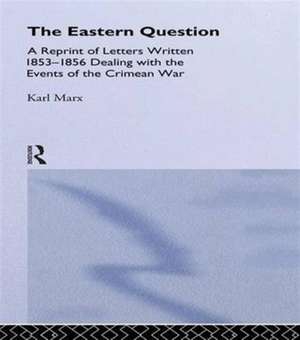
The Eastern Question
Autor Karl Marxen Limba Engleză Paperback – 26 mai 2016
Preț: 464.26 lei
Puncte Express: 696
Carte tipărită la comandă
Livrare economică 26 noiembrie-10 decembrie
Livrare prin curier în România Termenul estimat este afișat lângă disponibilitate.
Transport gratuit pentru acest produs Plată online sau ramburs, în funcție de opțiunile comenzii.
Retur gratuit în 14 zile Comandă securizată și suport în română.
Specificații
ISBN-13: 9781138993228
ISBN-10: 1138993220
Pagini: 676
Dimensiuni: 138 x 216 mm
Greutate: 0.45 kg
Ediția:1
Editura: Taylor & Francis
Colecția Routledge
Locul publicării:Oxford, United Kingdom
ISBN-10: 1138993220
Pagini: 676
Dimensiuni: 138 x 216 mm
Greutate: 0.45 kg
Ediția:1
Editura: Taylor & Francis
Colecția Routledge
Locul publicării:Oxford, United Kingdom
V-ar putea interesa
-
 CapitalKarl Marx-20%Preț: 119.69 lei148.75 lei
 -
 The Communist ManifestoKarl Marx-26%Preț: 48.13 lei65.27 lei
 -
 Dispatches for the New York TribuneKarl MarxPreț: 109.50 lei
 -
 Karl Marx: Selected WritingsKarl Marx-57%Preț: 421.16 lei987.72 lei
 -
 Kant and the End of WarHoward WilliamsPreț: 403.27 lei
 -
 Outline of a Theory of CivilizationYukichi FukazawaPreț: 266.63 lei
 -
 Preț: 369.93 lei
 -
 The Weimar RepublicEberhard KolbPreț: 398.82 lei
 -
 A History of Eastern Europe: Crisis and ChangeRobert Bideleux-15%Preț: 492.16 lei579.02 lei
 -
 Britain and Europe: A Political History Since 1918N. J. Crowson-15%Preț: 418.85 lei492.76 lei
 -
 The Modern StateChristopher Pierson-15%Preț: 418.91 lei492.84 lei
 -
 Preț: 462.43 lei
 -
 -18%Preț: 1310.47 lei1598.13 lei
 -
 Preț: 309.27 lei
 -
 Secessionism and Separatism in Europe and Asia: To Have a State of One’s OwnJean-Pierre Cabestan-18%Preț: 1256.91 lei1532.82 lei
 -
 -15%Preț: 423.54 lei498.29 lei
 -
 Interpretive Research Design: Concepts and ProcessesPeregrine Schwartz-Shea-15%Preț: 422.92 lei497.56 lei
 -
 The Essential MarxKarl MarxPreț: 84.22 lei
 -
 -18%Preț: 83.07 lei100.82 lei
 -
 Austria's Wars of Emergence, 1683-1797Michael Hochedlinger-15%Preț: 509.42 lei599.32 lei
 -
 Modern Europe, 1789-PresentAsa Briggs-15%Preț: 506.54 lei595.93 lei
 -
 Politics South AfricaHeather Deegan-15%Preț: 462.86 lei544.54 lei
 -
 Censored 2010: The Top 25 Censored Stories of 2008-9Peter Phillips-11%Preț: 94.05 lei105.68 lei
 -
 CapitalKarl MarxPreț: 49.36 lei
 -
 -38%Preț: 797.88 lei1297.13 lei
Cuprins
Turkey; the London Press - policy of Napoleon on the Turkish question; the real issue in Turkey; the Turkish question; Turkey and Russia; the ultimatum and after; the English and French fleets - The Times - Russian aggrandizement; the Russian humbug; Brunnow and Clarendon - Armenian proclamation; Aberdeen, Clarenden, Brunnow - connivance of the Aberdeen ministry with Russia; Russian policy against Turkey; Austria and Russia; Layard-Gladstone-Aberdeen-Palmerston; the Russo-Turkish difficulty -ducking and dodging of the British Cabinet - Nesselrode's latest note; the Russian question - curious diplomatic correspondence; Russia and the Western powers; traditional policy of Russia; the press on Eastern affairs - notes of England and Russia; Russian movements - Denmark - United States and Europe; to withdraw or not to withdraw; Urquhart-Bem - the Turkish question in the House of Lords; the Turkish question in the Commons; affairs continental and English; the Vienna note; the Vienna note (contd); the English ministry outwitted - panic; the war question; the Turkish manifesto; the northern powers; war; the holy war; Persia-Denmark; diplomacy again; the war on the Danube; the quadruple convention -England and the war; the Russian victory - position of England and France; private news from St. Petersburg; Russian policy; Palmerston's resignation; progress of the Turkish war; England and Russia; more documents; the European war; the war in Asia; the Czar's views - Prince Albert; Cobden and Russia; war finance; blue books - ambassadors withdrawing; Russian diplomacy - the shrines -Montenegro; Count Orloff's proposals; debates in Parliament; Kossuth - Disraeli and Hume - United States - France and England -Greece; France and England - the Greek rising - Asia; the Russian retreat; the documents on the partition of Turkey; the secret diplomatic correspondence; war declared - Mussulman and Christian; war with Russia; Russia and the German powers; Turkey and Greece -Italy; Austria and Servia - Greece and Turkey - Turkey and the Western powers; the Greek insurrection - alliance between Prussia and Austria - Russian armaments; bombardment of Odessa - Austria and Russia - the Greek insurrection - Montenegro - Manteuffel; Prussian policy; the exploits in the Baltic and Black Seas -Anglo-French system of operations; delay on the Danube; speeches -St. Arnaud; state of the Russian war; the war - debate in Parliament; the Russia failure; Russia, Austria, Turkey, Wallachia and Redcliffe; Austria; the siege of Silistria; the theatre of war - the Russian note to the German powers - Servia and Austria; the private conference at Vienna - ministerial crisis; another war debate; the Austro-Turkish treaty - more parliamentary talk; that bore of a war; the Russian retreat - Denmark; the evacuation; Servia - England, France and Constantinople; the capture of Bomarsund; the condition of Wallachia - revolution in Turkey; the fleet off at last - revolt of the Moldavians; the atta
Notă biografică
Karl Marx (1818-1883)
Karl Marx was a German philosopher, revolutionary, historian, sociologist, economist, and political theorist. Perhaps the most zealous intellectual advocate of communism, Marx was a proponent of ideas that were considered too radical for the time he lived in. Due to his political works, he was exiled from Germany and rendered stateless. Thereafter, he moved to London with his family, and continued to collaborate with Engels on path-breaking works, such as The Communist Manifesto and Das Kapital.
Marx advocated for the socialist mode of production, as opposed to the capitalist mode, where the means of production is controlled by the ruling class. He believed that the working class could topple the capitalist system through a proletariat revolution that would establish a classless, communist society. While Marx's ideologies have been both appreciated and criticized, there is no doubt that his works and ideas have heavily influenced subsequent economic and political thought and history.
Friedrich Engels (1820-1895)
Friedrich Engels was a German philosopher, revolutionary, socialist, historian, political theorist, activist, as well as economist. Along with Karl Marx, he developed the principles of what is now known as Marxism. He was a staunch critic of the capitalist society, and instead saw a space for a just and equal society in socialism. His works are a critical commentary on social structures, such as religion, and systems of governance, which thrive as a result of the oppression of marginalized sections in society.
In The Condition of Working Class in England, Engels studies the condition of the working class that worsened due to the Industrial Revolution (1760-1840). The work deeply influenced British historians of the time. Although he co-authored several texts with Marx, he edited and compiled Marx's unfinished works as well, while also continuing to publish his own.