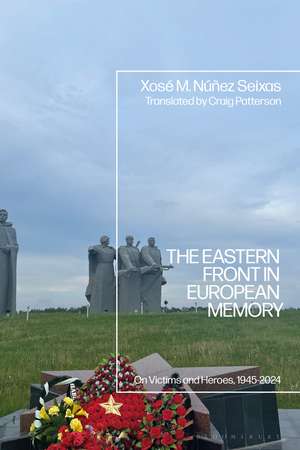
The Eastern Front in European Memory: On Victims and Heroes, 1945-2024
Autor Professor Xosé M. Núñez Seixas Traducere de Craig Pattersonen Limba Engleză Hardback – 16 oct 2025
Covering the whole post-war period to the present, with a particular emphasis on recent events, this book offers a cultural perspective on the different ways in which the politics of memory dictated by states interact with and are sometimes counteracted by grass-roots memory initiatives. The Eastern Front in European Memory focuses on a diversity of sources and agents of memory, from monuments and public ceremonies to literary narratives, films and other aspects of popular culture that contribute to shaping the historical culture of the societies concerned.
Preț: 552.40 lei
Preț vechi: 817.12 lei
-32%
Puncte Express: 829
Carte tipărită la comandă
Livrare economică 18 noiembrie-02 decembrie
Livrare prin curier în România Termenul estimat este afișat lângă disponibilitate.
Transport gratuit pentru acest produs Plată online sau ramburs, în funcție de opțiunile comenzii.
Retur gratuit în 14 zile Comandă securizată și suport în română.
Specificații
ISBN-13: 9781350435995
ISBN-10: 1350435996
Pagini: 280
Ilustrații: 35 bw illus
Dimensiuni: 156 x 236 x 22 mm
Greutate: 0.56 kg
Editura: Bloomsbury Publishing
Colecția Bloomsbury Academic
Locul publicării:London, United Kingdom
ISBN-10: 1350435996
Pagini: 280
Ilustrații: 35 bw illus
Dimensiuni: 156 x 236 x 22 mm
Greutate: 0.56 kg
Editura: Bloomsbury Publishing
Colecția Bloomsbury Academic
Locul publicării:London, United Kingdom
Cuprins
List of Illustrations
Introduction: The Eastern Front between Myth and Brutality
1. Germany: On Victims, Perpetrators and Fellow Travellers
2. The USSR and Russia: The Long Shadow of the Great Patriotic War
3. Post-Soviet Eastern Europe: Occupiers, the Occupied and Patriots
4. Finland: Two Wars, One Memory
5. 'Crusaders for Europe'. and those 'nice Mediterraneans'
Conclusion
Bibliography
Index
Introduction: The Eastern Front between Myth and Brutality
1. Germany: On Victims, Perpetrators and Fellow Travellers
2. The USSR and Russia: The Long Shadow of the Great Patriotic War
3. Post-Soviet Eastern Europe: Occupiers, the Occupied and Patriots
4. Finland: Two Wars, One Memory
5. 'Crusaders for Europe'. and those 'nice Mediterraneans'
Conclusion
Bibliography
Index
Recenzii
Second World War's Eastern Front featured a battlefield that was dominated by the Red Army and Wehrmacht but also included participants from Romania and Finland, as well as Spain and Italy. Each has developed myths about their respective experiences, suffering, and heroism and, for the first time, Xosé M. Núñez Seixas has put them into conversation with each other in a single volume that offers a modern synthesis and "panoramic investigation" of the state of the field of collective memory studies when it comes to the Eastern Front and its modern-day implications
Notă biografică
Xosé M. Núñez Seixas is Professor of Modern European History at the University of Santiago de Compostela, Spain. He has published widely on the comparative history of nationalist movements and national and regional identities. He has co-edited, along with Javier Moreno, Metaphors of Spain: Representations of Spanish National Identity in the Twentieth Century(2017).