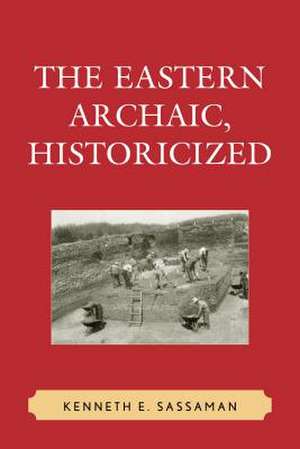
The Eastern Archaic, Historicized: Issues in Eastern Woodlands Archaeology
Autor Kenneth E. Sassamanen Limba Engleză Paperback – iul 2015

Preț: 314.81 lei
Preț vechi: 407.50 lei
-23%
Puncte Express: 472
Carte tipărită la comandă
Livrare economică 26 noiembrie-10 decembrie
Livrare prin curier în România Termenul estimat este afișat lângă disponibilitate.
Transport gratuit de la 400.00 lei Plată online sau ramburs, în funcție de opțiunile comenzii.
Retur gratuit în 14 zile Comandă securizată și suport în română.
Specificații
ISBN-13: 9780759106802
ISBN-10: 0759106800
Pagini: 296
Ilustrații: 9 black & white halftones, 13 maps, 5 charts
Dimensiuni: 154 x 228 x 18 mm
Greutate: 0.36 kg
Editura: Bloomsbury Publishing
Colecția Rowman & Littlefield
Seria Issues in Eastern Woodlands Archaeology
Locul publicării:New York, United States
ISBN-10: 0759106800
Pagini: 296
Ilustrații: 9 black & white halftones, 13 maps, 5 charts
Dimensiuni: 154 x 228 x 18 mm
Greutate: 0.36 kg
Editura: Bloomsbury Publishing
Colecția Rowman & Littlefield
Seria Issues in Eastern Woodlands Archaeology
Locul publicării:New York, United States
V-ar putea interesa
-
 Archaeology: A Very Short IntroductionPaul Bahn-20%Preț: 56.62 lei70.82 lei
 -
 The Art and Archaeology of PashashTerence GriederPreț: 302.61 lei
 -
 Museum Objects: Experiencing the Properties of ThingsSandra H. Dudley-8%Preț: 517.25 lei562.23 lei
 -
 -15%Preț: 475.10 lei558.94 lei
 -
 Heritage: Critical ApproachesRodney HarrisonPreț: 382.03 lei
 -
 The Heritage of WarMartin Gegner-15%Preț: 440.74 lei518.51 lei
 -
 Preț: 472.95 lei
 -
 -18%Preț: 1250.64 lei1525.16 lei
 -
 Preț: 147.04 lei
 -
 Conservation of Archaeological Ships and BoatsPer Hoffmann-23%Preț: 770.35 lei1000.45 lei
Cuprins
Chapter 1 Introduction Chapter 2 Chapter 1. Prehistory Reloaded Chapter 3 Chapter 2. A Continental Visa Chapter 4 Chapter 3. Landscapes of Historical Practice Chapter 5 Chapter 4. Craftworks of Structure Chapter 6 Chapter 5. Cultures of Daily Practice Chapter 7 Chapter 6. Structure Transformed Chapter 8 References Chapter 9 Index
Recenzii
As the title suggests, this is an attempt to reintegrate humanism into archaeological science, to use the best aspects of older culture history with the scientific techniques of the New Archaeology. The focus is on Archaic complex sites situated east of the Mississippi River from southern Canada to Florida, and dating from ca. 10,000 to 3,000 BCE. Sassaman (Univ. of Florida, Gainesville) argues that there are two ancestral populations that, by their creative interaction, are responsible for the rich cultural complexity of the Late Archaic with its associated elaboration in ceremonial mound construction like Poverty Point sites and the wider mortuary cults of the greater Florida area, with evidence of craft specialization and extensive trade. These people are the "accepted" descendants of Clovis populations and a proposed different people of the Cascade phase and Old Cordilleran tradition, coming into eastern America via the upper Missouri River. The author reminds readers of the rich natural resources of eastern America, with extensive fish and shellfish, nut mast, and flora and fauna available to Amerindians before agriculture. This richness made possible developments of complex sedentary cultures in eastern America that have direct parallels in their cultural elaboration with the historic Northwest Coast Indians. Summing Up: Recommended.
Kenneth Sassaman of the University of Florida has produced a much needed synthesis and reevaluation of the Archaic Period east of the Mississippi River.
[W]ell-written, informative, and thought-provoking... The Eastern Archaic, Historicized is particularly relevant to scholars of eastern North American hunter-gatherers, but Sassaman's perspective will be interesting to archaeologists working throughout the Americas and beyond.
A stimulating and provocative synthesis of the Eastern Archaic, filled with ideas that challenge traditional perspectives while simultaneously offering new ways of thinking about and reporting on the regional archaeological record. Refreshingly original, the perspectives advanced will shape much research in the decades to come. Whether you agree with Sassaman's arguments or not, this book will change the way you think about eastern North American prehistory.
Kenneth Sassaman of the University of Florida has produced a much needed synthesis and reevaluation of the Archaic Period east of the Mississippi River.
[W]ell-written, informative, and thought-provoking... The Eastern Archaic, Historicized is particularly relevant to scholars of eastern North American hunter-gatherers, but Sassaman's perspective will be interesting to archaeologists working throughout the Americas and beyond.
A stimulating and provocative synthesis of the Eastern Archaic, filled with ideas that challenge traditional perspectives while simultaneously offering new ways of thinking about and reporting on the regional archaeological record. Refreshingly original, the perspectives advanced will shape much research in the decades to come. Whether you agree with Sassaman's arguments or not, this book will change the way you think about eastern North American prehistory.