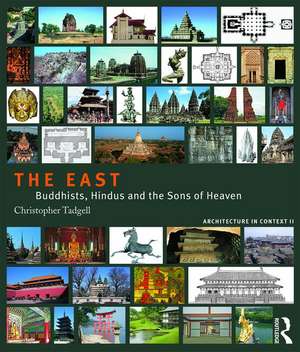
The East: Buddhists, Hindus and the Sons of Heaven: Architecture in Context
Autor Christopher Tadgellen Limba Engleză Paperback – iun 2017
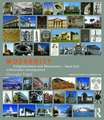
Evoluția istoriografiei arhitecturale a trecut în ultimele decenii de la simpla descriere a monumentelor la o analiză integrată a contextului cultural și politic care le-a generat. Reținem că The East reprezintă un efort enciclopedic de a cartografia tradițiile seminale ale Orientului, fiind al doilea volum din seria Architecture in Context. Cu un aparat vizual impresionant de peste 3300 de ilustrații, lucrarea nu se limitează la estetică, ci investighează modul în care cerințele de cult au modelat spațiul, de la templele hinduse din India până la pagodele din Birmania.
Descoperim aici o structură riguroasă, împărțită între originile subcontinentului indian și expansiunea acestora în Asia de Sud-Est, urmată de analiza tradițiilor conservatoare ale Chinei și Japoniei. Autorul extinde cadrul propus de The Hindu Temple de George Michell cu date noi privind difuzia acestor forme în Java sau Cambodgia, oferind o perspectivă comparativă între monumentalitatea de la Angkor Wat și simplitatea studiată a arhitecturii nipone. Această abordare completează cercetarea din Architecture in the Indian Subcontinent, unde Christopher Tadgell stabilise deja o continuitate între sectele religioase și formele laice.
În contextul operei sale, The East face tranziția necesară de la studiile europene, precum The West sau monografiile despre The Louvre and Versailles, către o înțelegere globală a spațiului construit. Progresia narativă, susținută de un glosar detaliat și o bibliografie extinsă, transformă acest volum dintr-un manual universitar într-o arhivă esențială pentru specialiștii în istoria artei și planificare teritorială, oferind o sinteză între natură, tehnologie și înalte idealuri spirituale.
Preț: 524.66 lei
Preț vechi: 570.28 lei
-8%
Carte disponibilă
Livrare economică 09-23 noiembrie
Livrare express 24-30 octombrie pentru 98.99 lei
Specificații
ISBN-10: 1138038989
Pagini: 912
Ilustrații: 3324
Dimensiuni: 180 x 210 x 58 mm
Greutate: 2.09 kg
Ediția:1
Editura: Taylor & Francis
Colecția Routledge
Seria Architecture in Context
Locul publicării:Oxford, United Kingdom
V-ar putea interesa
-
 -26%Preț: 91.03 lei123.73 lei
-
 The Light of AsiaChristopher HardingPreț: 108.16 lei
-
 -19%Preț: 592.85 lei731.91 lei
-
 -19%Preț: 162.59 lei201.08 lei
-
 The Story of ArchitectureWitold RybczynskiPreț: 231.00 lei
-
 Temples to the Buddha and the GodsSujatha Arundathi Meegama-15%Preț: 483.48 lei568.80 lei
-
 Architecture in the Indian Subcontinent: From the Mauryas to the MughalsChristopher Tadgell-8%Preț: 434.66 lei472.46 lei
-
 Preț: 388.47 lei
-
 Pre-Modern East AsiaPatricia Ebrey-26%Preț: 577.59 lei778.15 lei
-
 -25%Preț: 353.20 lei468.93 lei
-
 The Golden Road: How Ancient India Transformed the WorldWilliam Dalrymple-24%Preț: 83.57 lei110.22 lei
-
 How to Read Buddhist ArtKurt A. BehrendtPreț: 178.55 lei
-
 The Art of BuddhismDenise Patry LeidyPreț: 327.06 lei
-
 A World History of Architecture: Third EditionMarian Moffett-22%Preț: 318.86 lei407.21 lei
-
 AsiaVictoria BurrowsPreț: 154.28 lei
-
 Living in AsiaSunil SethiPreț: 236.72 lei
-
 -15%Preț: 129.14 lei151.05 lei
-
 -18%Preț: 754.93 lei920.66 lei
Public țintă
General, Postgraduate, Professional, Professional Practice & Development, and UndergraduateDe ce să citești această carte
Această lucrare este fundamentală pentru studenții și profesioniștii din arhitectură care doresc să înțeleagă rădăcinile structurale ale Asiei. Prin cele 3324 de ilustrații și analiza contextului social, Christopher Tadgell oferă nu doar o istorie a clădirilor, ci o lecție despre cum ideologia și clima influențează formele durabile. Este o resursă academică de neegalat pentru cei ce studiază patrimoniul mondial și evoluția urbană a Orientului.
Despre autor
Christopher Tadgell este un reputat istoric al arhitecturii, ocupând funcția de lector superior la Kent Institute of Art and Design din Canterbury, Anglia. Cariera sa este marcată de o ambiție academică rară, aceea de a documenta tradițiile arhitecturale globale prin seria Architecture in Context. Expertiza sa acoperă atât neoclasicismul francez, cât și complexitatea siturilor asiatice, Tadgell fiind recunoscut pentru capacitatea de a sintetiza evoluții tehnologice și curente religioase în narațiuni coerente, devenind o voce de referință în cercetarea academică internațională.
Descriere scurtă
The tradition in its exported forms – in Java, Cambodia, Burma and Thailand among other territories – developed in stupendous buildings, producing monuments as fabulous as Angkor Wat and the Shwe-dagon pagoda in Rangoon.
In the second part of the book, the long but conservative traditions of China, Korea and Japan and their spheres of influence are examined, a story of absorption and transformation centred on the walled enclosures of China and the Japanese predilection for informality and artful simplicity.
Not simply a profusely illustrated catalogue of buildings, the book also provides their political, technological, social and cultural contexts. It functions equally well as a detailed and comprehensive narrative, as a collection of the great buildings of the world, and as an archive of themes across time and place.
Cuprins
Recenzii
Notă biografică
Born in Sydney, he studied art history at the Courtauld Institute in London. In 1974 he was awarded his PhD for a thesis on the Neoclassical architectural theorist, Ange-Jacques Gabriel. He subsequently taught in London and at the Kent Institute of Art and Design in Canterbury, with interludes as F.L. Morgan Professor of Architectural Design at the University of Louisville and as a Member of the Institute for Advanced Study, Princeton. He has lectured at academic institutions around the world, including the universities of Princeton, Harvard, Columbia and Cornell, the Graham Foundation in Chicago, and Cambridge University and the Courtauld Institute in the UK. He is a Trustee of the World Monuments Fund, a Fellow of the Society of Antiquaries and a member of both the British and American Societies of Architectural Historians.
His The History of Architecture in India (1990, several reprints, Phaidon) is the definitive one-volume account of the architecture of the subcontinent, while many publications on French architecture include the standard account in Baroque and Rococo Architecture and Decoration (ed. Blunt, 1978, Elek). He has contributed many articles on Indian and French architecture to The Grove Dictionary of Art and other major reference books.