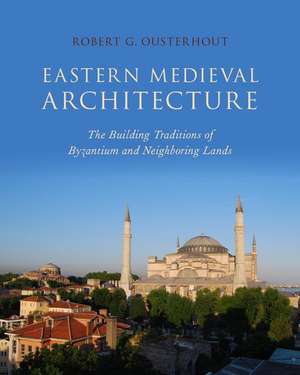
Eastern Medieval Architecture: The Building Traditions of Byzantium and Neighboring Lands: Onassis Series in Hellenic Culture
Autor Robert G. Ousterhouten Limba Engleză Hardback – 10 oct 2019
Descoperim în Eastern Medieval Architecture o lucrare fundamentală care vine să completeze o lacună majoră în literatura academică: înțelegerea limitată a monumentelor din Răsăritul bizantin, deseori eclipsate în studiile de profil de catedralele gotice ale Europei Occidentale. Considerăm că acest volum, publicat în seria Onassis Series in Hellenic Culture, reușește să ofere prima sinteză exhaustivă a tradițiilor constructive care au definit nu doar Constantinopolul, ci și regiuni vaste precum Caucazul, Balcanii, Rusia și zonele de influență islamică timpurie.
Autorul, Robert G. Ousterhout, propune o structură hibridă, alternând riguros între evoluția cronologică și analize tematice care explorează funcționalitatea spațiului și contextul social. Această abordare completează perspectiva oferită de Byzantine Art and Architecture de Lyn Rodley, adăugând o analiză mult mai detaliată a contextului structural și a legăturii dintre arhitectură și geopolitica regiunilor periferice. Față de Medieval Architecture in Western Europe, volumul de față demonstrează de ce arhitectura estică a urmat o traiectorie distinctă, punând accent pe continuitatea antichității târzii și pe adaptabilitatea formelor bizantine în haine culturale diverse.
În contextul operei sale, această lucrare reprezintă punctul culminant al cercetărilor lui Robert G. Ousterhout, integrând expertiza tehnică din Master Builders of Byzantium cu viziunea sa asupra spațiului sacru dezvoltată în Architecture of the Sacred. Cu peste 800 de ilustrații și hărți, ediția de față nu este doar un tratat teoretic, ci un instrument vizual esențial pentru înțelegerea unei moșteniri arhitecturale care a supraviețuit căderii imperiului.

Preț: 592.85 lei
Preț vechi: 731.91 lei
-19%
Carte disponibilă
Livrare economică 07-21 noiembrie
Specificații
ISBN-10: 0190272732
Pagini: 816
Ilustrații: 445 color illus., 368 b/w illus., 6 maps
Dimensiuni: 259 x 208 x 46 mm
Greutate: 2.47 kg
Editura: Oxford University Press
Colecția OUP USA
Seria Onassis Series in Hellenic Culture
Locul publicării:New York, United States
V-ar putea interesa
-
 Saints and Spectacle: Byzantine Mosaics in their Cultural SettingCarolyn L. Connor-31%Preț: 744.55 lei1079.60 lei
 -
 The Framing of Sacred Space: The Canopy and the Byzantine ChurchJelena Bogdanović-27%Preț: 540.45 lei737.31 lei
 -
 Preț: 411.28 lei
 -
 Welcoming FinitudeChristina M. GschwandtnerPreț: 297.41 lei
 -
 The Holy ApostlesMargaret Mullett-13%Preț: 423.90 lei487.23 lei
 -
 The Advanced Montessori Method - The Montessori Elementary MaterialMaria MontessoriPreț: 156.25 lei
 -
 Europa Postmediaevalis 2018Gabriela Blazkova-8%Preț: 453.16 lei492.56 lei
 -
 Preț: 243.78 lei
De ce să citești această carte
Recomandăm această carte istoricilor de artă, arhitecților și studenților care doresc să depășească viziunea eurocentrică asupra Evului Mediu. Cititorul câștigă o înțelegere profundă a modului în care s-au construit identitățile în Balcani și Orient prin intermediul pietrei și al spațiului. Este un manual de referință pentru orice curriculum de istorie a arhitecturii, oferind claritate într-un domeniu complex prin ilustrații de o calitate excepțională.
Despre autor
Robert G. Ousterhout este profesor emerit de Istoria Artei la University of Pennsylvania și o autoritate recunoscută internațional în domeniul arhitecturii bizantine. Cercetările sale s-au concentrat pe documentarea și conservarea patrimoniului fragil din zona mediteraneană, fiind autorul unor studii de referință despre așezările din Cappadocia și monumentele de pe valea râului Meriç. Prin activitatea sa ca director al Center for Ancient Studies, Ousterhout a promovat o abordare interdisciplinară, îmbinând arheologia cu analiza istorică, elemente care se regăsesc din plin în actuala monografie dedicată arhitecturii medievale estice.
Descriere
Recenzii
An engaging exploration of the monuments of the Christian East, as well as the interaction between architecture and the many cultures and intellectual, political, and economic currents that help shape it. Augmented by recommendations for further reading and an extensive bibliography, Eastern Medieval Architecture offers the reader a starting point for study of these structures, as well as a window into an impressive career.... Accessible and affordable, Robert Ousterhout's Eastern Medieval Architecture is a must-have for any teacher or student of architecture, Byzantium, or of the medieval.
It is beautifully written, and filled with the most carefully chosen photographs of structures and details, rendered in glorious colour, and scores of drawings by the author's own hand. If every generation gets the history of Byzantine architecture that it deserves, then ours is very fortunate indeed!
Eastern Medieval Architecture offers a fresh and inviting introduction to the vibrant architectural traditions of the Byzantine Empire and its neighbors. In this learned yet eminently readable volume, Ousterhout masterfully distills a vast amount of specialized research on more than a millennium of architectural production, both sacred and secular. His synthesis of canonical monuments and lesser-known buildings engagingly situates architecture within broader histories of empire, sacred space, craft production, and cultural interaction.
This is the most consequential study of its kind to appear in many years. It will change the way we study and teach Byzantine architecture.
In this much-needed book, Robert Ousterhout provides an up-to-date introduction to the architecture of Byzantium and its neighbors. Diverse and generous in its scope and approach, while at the same time presenting a coherent narrative of a fascinating and complex subject, it will long remain the pre-eminent survey of the field for specialists and non-specialists alike.
A masterful, concise, and eminently readable synthesis of the architectural -- and thus also a key aspect of the cultural -- history of the medieval eastern Roman world and its neighbors. Drawing on his own ground-breaking research, on the original sources (written, material-cultural, and archaeological), and informed by an intimate knowledge of the vast modern literature in the field, Robert Ousterhout has produced an invaluable survey that will undoubtedly be the basic 'go-to' reference work for the subject for many years to come.