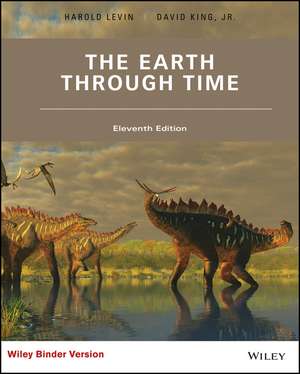
The Earth Through Time
Autor Harold L Levin, David T Kingen Limba Engleză Foi volante – 21 iun 2016
Preț: 866.89 lei
Preț vechi: 1057.19 lei
-18%
Puncte Express: 1300
Carte disponibilă
Livrare economică 10-24 noiembrie
Livrare prin curier în România Termenul estimat este afișat lângă disponibilitate.
Transport gratuit pentru acest produs Plată online sau ramburs, în funcție de opțiunile comenzii.
Retur gratuit în 14 zile Comandă securizată și suport în română.
Specificații
ISBN-13: 9781119228349
ISBN-10: 1119228344
Pagini: 608
Dimensiuni: 215 x 274 x 20 mm
Greutate: 1 kg
Ediția:11th edition
Editura: Wiley
ISBN-10: 1119228344
Pagini: 608
Dimensiuni: 215 x 274 x 20 mm
Greutate: 1 kg
Ediția:11th edition
Editura: Wiley
V-ar putea interesa
-
 Engineering Geology and ConstructionFred G. Bell-18%Preț: 2823.06 lei3442.76 lei
 -
 Hill Geom:Geom Crit Conc Vol 2Mike Kirkby-18%Preț: 2345.44 lei2860.29 lei
 -
 Peri Geom:Geom Crit Conc Vol 5Hugh M. French-18%Preț: 2346.84 lei2862.00 lei
 -
 Arid Land Geom: Geom Crit ConcAndrew S. Goudie-18%Preț: 2338.48 lei2851.80 lei
 -
 How to Read a North Carolina BeachOrrin H. PilkeyPreț: 118.95 lei
 -
 Preț: 105.43 lei
 -
 Preț: 455.48 lei
 -
 Fundamentals of GeobiologyAndrew H. Knoll-19%Preț: 420.72 lei519.41 lei
 -
 Geology and Resources of TitaniumE R. ForcePreț: 116.28 lei
 -
 Geological Prospecting and ExplorationV. M. KreiterPreț: 292.19 lei
 -
 Geological Field TechniquesAngela L. CoePreț: 363.85 lei
 -
 The Handy Geology Answer BookPatricia Barnes-SvarneyPreț: 334.25 lei
 -
 Geologische Streifzüge durch die EifelWolfgang SpielmannPreț: 104.88 lei
Notă biografică
Harold ("Hal") Levin began his career as a petroleum geologist in 1956 after receiving bachelor's and master's degrees from the University of Missouri and a doctorate from Washington University. His fondness for teaching brought him back to Washington University in 1962, where he is currently professor of geology and paleontology in the Department of Earth and Planetary Sciences. His writing efforts include authorship of seven edition of The Earth Through Time, four editions of Contemporary Physical Geology; Essentials of Earth Science and co-authorship of Earth: Past and Present, as well as eight editions of Laboratory Studies in Historical Geology; Life Through Time, and more recently, Ancient Invertebrates and Their Living Relatives.
For his courses in physical geology, historical geology, paleontology, sedimentology, and stratigraphy, Hal has received several awards for excellence in teaching. The accompanying photograph was taken during a lecture on life of the Cenozoic Era. The horse skull serves to illustrate changes in the teeth and jaws of grazing animals in response to the spread of prairies and savannahs during the Miocene and subsequent epochs.
For his courses in physical geology, historical geology, paleontology, sedimentology, and stratigraphy, Hal has received several awards for excellence in teaching. The accompanying photograph was taken during a lecture on life of the Cenozoic Era. The horse skull serves to illustrate changes in the teeth and jaws of grazing animals in response to the spread of prairies and savannahs during the Miocene and subsequent epochs.