The Eagle and the Virgin
Editat de Mary Kay Vaughanen Limba Engleză Paperback – 13 mar 2006
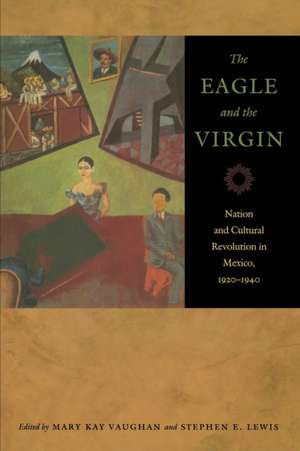
În volumul The Eagle and the Virgin, coordonat de Mary Kay Vaughan și Stephen E. Lewis, observăm o analiză riguroasă a efortului monumental de construcție națională întreprins de Mexic între 1920 și 1940. Această ediție în format paperback de la Duke University Press investighează modul în care guvernul post-revoluționar a cooptat artiștii și intelectualii pentru a crea o identitate mexicană coerentă, capabilă să integreze populațiile indigene și să pregătească țara pentru competiția economică globală. Lucrarea extinde cadrul propus de Crafting Mexico de Rick A López prin examinarea nu doar a artizanatului, ci a unui spectru larg de manifestări culturale, de la muralele lui Diego Rivera până la impactul radioului și al infrastructurii rutiere. Structura volumului este împărțită tematic, începând cu estetica construcției naționale și continuând cu proiectele utopice ale statului. Capitolul introductiv semnat de editori stabilește premisa centrală: negocierea dintre „vultur” (statul secular, modernizator) și „fecioară” (Fecioara de Guadalupe, simbolul rezistenței credinței). Considerăm esențială includerea celor 36 de ilustrații, care documentează vizual trecerea de la arta monumentală a „celor trei mari” muraliști la perspectivele feminine oferite de Frida Kahlo și Maria Izquierdo. Cartea completează datele din Radio Nation de Joy Elizabeth Hayes, integrând rolul mass-media într-un context sociopolitic mai vast. În contextul operei sale, Mary Kay Vaughan continuă aici explorarea politicilor culturale începute în lucrări precum Cultural Politics in Revolution, dar cu o deschidere transnațională mai accentuată. Spre deosebire de Sex in Revolution, unde accentul cade pe gen și sexualitate, volumul de față adoptă o perspectivă multidisciplinară, reunind istorici, specialiști în comunicare și istorici de artă pentru a explica cum miturile și eroii au fost utilizați pentru a transforma țăranii în subiecți productivi ai statului modern.
Preț: 300.73 lei
Carte tipărită la comandă
Livrare economică 08-22 decembrie
Specificații
ISBN-10: 0822336685
Pagini: 396
Ilustrații: 36 illustrations (20 in colour)
Dimensiuni: 158 x 235 x 25 mm
Greutate: 0.58 kg
Editura: Duke University Press
V-ar putea interesa
-
 A World on FireAmanda ForemanPreț: 162.54 lei
 -
 El Lector: A History of the Cigar Factory ReaderAraceli TinajeroPreț: 247.95 lei
 -
 Preț: 400.71 lei
 -
 RatificationPauline MaierPreț: 150.38 lei
 -
 OklahomaW. D. BairdPreț: 135.53 lei
 -
 Unspeakable ViolenceNicole M Guidotti-HernándezPreț: 292.09 lei
 -
 Santa Fe, Its 400th Year (Hardcover)Rob DeanPreț: 235.43 lei
 -
 Everything You Were Taught about the Civil War Is Wrong, Ask a Southerner!Lochlainn SeabrookPreț: 134.49 lei
 -
 Monster EyeballsJacqueline WilsonPreț: 42.98 lei
 -
 Angel in the WhirlwindBenson BobrickPreț: 207.23 lei
 -
 Howard Zinn on HistoryHoward Zinn-6%Preț: 79.48 lei85.00 lei
 -
 9-11: 10th Anniversary EditionNoam Chomsky-20%Preț: 61.61 lei77.30 lei
 -
 Making Haste From BabylonNick BunkerPreț: 122.61 lei
 -
 Preț: 244.59 lei
De ce să citești această carte
Această lucrare este fundamentală pentru cei interesați de sociologia culturii și istoria Americii Latine. Cititorul va înțelege cum simbolurile contradictorii pot fi armonizate pentru a crea o identitate națională durabilă. Este o resursă valoroasă pentru studenții la istoria artei și științe politice, oferind o perspectivă critică asupra modului în care statul utilizează estetica pentru a-și legitima controlul social și modernizarea economică.
Despre autor
Mary Kay Vaughan este profesor emerit de istorie la University of Maryland, College Park, fiind o autoritate recunoscută în studiul Mexicului post-revoluționar. Opera sa, care include titluri precum Portrait of a Young Painter și Sex in Revolution, se concentrează pe intersecția dintre educație, politică și identitate culturală. A fost co-editor al prestigioasei publicații Hispanic American Historical Review. Contribuțiile sale academice sunt dublate de cele ale lui Stephen E. Lewis, specialist în istoria statului Chiapas, oferind împreună o viziune profundă asupra mecanismelor de formare a statului mexican modern.
Descriere scurtă
Cuprins
Acknowledgments ix
Introduction / Mary Kay Vaughan and Stephen E. Lewis 1
I. The Aesthetics of Nation Building
The Noche Mexicana and the Exhibition of Popular Arts:
> The Sickle, the Serpent, and the Soil: History, Revolution, Nationhood, and Modernity in the Murals of Diego Rivera, Jose Clemente Orozco, and David Alfaro Siqueiros / Desmond Rochfort 43
Painting in the Shadow of the Big Three
Frida Kahlo / Sarah M. Lowe 53
Maria Izquierdo / Adrianna Zavala 67
The Mexican Experience of Marion and Grace Greenwood / James Oles 79
Mestizaje and Musical Nationalism in Mexico/ Marco Velazquez and Mary Kay Vaughan 95
Revolution in the City Streets: Changing Nomenclature, Changing Form, and the Revision of Public Memory / Patrice Elizabeth Olsen 119
II. Utopian Projects of the State
Saints, Sinners, and the State Formation: Local Religion and Cultural Revolution in Mexico / Adrian A. Bantjes 137
Nationalizing the Countryside: Schools and Rural Communities in the 1930’s / Mary Kay Vaughan 157
The Nation, Education, and the “Indian Problem” in Mexico, 1920–1940 / Stephen E. Lewis 176
For the Health of the Nation: Gender and the Cultural Politics of Social Hygiene in Revolutionary Mexico / Katherine E. Bliss 196
III. Mass Communication and Nation Building
Remapping Identities: Road Construction and Nation Building in Postrevolutionary Mexico / Wendy Waters 221
National Imaginings on the Air: Radio in Mexico, 1920–1950 / Joy Elizabeth Hayes 243
Screening the Nation / Joanne Hershfield 259
IV. Social Construction of Nations
An Idea of Mexico: Catholics in the Revolution / Jean Meyer 281
Guadalajaran Women and the Construction of National Identity / Maria Teresa Fernandez Aceves 297
“We Are All Mexicans Here”: Workers, Patriotism, and Union Struggles in Monterrey / Michael Snodgrass 314
Final Reflections: What Was Mexico’s Cultural Revolution? / Claudio Lomnitz 335
Contributors 351
Index 357
Recenzii
"Steeped in a generation of new cultural and transnational analysis of state formation and popular expression, The Eagle and the Virgin raises the bar for studies of nation building and cultural politics in postrevolutionary Mexico. Particularly impressive is the volumes sensitive analysis of contests over religious culture and symbols, its gendered understanding of state formation, and its handsomely illustrated treatment of the development of a Mexican revolutionary aesthetic.--Gilbert M. Joseph, coeditor of The Mexico Reader: History, Culture, Politics
"The Eagle and the Virgin is an excellent overview of the different cultural, political and social movements that helped to shape an image for the nation after the Mexican Revolution of 1910. Fabiola Martínez Rodríguez, Art History, Summer 2009
"The Eagle and the Virgin is a necessary book, a selection of essays which allows readers to see in detail how a nation is invented and reinvented, how it experiences its achievements and its customs, both the good and the bad; and how it is internationalized and nationalized (since by 1940 Mexico was both a more cosmopolitan country and a more Mexican one). A delightful work."--Carlos Monsivais "Steeped in a generation of new cultural and transnational analysis of state formation and popular expression, The Eagle and the Virgin raises the bar for studies of nation building and cultural politics in postrevolutionary Mexico. Particularly impressive is the volume's sensitive analysis of contests over religious culture and symbols, its gendered understanding of state formation, and its handsomely illustrated treatment of the development of a Mexican revolutionary aesthetic."--Gilbert M. Joseph, coeditor of The Mexico Reader: History, Culture, Politics "The Eagle and the Virgin is an excellent overview of the different cultural, political and social movements that helped to shape an image for the nation after the Mexican Revolution of 1910." Fabiola Martinez Rodriguez, Art History, Summer 2009