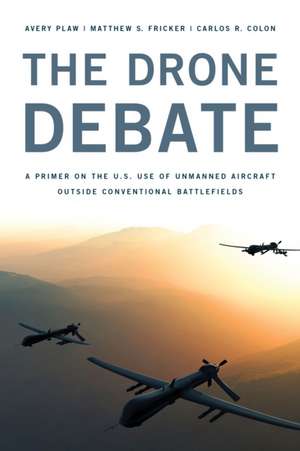
The Drone Debate: A Primer on the U.S. Use of Unmanned Aircraft Outside Conventional Battlefields
Autor Avery Plaw, Matthew S. Fricker, Carlos Colonen Limba Engleză Hardback – 24 dec 2015
Preț: 617.46 lei
Preț vechi: 871.25 lei
-29%
Puncte Express: 926
Carte tipărită la comandă
Livrare economică 03-17 decembrie
Livrare prin curier în România Termenul estimat este afișat lângă disponibilitate.
Transport gratuit pentru acest produs Plată online sau ramburs, în funcție de opțiunile comenzii.
Retur gratuit în 14 zile Comandă securizată și suport în română.
Specificații
ISBN-13: 9781442230583
ISBN-10: 1442230584
Pagini: 356
Ilustrații: 18 tables
Dimensiuni: 150 x 228 x 26 mm
Greutate: 0.66 kg
Editura: Bloomsbury Publishing
Colecția Rowman & Littlefield
Locul publicării:New York, United States
ISBN-10: 1442230584
Pagini: 356
Ilustrații: 18 tables
Dimensiuni: 150 x 228 x 26 mm
Greutate: 0.66 kg
Editura: Bloomsbury Publishing
Colecția Rowman & Littlefield
Locul publicării:New York, United States
Cuprins
Introduction: The Drone Debate
Chapter 1: A Brief Overview of Aerial Drones and their Military Use by the United States
Case Study: The U.S. Drone Campaign in Pakistan
Chapter 2: The Debate over Strategy: Are Drones Helping to Defeat al-Qaeda and Associated Forces?
Case Study: The Drone War in Yemen
Chapter 3: The Debate over Legality: Are Drone Strikes Permissible Under U.S. and International Law?
Case Study: Signature Strikes
Chapter 4: The Ethical Debate: Are Drone Strikes Compatible with the Ideals of Just War?
Case Study: Oversight and Accountability
Chapter 5: The Politics of Drone Strikes: What Political Considerations Shape the U.S. Drone Policy?
Case Study: Interesting Drone Polls
Chapter 6: Emerging Issues: Will Armed Drones Proliferate Rapidly and What Impact Will They Have on International Security?
Case Study: Non-U.S. Drone Strikes
Conclusion: The Age of Drones?
About the Authors
Index
Chapter 1: A Brief Overview of Aerial Drones and their Military Use by the United States
Case Study: The U.S. Drone Campaign in Pakistan
Chapter 2: The Debate over Strategy: Are Drones Helping to Defeat al-Qaeda and Associated Forces?
Case Study: The Drone War in Yemen
Chapter 3: The Debate over Legality: Are Drone Strikes Permissible Under U.S. and International Law?
Case Study: Signature Strikes
Chapter 4: The Ethical Debate: Are Drone Strikes Compatible with the Ideals of Just War?
Case Study: Oversight and Accountability
Chapter 5: The Politics of Drone Strikes: What Political Considerations Shape the U.S. Drone Policy?
Case Study: Interesting Drone Polls
Chapter 6: Emerging Issues: Will Armed Drones Proliferate Rapidly and What Impact Will They Have on International Security?
Case Study: Non-U.S. Drone Strikes
Conclusion: The Age of Drones?
About the Authors
Index
Recenzii
Few political topics have drawn such debate in recent years both domestically and internationally as the continued American military reliance on unmanned aerial vehicles as part of overseas conflict strategy. Plaw, Fricker, and Colon masterfully cover the breadth and depth of drone usage across the globe. By examining drones from the perspectives of military strategy, ethics, and international law, the book avoids falling into any single approach to framing the drone debate-which most similar works unfortunately do. Furthermore, the authors craft a compelling narrative regarding international opinions about the use of drones, although the cited research is restrictive compared to all that is available. Most important, the book is not entirely US-centric; the authors look at how China and Israel use drones in their military strategies. Case studies from different countries focus on patterns and strike types, adding clear examples that help readers understand how complex the drone debate truly is. The book will speak to all readers from drone experts to those simply seeking more knowledge.
Summing Up: Highly recommended. Lower-division undergraduates through faculty.
Some of these books, such as The Drone Debate...provide admirable overviews of the debate. . . .Plaw, Fricker, and Colon provide the most thorough analysis of the available numbers, highlighting the discrepancies between official figures and those reported by independent organizations.
The work contains a detailed analysis and an exhaustive search of open-source, unclassified materials that are accessible to any reader of the work. Their citations are thorough and extremely helpful.. The authors have presented a balanced study of each of their topic areas, and where applicable, have presented all sides of an open debate without forcing the reader to accept their perspective. In that regard, this is a wonderful introduction to the subject of remotely piloted aircraft and how they have been recently utilized by the United States.. This work is a very readable and practical introduction to the key elements of contention regarding the utility of drones in modern conflict.. [I]t is an excellent starting point for scholars seeking to determine the primary schools of thought regarding unmanned vehicles in combat, and is a worthy addition to the shelf of any individual interested in modern warfare, military technology, and the ethics of conflict.
Offers a wealth of fascinating and important analysis of how drones are used in warfare by several countries, and the ways in which these flying weapons will impact the future of global security.
Plaw and Fricker have long been highly respected voices in the contentious debate over U.S. drone use, in no small part due to their excellent empirical research and analytic databases dedicated to shedding light on the notoriously secretive practice of targeted killings. In The Drone Debate, Plaw and Fricker continue their enlightening and important work on this issue, providing a masterful tour de force on the history of drone use and its current implementation across all corners of the globe. It is essential reading for anyone interested in the seemingly ever-rising use of drones and targeted killing as state practice, or anyone who rightly finds these geopolitical life-and-death questions important. Any informed opinion on the matter must necessarily take these experts insights into account.
Summing Up: Highly recommended. Lower-division undergraduates through faculty.
Some of these books, such as The Drone Debate...provide admirable overviews of the debate. . . .Plaw, Fricker, and Colon provide the most thorough analysis of the available numbers, highlighting the discrepancies between official figures and those reported by independent organizations.
The work contains a detailed analysis and an exhaustive search of open-source, unclassified materials that are accessible to any reader of the work. Their citations are thorough and extremely helpful.. The authors have presented a balanced study of each of their topic areas, and where applicable, have presented all sides of an open debate without forcing the reader to accept their perspective. In that regard, this is a wonderful introduction to the subject of remotely piloted aircraft and how they have been recently utilized by the United States.. This work is a very readable and practical introduction to the key elements of contention regarding the utility of drones in modern conflict.. [I]t is an excellent starting point for scholars seeking to determine the primary schools of thought regarding unmanned vehicles in combat, and is a worthy addition to the shelf of any individual interested in modern warfare, military technology, and the ethics of conflict.
Offers a wealth of fascinating and important analysis of how drones are used in warfare by several countries, and the ways in which these flying weapons will impact the future of global security.
Plaw and Fricker have long been highly respected voices in the contentious debate over U.S. drone use, in no small part due to their excellent empirical research and analytic databases dedicated to shedding light on the notoriously secretive practice of targeted killings. In The Drone Debate, Plaw and Fricker continue their enlightening and important work on this issue, providing a masterful tour de force on the history of drone use and its current implementation across all corners of the globe. It is essential reading for anyone interested in the seemingly ever-rising use of drones and targeted killing as state practice, or anyone who rightly finds these geopolitical life-and-death questions important. Any informed opinion on the matter must necessarily take these experts insights into account.