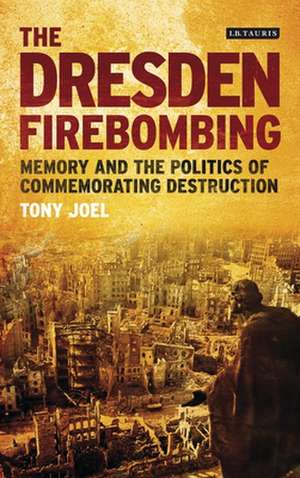
The Dresden Firebombing: Memory and the Politics of Commemorating Destruction
Autor Tony Joelen Limba Engleză Paperback – 30 apr 2020
Preț: 264.60 lei
Preț vechi: 335.06 lei
-21%
Puncte Express: 397
Carte tipărită la comandă
Livrare economică 09-23 decembrie
Livrare prin curier în România Termenul estimat este afișat lângă disponibilitate.
Transport gratuit de la 400.00 lei Plată online sau ramburs, în funcție de opțiunile comenzii.
Retur gratuit în 14 zile Comandă securizată și suport în română.
Specificații
ISBN-13: 9781350159075
ISBN-10: 1350159077
Pagini: 384
Ilustrații: 17 bw illus
Dimensiuni: 138 x 214 x 24 mm
Greutate: 0.96 kg
Editura: Bloomsbury Publishing
Colecția Bloomsbury Academic
Locul publicării:London, United Kingdom
ISBN-10: 1350159077
Pagini: 384
Ilustrații: 17 bw illus
Dimensiuni: 138 x 214 x 24 mm
Greutate: 0.96 kg
Editura: Bloomsbury Publishing
Colecția Bloomsbury Academic
Locul publicării:London, United Kingdom
V-ar putea interesa
-
 -21%Preț: 270.09 lei340.16 lei
 -
 Leningrad 1943: Inside a City Under SiegeNicolas Werth-19%Preț: 329.09 lei404.33 lei
 -
 World War II US Navy Special Warfare UnitsEugene Liptak-31%Preț: 78.85 lei114.90 lei
 -
 A Civil WarClaudio PavonePreț: 323.02 lei
 -
 -31%Preț: 85.01 lei122.87 lei
 -
 Hitler: A Life in PicturesBob CarruthersPreț: 154.47 lei
 -
 Lion RampantRobert Woollcombe-17%Preț: 48.86 lei58.69 lei
 -
 The City of Coventry: A Twentieth Century IconAdrian Smith-25%Preț: 389.25 lei515.97 lei
 -
 Germans Against HitlerHans Mommsen-12%Preț: 148.43 lei167.94 lei
 -
 Preț: 333.82 lei
 -
 The Wartime JournalsHugh Trevor-Roper-10%Preț: 358.34 lei398.58 lei
Cuprins
INTRODUCTION
The Destruction of Dresden and the Shifting Dynamics of German Victimisation Discourse
Dresden as paradigm of German victimisation and sacrifice
Writing about the Dresden bombing and its aftermath
Conceptual framework and key terms
A mythical taboo
Victimisation discourse in divided Germany
Bombing and victimisation discourse in reunified Germany
Application of concepts
CHAPTER 1
The Western Allies' Strategic Bombing Offensive and Dresden's Transformation from European Kulturstadt to Germany's Opferstadt
Build-up
Watershed
Escalation
Why is Dresden special? Or, why Dresden is special
Wartime reactions
Issues of interpretation: shaping and reflecting controversy
Conclusion
CHAPTER 2
The Fashioning of Dresden's Destruction into a Political Asset: 1946 to the Early 1980s
The Nuremberg interregnum
The 1950s
The 1960s
The 1970s and early 1980s
CHAPTER 3
Dresden's Last Milestone Gedenktag before the Fall of the Wall: 13 February 1985
West German mass-mediation of Dresden as Opferstadt
The party's Gro?kundgebung
The reopening of the Semperoper
The Frauenkirche ruins
Conclusion
CHAPTER 4
Dresden Memory Politics in the Schwebezeit: 1989-90
Kohl, the ruins, and "die Einheit der Nation"
Church over ruins?
Dresden's stateless Gedenktag: 13 February 1990
Conclusion
CHAPTER 5
A British Dimension to Dresden Commemorative Politics: 1992-2000
Homage to a hangman, or misunderstood memorialisation?
Dresden: the awkward but obligatory interlude
Britain responds to the Ruf: the Dresden Trust
The 1995 Gedenktag and a signal of intent
The 2000 Gedenktag and making good on a promise
Conclusion
CHAPTER 6
Dresden as a Memory Battleground: 13 February 2005
The Queen and Dresden: revisiting a theme, but not the city
Depicting Dresden as the "Bomben-Holocaust"
Renewed focus on longstanding controversies
Reconciliation remains a central plank
Making a statement in absentia
Mixed messages and the struggle over commemoration
Conclusion
CONCLUSION
Memory Work-in-Progress: Remembering the Past, Reflecting on the Present and Future
NOTES
BIBLIOGRAPHY
The Destruction of Dresden and the Shifting Dynamics of German Victimisation Discourse
Dresden as paradigm of German victimisation and sacrifice
Writing about the Dresden bombing and its aftermath
Conceptual framework and key terms
A mythical taboo
Victimisation discourse in divided Germany
Bombing and victimisation discourse in reunified Germany
Application of concepts
CHAPTER 1
The Western Allies' Strategic Bombing Offensive and Dresden's Transformation from European Kulturstadt to Germany's Opferstadt
Build-up
Watershed
Escalation
Why is Dresden special? Or, why Dresden is special
Wartime reactions
Issues of interpretation: shaping and reflecting controversy
Conclusion
CHAPTER 2
The Fashioning of Dresden's Destruction into a Political Asset: 1946 to the Early 1980s
The Nuremberg interregnum
The 1950s
The 1960s
The 1970s and early 1980s
CHAPTER 3
Dresden's Last Milestone Gedenktag before the Fall of the Wall: 13 February 1985
West German mass-mediation of Dresden as Opferstadt
The party's Gro?kundgebung
The reopening of the Semperoper
The Frauenkirche ruins
Conclusion
CHAPTER 4
Dresden Memory Politics in the Schwebezeit: 1989-90
Kohl, the ruins, and "die Einheit der Nation"
Church over ruins?
Dresden's stateless Gedenktag: 13 February 1990
Conclusion
CHAPTER 5
A British Dimension to Dresden Commemorative Politics: 1992-2000
Homage to a hangman, or misunderstood memorialisation?
Dresden: the awkward but obligatory interlude
Britain responds to the Ruf: the Dresden Trust
The 1995 Gedenktag and a signal of intent
The 2000 Gedenktag and making good on a promise
Conclusion
CHAPTER 6
Dresden as a Memory Battleground: 13 February 2005
The Queen and Dresden: revisiting a theme, but not the city
Depicting Dresden as the "Bomben-Holocaust"
Renewed focus on longstanding controversies
Reconciliation remains a central plank
Making a statement in absentia
Mixed messages and the struggle over commemoration
Conclusion
CONCLUSION
Memory Work-in-Progress: Remembering the Past, Reflecting on the Present and Future
NOTES
BIBLIOGRAPHY