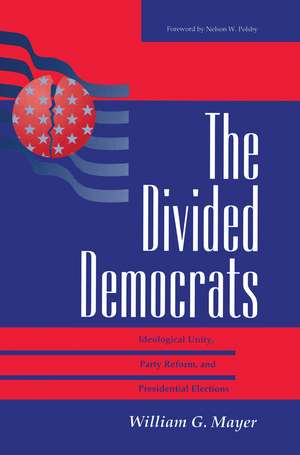
The Divided Democrats: Ideological Unity, Party Reform, And Presidential Elections
Autor William G. Mayeren Limba Engleză Hardback – noi 2019
Preț: 1112.48 lei
Preț vechi: 1356.68 lei
-18%
Puncte Express: 1669
Carte tipărită la comandă
Livrare economică 09-23 noiembrie
Livrare prin curier în România Termenul estimat este afișat lângă disponibilitate.
Transport gratuit pentru acest produs Plată online sau ramburs, în funcție de opțiunile comenzii.
Retur gratuit în 14 zile Comandă securizată și suport în română.
Specificații
ISBN-13: 9780367320300
ISBN-10: 0367320304
Pagini: 236
Dimensiuni: 152 x 229 x 14 mm
Greutate: 0.45 kg
Ediția:1
Editura: Taylor & Francis
Colecția Routledge
Locul publicării:Oxford, United Kingdom
ISBN-10: 0367320304
Pagini: 236
Dimensiuni: 152 x 229 x 14 mm
Greutate: 0.45 kg
Ediția:1
Editura: Taylor & Francis
Colecția Routledge
Locul publicării:Oxford, United Kingdom
V-ar putea interesa
-
 -31%Preț: 851.50 lei1238.58 lei
 -
 Rethinking Political ObligationD. MokrosinskaPreț: 385.54 lei
 -
 Can Russia Modernise?Alena V. LedenevaPreț: 253.21 lei
 -
 The Price of InequalityJoseph E. Stiglitz-18%Preț: 88.03 lei107.41 lei
 -
 A History of Modern LebanonFawwaz TraboulsiPreț: 299.68 lei
 -
 Public OpinionCarroll J. Glynn-15%Preț: 444.64 lei523.11 lei
 -
 -15%Preț: 437.03 lei514.15 lei
 -
 The Power of Scientific KnowledgeReiner GrundmannPreț: 254.80 lei
 -
 U.S. Political & Trade Relations with AfricaGregory D Ferro-27%Preț: 778.07 lei1058.64 lei
 -
 Weekend Voting for Federal Elections: Proposals & ViewsAnthony K Harris-26%Preț: 500.79 lei675.01 lei
 -
 -27%Preț: 998.03 lei1361.43 lei
 -
 -27%Preț: 1243.39 lei1698.52 lei
 -
 -26%Preț: 500.87 lei675.07 lei
 -
 Preț: 110.15 lei
 -
 A Short History of PowerSimon HefferPreț: 112.74 lei
Cuprins
Forthcoming Titles -- Foreword -- Introduction: Party Unity and Presidential Elections -- Do Democratic Rules Make the Nomination Process More Divisive? -- The Divisive Primary Revisited -- Ideological Cohesion in the American Party System -- Ideological Cohesion over Time: The Origin and Evolution of the Party Coalitions -- Group Appeals and the Democratic Coalition -- The Politics of Democratic Disunity -- Variables Used in the Probit Equations in Chapter 3 -- Measuring Ideological Cohesion -- Open-Ended Responses on Group-Related Themes and Issues
Notă biografică
William G. Mayer is assistant professor of political science at Northeastern University.
Descriere
This book argues that Democrats have greater difficulty maintaining party unity than Republicans, chiefly because the Democrats are a more ideologically diverse, less cohesive party. It discusses Democrat's implications for interest groups, party reform, and American politics in general.