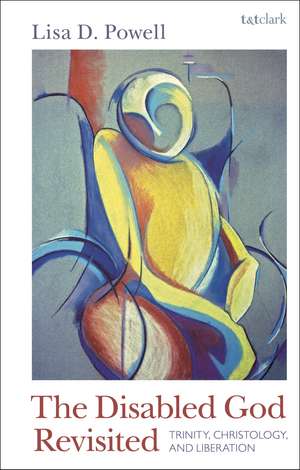
The Disabled God Revisited: Trinity, Christology, and Liberation
Autor Associate Professor Lisa D. Powellen Limba Engleză Paperback – 18 mai 2023
Powell revisits Eiesland's claim about Christ's resurrected body and her conclusions about eschatological embodiment, arguing that it is the able-body that does not persist eschatologically, but all humanity journeys toward ever more transparency, vulnerability and interdependency as the Body of Christ.
Preț: 126.25 lei
Preț vechi: 148.31 lei
-15%
Puncte Express: 189
Carte tipărită la comandă
Livrare economică 05-19 decembrie
Livrare express 03-07 noiembrie pentru 45.84 lei
Livrare prin curier în România Termenul estimat este afișat lângă disponibilitate.
Transport gratuit de la 400.00 lei Plată online sau ramburs, în funcție de opțiunile comenzii.
Retur gratuit în 14 zile Comandă securizată și suport în română.
Specificații
ISBN-13: 9780567694331
ISBN-10: 056769433X
Pagini: 168
Dimensiuni: 214 x 138 x 10 mm
Greutate: 0.3 kg
Editura: Bloomsbury Publishing
Colecția T&T Clark
Locul publicării:London, United Kingdom
ISBN-10: 056769433X
Pagini: 168
Dimensiuni: 214 x 138 x 10 mm
Greutate: 0.3 kg
Editura: Bloomsbury Publishing
Colecția T&T Clark
Locul publicării:London, United Kingdom
Cuprins
Dedication
Acknowledgements
Introduction
Chapter 1:
Nancy Eiesland and the Disabled God
Chapter 2:
Covenant Ontology and The Impaired Body of the Son
Chapter 3:
The Vulnerability and Need of God
Chapter 4:
The Receptivity of God
Chapter 5:
Disability and Resurrection
Bibliography
Index
Acknowledgements
Introduction
Chapter 1:
Nancy Eiesland and the Disabled God
Chapter 2:
Covenant Ontology and The Impaired Body of the Son
Chapter 3:
The Vulnerability and Need of God
Chapter 4:
The Receptivity of God
Chapter 5:
Disability and Resurrection
Bibliography
Index
Recenzii
This book will be of interest not only to disability theologians, but also to those engaged in debates in trinitarian theology and theological anthropology. The brevity and clarity with which it is written make the book accessible to undergraduate students and refreshing to more advanced readers as well. The Disabled God Revisited is a thought-provoking and welcome addition to the growing literature on disability in Christian systematic theology.
Nancy Eiesland's Disabled God has shaped several generations of disability theologians, despite leaving some important theological questions unasked. Gathering together various criticisms in an extremely helpful way, Lisa D. Powell constructively and sympathetically extends Eisland's liberation theology, and shows why the doctrine of God remains generative for a liberative theology today.
Do not let yourself be fooled by the modest title claim! Powell's magnificent book is much more than a mere "revisiting" of Eiesland's landmark Disabled God. Masterfully combining crip theory, queer critique, and Barth's doctrine of election, Powell offers nothing short of a theological ontology of God as disabled, while at the same time pulling the rug out of disability as a human identity category. Finding the triune God constituted in the eternal election of the (impaired body of the) Son, she reclaims receptivity for a kenotic Christology from its feminist critics, develops the ensuing covenantal solidarity with creation, and develops an eschatological vision of deepening mutual interdependence rather than the retention of abled/disabled individuality. The result is a doctrinally sound, critically sourced, and constructively liberationist Christology that will have repercussions across a variety of fields in the years to come.
If Barth's Romans commentary was said to have dropped like a bomb on the playground of theologians, then Powell's The Disabled God Revisited picks up the pieces left by Nancy Eiesland's The Disability God deploying the Barthian shards. Barth studies gets reconfigured and extended, disability theology is fortified, and our understanding of God and ourselves is transformed in the process.
The Disabled God Revisited is a creative and timely intervention into debates about the Trinity, Christology, theological anthropology, and liberation. Skillfully gathering insights from cutting-edge studies of Karl Barth, theologies of disability, and feminist and queer thinkers, while also advancing a powerful constructive perspective of her own, Powell's book will repay close study and inspire valuable conversations.
Powell has provided readers with a rich exploration in The Disabled God Revisited. Of course, in re-envisioning God, our sense of self is also reframed, insofar as disability is seen as received in the broken body of Christ in the Eucharist. This can be profoundly liberating for people with disabilities.
Nancy Eiesland's Disabled God has shaped several generations of disability theologians, despite leaving some important theological questions unasked. Gathering together various criticisms in an extremely helpful way, Lisa D. Powell constructively and sympathetically extends Eisland's liberation theology, and shows why the doctrine of God remains generative for a liberative theology today.
Do not let yourself be fooled by the modest title claim! Powell's magnificent book is much more than a mere "revisiting" of Eiesland's landmark Disabled God. Masterfully combining crip theory, queer critique, and Barth's doctrine of election, Powell offers nothing short of a theological ontology of God as disabled, while at the same time pulling the rug out of disability as a human identity category. Finding the triune God constituted in the eternal election of the (impaired body of the) Son, she reclaims receptivity for a kenotic Christology from its feminist critics, develops the ensuing covenantal solidarity with creation, and develops an eschatological vision of deepening mutual interdependence rather than the retention of abled/disabled individuality. The result is a doctrinally sound, critically sourced, and constructively liberationist Christology that will have repercussions across a variety of fields in the years to come.
If Barth's Romans commentary was said to have dropped like a bomb on the playground of theologians, then Powell's The Disabled God Revisited picks up the pieces left by Nancy Eiesland's The Disability God deploying the Barthian shards. Barth studies gets reconfigured and extended, disability theology is fortified, and our understanding of God and ourselves is transformed in the process.
The Disabled God Revisited is a creative and timely intervention into debates about the Trinity, Christology, theological anthropology, and liberation. Skillfully gathering insights from cutting-edge studies of Karl Barth, theologies of disability, and feminist and queer thinkers, while also advancing a powerful constructive perspective of her own, Powell's book will repay close study and inspire valuable conversations.
Powell has provided readers with a rich exploration in The Disabled God Revisited. Of course, in re-envisioning God, our sense of self is also reframed, insofar as disability is seen as received in the broken body of Christ in the Eucharist. This can be profoundly liberating for people with disabilities.