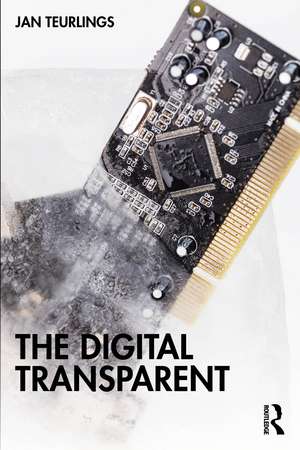
The Digital Transparent
Autor Jan Teurlingsen Limba Engleză Paperback – 2 oct 2026
Using Michel Foucault’s concept of the dispositif, the book demonstrates that transparency arrangements are always selective, partial and strategically constructed. It argues that transparency functions both as an opening up of the platform and as a mechanism that enables platforms to govern. Through dispositif analysis of two key transparency devices—the dashboard and the transparency centre—the book examines YouTube, SoundCloud, Facebook and X.com/Twitter using textual analysis, interface analysis and interviews with YouTubers.
The Digital Transparent is essential reading for students and scholars in media studies, offering a historical perspective on digital platforms that reveals what is genuinely new and what continues from earlier media. It will appeal to those interested in Foucault’s work and its application to contemporary media, researchers in transparency studies seeking critical perspectives on communication and distribution, and platform scholars focused on governance, creative practices and regulation.
Preț: 438.86 lei
Nou
Puncte Express: 658
Carte tipărită la comandă
Livrare economică 03-17 decembrie
Livrare prin curier în România Termenul estimat este afișat lângă disponibilitate.
Transport gratuit pentru acest produs Plată online sau ramburs, în funcție de opțiunile comenzii.
Retur gratuit în 14 zile Comandă securizată și suport în română.
Specificații
ISBN-13: 9781041064367
ISBN-10: 1041064365
Pagini: 162
Ilustrații: 10
Dimensiuni: 156 x 234 mm
Greutate: 0.3 kg
Ediția:1
Editura: Taylor & Francis
Colecția Routledge
Locul publicării:Oxford, United Kingdom
ISBN-10: 1041064365
Pagini: 162
Ilustrații: 10
Dimensiuni: 156 x 234 mm
Greutate: 0.3 kg
Ediția:1
Editura: Taylor & Francis
Colecția Routledge
Locul publicării:Oxford, United Kingdom
Public țintă
Academic, Postgraduate, and Undergraduate AdvancedCuprins
Introduction 1. The Opacity of Dissemination, the Promise of Platforms 2. Transparency The Manifold 3. Platform Metrics as Ways of Knowing the Audience 4. The Uses of Dashboards 5. The Politics of Transparency Centres Conclusion
Recenzii
“This remarkable book will make you think about the internet in a new way. Teurling’s critical history of digital transparency is absorbing and deeply researched. Essential reading for students and scholars in cultural theory, cultural history, and internet studies."
- Ramon Lobato, Professor of Digital Media, Swinburne University of Technology, Melbourne, Australia
"The Digital Transparent is an enlightening read: it connects the historical dots between various types of media (newspaper, cinema, radio, tv) to contemporary modes of distributing digital content. Teurlings’ conceptual acuity and engaging writing style take the reader on a fascinating discovery trip. I recommend this book to all media and communication scholars and students.”
- José van Dijck, Professor of Media and Digital Society, Utrecht University (The Netherlands), author of The Culture of Connectivity and The Platform Society
"Via the important but often neglected concept of transparency, Teurlings does a brilliantly lucid job of comparing a crucial media technology of the twenty first century – the digital platform - with its press, film and broadcasting antecedents. The resulting book deserves to take a central place in the burgeoning field of platform studies."
- David Hesmondhalgh, University of Leeds, UK
- Ramon Lobato, Professor of Digital Media, Swinburne University of Technology, Melbourne, Australia
"The Digital Transparent is an enlightening read: it connects the historical dots between various types of media (newspaper, cinema, radio, tv) to contemporary modes of distributing digital content. Teurlings’ conceptual acuity and engaging writing style take the reader on a fascinating discovery trip. I recommend this book to all media and communication scholars and students.”
- José van Dijck, Professor of Media and Digital Society, Utrecht University (The Netherlands), author of The Culture of Connectivity and The Platform Society
"Via the important but often neglected concept of transparency, Teurlings does a brilliantly lucid job of comparing a crucial media technology of the twenty first century – the digital platform - with its press, film and broadcasting antecedents. The resulting book deserves to take a central place in the burgeoning field of platform studies."
- David Hesmondhalgh, University of Leeds, UK
Notă biografică
Jan Teurlings is Assistant Professor in Media Studies at the University of Amsterdam. He is the co-editor (together with Marijke De Valck) of The Ends of Television (2013). In the last decade, he has repeatedly returned to the relation between media and transparency, as co-editor of special issues of Cultural Studies ↔ Critical Methodologies (2014) and symplokē (2025). The Digital Transparent is the culmination of that research arch.
Descriere
In the 2010s, digital platforms became the dominant way to disseminate media content, promising to make communication transparent in ways that print, cinema, and broadcast never could. The Digital Transparent critically interrogates this claim, arguing that while platforms introduce new transparencies, they also create opacities.