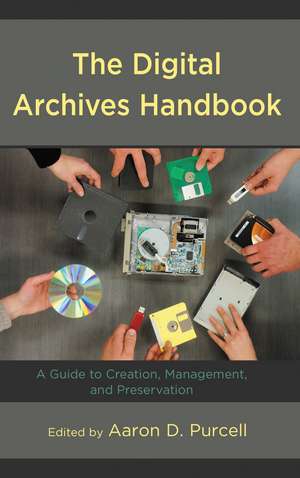
The Digital Archives Handbook: A Guide to Creation, Management, and Preservation
Editat de Aaron D. Purcellen Limba Engleză Hardback – 15 feb 2019
Deși literatura de specialitate abundă în ghiduri tehnice despre stocarea datelor, existau puține resurse care să integreze fluxul de lucru arhivistic tradițional cu noile imperative ale mediului virtual într-o manieră coerentă pentru profesioniști. The Digital Archives Handbook completează această lacună, oferind o foaie de parcurs care echilibrează rigoarea teoretică cu pragmatismul necesar în instituțiile de memorie contemporane. Considerăm că forța acestui manual rezidă în abordarea sa holistică: nu se limitează la software și servere, ci recalibrează rolul arhivistului ca mediator între creatori, donatori și cercetători.
Structura volumului reflectă o progresie logică, de la achiziție și evaluare la conservare și acces. Prima parte, „Processes and Practices”, analizează pilonii gestiunii digitale, inclusiv aspecte critice precum Digital Forensics și drepturile de proprietate intelectuală. Partea a doua oferă o perspectivă aplicată, explorând medii specifice precum înregistrările de istorie orală, arhivele de arhitectură sau provocările unice ale salvării corespondenței electronice (email). Această lucrare completează perspectiva oferită de The Handbook of Archival Practice de Patricia C. Franks, adăugând o profunzime sporită managementului relației cu donatorii și specificului colecțiilor digitale native, pe care volumul lui Franks le tratează într-un context mai larg, hibrid.
În contextul operei sale, Aaron D. Purcell rafinează aici temele explorate în Donors and Archives și Digital Library Programs for Libraries and Archives. Dacă lucrările anterioare se concentrau pe strategii de strângere de fonduri sau proiecte de digitizare punctuale, volumul de față propune o viziune sistemică, transformând proiectele izolate în programe de arhivare digitală sustenabile pe termen lung. Tonul este precis, academic, dar ancorat în realitatea practică a unui director de colecții speciale.
Preț: 658.47 lei
Preț vechi: 974.01 lei
-32%
Carte tipărită la comandă
Livrare economică 06-20 iunie
Specificații
ISBN-10: 1538122375
Pagini: 264
Ilustrații: 1 b/w illustration; 15 b/w photos; 3 tables
Dimensiuni: 158 x 231 x 25 mm
Greutate: 0.54 kg
Editura: Bloomsbury Publishing
Colecția Rowman & Littlefield
Locul publicării:New York, United States
V-ar putea interesa
-
 Oral History: A Very Short IntroductionDouglas A. Boyd-22%Preț: 52.95 lei67.47 lei
 -
 Archiving MachinesAmelia AckerPreț: 311.08 lei
 -
 -23%Preț: 172.43 lei223.50 lei
 -
 Futures of Digital Scholarly EditingMatt CohenPreț: 201.08 lei
 -
 The Little Database: A Poetics of Media FormatsDaniel Scott SnelsonPreț: 175.90 lei
 -
 Organizing Archival Records: A Guide for Both Physical and Digital CollectionsDavid W. Carmicheal-23%Preț: 200.82 lei259.81 lei
 -
 Digital Asset Management for MuseumsMargaret C. McKee-27%Preț: 421.61 lei580.67 lei
 -
 -22%Preț: 260.32 lei334.27 leiNou
 -
 Personal Digital Archiving: Guidance & PerspectivesBeverly Winston-30%Preț: 488.92 lei701.21 lei
 -
 Silence of the ArchiveValerie Johnson-19%Preț: 557.16 lei687.86 lei
 -
 Archives, Second Revised Edition: Principles and PracticesLaura Agnes Millar-19%Preț: 460.84 lei568.93 lei
 -
 The Special Collections HandbookAlison Cullingford-19%Preț: 519.52 lei641.39 lei
 -
 Preț: 292.58 lei
 -
 Fundamentals of Collection Development and ManagementPeggy Johnson-19%Preț: 560.98 lei692.57 lei
 -
 Critical Digital Art HistoryAmanda WasielewskiPreț: 223.07 lei
 -
 Archiving Gaza in the PresentDina MatarPreț: 214.31 lei
 -
 Collection Management BasicsG. Edward Evans-17%Preț: 376.65 lei454.58 lei
De ce să citești această carte
Recomandăm acest manual profesioniștilor care doresc să treacă de la simpla digitizare la un program matur de arhivare digitală. Cititorul câștigă un set clar de bune practici pentru gestionarea formatelor complexe și a problemelor juridice moderne. Este o resursă esențială pentru bibliotecari, arhiviști și curatori care gestionează colecții de istorie orală sau email-uri, oferind soluții scalabile indiferent de dimensiunea instituției.
Despre autor
Aaron D. Purcell este un expert recunoscut în domeniul științelor informației, ocupând funcția de profesor și director al colecțiilor speciale la Virginia Tech. Cu un doctorat în istorie și un master în biblioteconomie (M.L.S.), Purcell îmbină rigoarea cercetării istorice cu expertiza tehnică dobândită în instituții de prestigiu precum Arhivele Naționale și Administrația Documentelor (NARA) din SUA și Biblioteca Națională de Medicină. Experiența sa vastă în lucrul cu donatorii și în managementul arhivelor academice fundamentează abordarea practică din acest manual, transformându-l într-o voce autoritară în peisajul arhivistic internațional.
Descriere
The book discuss the core components of digital archives-the technological infrastructure that provides storage, access, and long-term preservation; the people or organizations that create or donate digital material to archives programs, as well as the researchers use them; and the digital collections themselves, full of significant research content in a variety of formats with a multitude of research possibilities. The chapters emphasize that the people and the collections that make up digital archives are just as important as the technology.
Also highlighted are the importance of donors and creators of digital archives. Building digital archives parallels the cycle of donor work-planning, cultivation, and stewardship. During each stage, archivists work with donors to ensure that the digital collections will be arranged, described, preserved, and made accessible for years to come.
Archivists must take proactive and informed actions to build valuable digital collections. Knowing where digital materials come from, how those materials were created, what materials are important, what formats or topical areas are included, and how to serve those collections to researchers in the long term is central to archival work. This handbook is designed to generate new discussions about how archivists of the twenty-first century can overcome current challenges and chart paths that anticipate, rather than merely react to, future donations of digital archives.
Cuprins
Part I: Processes and Practices
Chapter 1: Acquisitions, Appraisal, and Arrangement
Lisa Calahan
Chapter 2: Description and Delivery
Dorothy Waugh
Chapter 3: Digital Preservation
Bertram Lyons
Chapter 4: Digital Forensics and Curation
Martin Gengenbach
Chapter 5: Contracts, Intellectual Property, and Privacy
Heather Briston
Part II: Collections and Environments
Chapter 6: Performing Arts Collections
Vincent J. Novara
Chapter 7: Oral History Collections
Douglas A. Boyd
Chapter 8: Architectural and Design Collections
Aliza Leventhal
Chapter 9: Congressional Collections
Danielle Emerling
Chapter 10: Email
Matthew Farrell
Recenzii
The goal of this book is to give archivists the tools and confidence to "overcome current challenges and chart paths that anticipate, rather than merely react to, future donations of digital archives" (p. xxiv). These records cannot wait for the ideal situation; archivists must act now by learning about the formats being acquired by their institutions, setting realistic policies and procedures, talking early and often with their donors about expectations and access, documenting the work so future archivists understand their choices and actions, staying abreast of new technologies and tools, and continuously advocating for resources. Archivists have learned to maintain analog collections without the benefit of ideal staffing, funding, or resources, and Purcell wants to empower them to handle digital materials in the same manner. Action is important, andThe Digital Archives Handbookprovides realistic solutions and a way to get started.
The Digital Archives Handbook is a great value to new professionals and experienced archivists alike. In ten chapters, leading practitioners share essential context, real-world experiences, and authoritative guidance on core archival functions, professional standards, and diverse content types. The clear and lucid explanation of the more technical aspects of digital archives will empower readers to tackle their own challenges.
A great donor and access-focused anthology on the fundamentals of managing digital materials, especially for those working in archives that collect from beyond their own institutions. The technical language is accessible and much of the content is scalable to archives of many sizes.