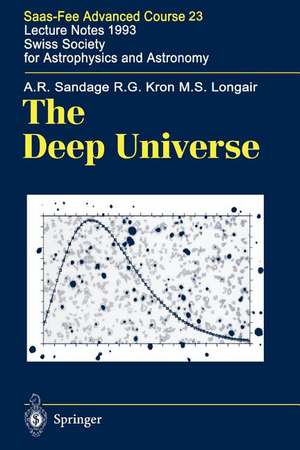
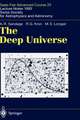
The Deep Universe: Saas-Fee Advanced Course, cartea 23
Autor A. R. Sandage, R. G. Kron, M. S. Longair Editat de Bruno Binggeli, Roland Buseren Limba Engleză Paperback – 24 feb 2011
Din seria Saas-Fee Advanced Course
-
 Preț: 376.27 lei
 -
 Preț: 348.56 lei
 -
 Preț: 419.62 lei
 -
 Preț: 417.93 lei
 - 15%
 Preț: 677.34 lei
 - 15%
 Preț: 633.89 lei
 - 18%
 Preț: 925.95 lei
 - 15%
 Preț: 669.50 lei
 - 20%
 Preț: 646.14 lei
 - 20%
 Preț: 657.99 lei
 - 18%
 Preț: 872.19 lei
 - 20%
 Preț: 627.31 lei
 - 15%
 Preț: 669.20 lei
 - 15%
 Preț: 679.04 lei
 - 15%
 Preț: 622.91 lei
 - 15%
 Preț: 743.40 lei
 - 15%
 Preț: 677.06 lei
 - 15%
 Preț: 666.73 lei
 - 18%
 Preț: 1046.00 lei
 -
 Preț: 405.58 lei
 - 18%
 Preț: 753.43 lei
 -
 Preț: 445.40 lei
 -
 Preț: 395.96 lei
 -
 Preț: 413.84 lei
 - 18%
 Preț: 989.31 lei
 - 23%
 Preț: 717.91 lei
 - 15%
 Preț: 539.16 lei
 -
 Preț: 468.30 lei
Preț: 649.46 lei
Preț vechi: 764.07 lei
-15%
Puncte Express: 974
Carte tipărită la comandă
Livrare economică 23 noiembrie-07 decembrie
Livrare prin curier în România Termenul estimat este afișat lângă disponibilitate.
Transport gratuit pentru acest produs Plată online sau ramburs, în funcție de opțiunile comenzii.
Retur gratuit în 14 zile Comandă securizată și suport în română.
Specificații
ISBN-13: 9783642082092
ISBN-10: 3642082092
Pagini: 544
Ilustrații: XIV, 526 p.
Dimensiuni: 155 x 235 x 30 mm
Greutate: 0.81 kg
Ediția:Softcover reprint of hardcover 1st ed. 1995
Editura: Springer
Colecția Saas-Fee Advanced Course
Seria Saas-Fee Advanced Course
Locul publicării:Berlin, Heidelberg, Germany
ISBN-10: 3642082092
Pagini: 544
Ilustrații: XIV, 526 p.
Dimensiuni: 155 x 235 x 30 mm
Greutate: 0.81 kg
Ediția:Softcover reprint of hardcover 1st ed. 1995
Editura: Springer
Colecția Saas-Fee Advanced Course
Seria Saas-Fee Advanced Course
Locul publicării:Berlin, Heidelberg, Germany
Public țintă
ResearchCuprins
Evolution in the Galaxy Population.- Foundations of Galaxy Evolution Models.- Evolutionary Synthesis Models.- Basic Statistics of Galaxies.- Computing Models for Faint-Galaxy Samples.- Distant Galaxy Observations in the Real World.- Galaxy Profiles at High Redshift.- Reconciling Counts with the Redshift Distribution.- The Butcher-Oemler Effect — A Case Study.- Deep-Universe Programs for the Future.- to the Standard Model.- The Physics of Background Radiation.- Observations of the Extragalactic Background Radiation.- The Robertson-Walker Metric.- World Models.- Number Counts and the Background Radiation.- The Origin of the X-ray and Gamma-ray Backgrounds.- A Brief Thermal History of the Universe.- The Origin of the Large-Scale Structure of the Universe.- Dark Matter and Galaxy Formation.- Fluctuations in the Cosmic Microwave Background Radiation.- The Intergalactic Gas.- Galaxy Formation and the Background Radiation.- The First Test: The Count—Magnitude Relation: Theory and Practice I (The Early Phase 1920–1938).- The Count—Magnitude Relation: Theory and Practice II (The Modern Attempts).- The Second Test: Angular Size = f(z,q0).- The Third Test: The Redshift—Distance Relation Based on the m(z, qo) Hubble Diagram.- Is the Expansion Real?.- The Fourth Test: Timing (Age of the Galaxy).- Timing Test Continued.- The Hubble Constant from Type Ia Supernovae.- Observational Selection Bias.
Textul de pe ultima copertă
This book provides a first-hand account of modern cosmology, written by three celebrated astronomers renowned for their excellence in both research and teaching. The central theme of the book, the deep Universe, is approached in three truly complementary ways: as a coherent and smooth theory embracing the evolution of the Universe from its original radiations emerging from the hot Big Bang to the present structures of matter; as a meandering, rough road paved by our observations of stars, galaxies, and clusters; and in terms of how these approaches have been gradually developed and intertwined in the historical process that led to the modern science of cosmology. The book is written for graduate students in astrophysics but is also of interest to professional astronomers and particle physicists.