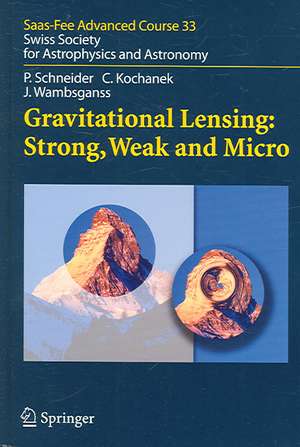
Gravitational Lensing: Strong, Weak and Micro: Saas-Fee Advanced Course, cartea 33
Autor Peter Schneider, Christopher Kochanek, Joachim Wambsganß Editat de Georges Meylan, Philippe Jetzer, Pierre Northen Limba Engleză Hardback – 5 mai 2006
Din seria Saas-Fee Advanced Course
-
 Preț: 376.27 lei
 -
 Preț: 348.56 lei
 -
 Preț: 419.62 lei
 -
 Preț: 417.93 lei
 - 15%
 Preț: 677.34 lei
 - 15%
 Preț: 633.89 lei
 - 15%
 Preț: 649.46 lei
 - 18%
 Preț: 925.95 lei
 - 15%
 Preț: 669.50 lei
 - 20%
 Preț: 646.14 lei
 - 20%
 Preț: 657.99 lei
 - 18%
 Preț: 872.19 lei
 - 20%
 Preț: 627.31 lei
 - 15%
 Preț: 669.20 lei
 - 15%
 Preț: 679.04 lei
 - 15%
 Preț: 622.91 lei
 - 15%
 Preț: 677.06 lei
 - 15%
 Preț: 666.73 lei
 - 18%
 Preț: 1046.00 lei
 -
 Preț: 405.58 lei
 - 18%
 Preț: 733.02 lei
 -
 Preț: 445.40 lei
 -
 Preț: 395.96 lei
 -
 Preț: 413.84 lei
 - 18%
 Preț: 989.31 lei
 - 23%
 Preț: 717.91 lei
 - 15%
 Preț: 539.16 lei
 -
 Preț: 468.30 lei
Preț: 743.40 lei
Preț vechi: 874.59 lei
-15%
Puncte Express: 1115
Carte tipărită la comandă
Livrare economică 23 noiembrie-07 decembrie
Livrare prin curier în România Termenul estimat este afișat lângă disponibilitate.
Transport gratuit pentru acest produs Plată online sau ramburs, în funcție de opțiunile comenzii.
Retur gratuit în 14 zile Comandă securizată și suport în română.
Specificații
ISBN-13: 9783540303091
ISBN-10: 354030309X
Pagini: 572
Ilustrații: XVI, 552 p.
Dimensiuni: 160 x 241 x 41 mm
Greutate: 1.07 kg
Ediția:2006
Editura: Springer
Colecția Saas-Fee Advanced Course
Seria Saas-Fee Advanced Course
Locul publicării:Berlin, Heidelberg, Germany
ISBN-10: 354030309X
Pagini: 572
Ilustrații: XVI, 552 p.
Dimensiuni: 160 x 241 x 41 mm
Greutate: 1.07 kg
Ediția:2006
Editura: Springer
Colecția Saas-Fee Advanced Course
Seria Saas-Fee Advanced Course
Locul publicării:Berlin, Heidelberg, Germany
V-ar putea interesa
-
 Feynman's Lost LectureDavid L Goodstein-33%Preț: 52.70 lei78.65 lei
 -
 The Wall JumperPeter Schneider-28%Preț: 50.94 lei70.66 lei
 -
 The Mathematical Theory of Black HolesS. Chandrasekhar-30%Preț: 666.47 lei958.64 lei
 -
 Flat and Curved Space-TimesG. F. R. Ellis-28%Preț: 508.50 lei707.91 lei
 -
 Astrophysical LasersVladilen Letokhov-31%Preț: 870.64 lei1263.75 lei
 -
 -19%Preț: 286.85 lei352.05 lei
 -
 Berlin NowPeter Schneider-19%Preț: 75.06 lei93.12 lei
 -
 Unmasking EuropaRichard GreenbergPreț: 348.54 lei
 -
 Measuring and Modeling the UniverseWendy L. FreedmanPreț: 373.60 lei
 -
 Physics of the Interstellar and Intergalactic MediumBruce T. Draine-16%Preț: 678.70 lei807.97 lei
 -
 Stellar Spectral ClassificationRichard O. Gray-19%Preț: 657.38 lei811.58 lei
 -
 The Sky Is Not the LimitNeil De Grasse TysonPreț: 120.77 lei
 -
 Astrophysics of the Diffuse UniverseMichael A. Dopita-15%Preț: 616.89 lei725.76 lei
Public țintă
ResearchCuprins
to Gravitational Lensing and Cosmology.- Strong Gravitational Lensing.- Weak Gravitational Lensing.- Gravitational Microlensing.
Textul de pe ultima copertă
The theory, observations, and applications of gravitational lensing constitute one of the most rapidly growing branches of astrophysics. The gravitational deflection of light generated by mass concentrations along a light path produces magnification, multiplicity, and distortion of images and delays photon propagation from one line of sight relative to another. The huge amount of scientific work on gravitational lensing produced over the last decade has clearly revealed its already substantial and wide impact and its potential for future astrophysical applications.
The up-to-date contributions in this book are based on the lecture notes of the 33rd Saas–Fee Advanced Course of the Swiss Society of Astronomy and Astrophysics, entitled Gravitational Lensing: Strong, Weak, and Micro. The book comprises four complementary parts, written by leading experts in the field, constituting a genuine textbook about gravitational lensing:
• Peter Schneider – Part 1: Introduction to Gravitational Lensing and Cosmology
• Christopher Kochanek – Part 2: Strong Gravitational Lensing
• Peter Schneider – Part 3: Weak Gravitational Lensing
• Joachim Wambsganss – Part 4: Gravitational Microlensing
Students and researchers alike will benefit from this comprehensive presentation of the astrophysical and astronomical aspects of gravitational lensing.
The up-to-date contributions in this book are based on the lecture notes of the 33rd Saas–Fee Advanced Course of the Swiss Society of Astronomy and Astrophysics, entitled Gravitational Lensing: Strong, Weak, and Micro. The book comprises four complementary parts, written by leading experts in the field, constituting a genuine textbook about gravitational lensing:
• Peter Schneider – Part 1: Introduction to Gravitational Lensing and Cosmology
• Christopher Kochanek – Part 2: Strong Gravitational Lensing
• Peter Schneider – Part 3: Weak Gravitational Lensing
• Joachim Wambsganss – Part 4: Gravitational Microlensing
Students and researchers alike will benefit from this comprehensive presentation of the astrophysical and astronomical aspects of gravitational lensing.