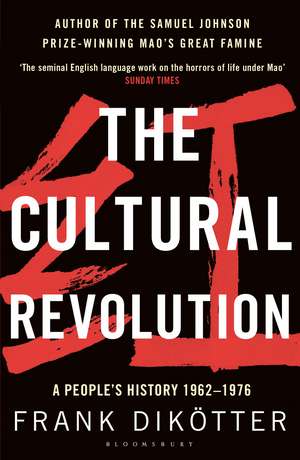
The Cultural Revolution: A People's History, 1962—1976: Bloomsbury Paperbacks
Autor Frank Dikötteren Limba Engleză Paperback – 9 feb 2017
Ne-a atras atenția modul în care Frank Dikötter deschide acest volum prin analiza eșecului economic al „Marelui Salt Înainte”, un eveniment care a servit drept catalizator pentru lansarea Revoluției Culturale. Autorul propune o reevaluare radicală a perioadei 1962–1976, demonstrând că acest proiect ambițios nu a fost doar o mișcare ideologică, ci o strategie a unui lider îmbătrânit de a-și elimina rivalii politici și de a-și securiza moștenirea. Merită menționat că, spre deosebire de relatările standard, The Cultural Revolution oferă voce oamenilor obișnuiți prin interviuri aprofundate, ilustrând cum haosul politic a fost utilizat de populație pentru a resuscita piața liberă și a goli de conținut ideologia partidului.
Putem afirma că forța acestui volum rezidă în accesul fără precedent la documente de arhivă din perioada respectivă, de la rapoarte ale poliției secrete până la versiuni neexpurgate ale discursurilor oficiale. Această abordare factuală oferă o perspectivă nouă asupra modului în care China a devenit un stat-garnizoană, unde epurările violente au afectat până la unul din cincizeci de cetățeni. Cartea servește ca o alternativă documentată la The Origins of the Cultural Revolution pentru cursurile de istoria Asiei, având avantajul utilizării unor surse primare declasificate recent, care infirmă imaginea de conformitate totală a regimului.
În contextul operei autorului, lucrarea încheie magistral trilogia începută cu Mao's Great Famine și continuată cu The Tragedy of Liberation. Dacă lucrările anterioare s-au concentrat pe instaurarea regimului și dezastrul economic, acest volum final sintetizează colapsul ideologic și reziliența socială a poporului chinez. Tonul este precis, academic dar accesibil, transformând datele brute din arhive într-o narațiune coerentă despre supraviețuire și transformare politică.
Din seria Bloomsbury Paperbacks
- 27%
 Preț: 51.74 lei
 - 28%
 Preț: 56.09 lei
 - 28%
 Preț: 55.07 lei
 - 27%
 Preț: 51.60 lei
 - 24%
 Preț: 60.76 lei
 - 27%
 Preț: 51.58 lei
 - 33%
 Preț: 52.17 lei
 - 27%
 Preț: 66.67 lei
 - 28%
 Preț: 66.20 lei
 - 33%
 Preț: 52.95 lei
 - 26%
 Preț: 53.07 lei
 - 32%
 Preț: 53.75 lei
 - 26%
 Preț: 52.68 lei
 - 27%
 Preț: 51.97 lei
 - 27%
 Preț: 57.12 lei
 - 26%
 Preț: 90.23 lei
 - 27%
 Preț: 57.20 lei
 - 32%
 Preț: 62.00 lei
 - 23%
 Preț: 40.00 lei
 - 27%
 Preț: 66.81 lei
 - 26%
 Preț: 52.74 lei
 - 26%
 Preț: 52.37 lei
 - 26%
 Preț: 52.75 lei
 - 26%
 Preț: 69.11 lei
 - 26%
 Preț: 36.66 lei
 - 37%
 Preț: 58.52 lei
 - 27%
 Preț: 56.63 lei
 - 26%
 Preț: 37.23 lei
 - 26%
 Preț: 52.75 lei
 - 37%
 Preț: 58.26 lei
 - 26%
 Preț: 69.77 lei
 - 25%
 Preț: 53.45 lei
 - 24%
 Preț: 54.63 lei
 - 44%
 Preț: 59.29 lei
 - 24%
 Preț: 49.86 lei
 - 22%
 Preț: 51.70 lei
Preț: 79.09 lei
Preț vechi: 107.21 lei
-26%
Carte disponibilă
Livrare economică 23 octombrie-06 noiembrie
Livrare express 08-14 octombrie pentru 54.79 lei
Specificații
ISBN-10: 1408856522
Pagini: 448
Ilustrații: 1 x 16pp B&W plate section
Dimensiuni: 128 x 192 x 34 mm
Greutate: 0.36 kg
Editura: Bloomsbury Publishing
Colecția Bloomsbury Paperbacks
Seria Bloomsbury Paperbacks
Locul publicării:London, United Kingdom
V-ar putea interesa
-
 The Blue FlowerPenelope FitzgeraldPreț: 77.86 lei
 -
 My Family and Other AnimalsGerald Durrell-17%Preț: 48.00 lei57.91 lei
 -
 Birds, Beasts and RelativesGerald Durrell-26%Preț: 62.07 lei84.42 lei
 -
 The Garden of the GodsGerald Durrell-27%Preț: 56.14 lei76.91 lei
 -
 OrthodoxyG. K. Chesterton-18%Preț: 29.30 lei35.91 lei
 -
 The Clothing of BooksJhumpa LahiriPreț: 51.70 lei
 -
 A History of Japan: Revised EditionR. H. P. Mason-19%Preț: 98.61 lei121.51 lei
 -
 AlchemyMarie-Louise Von Franz-5%Preț: 128.05 lei134.79 lei
 -
 -27%Preț: 87.21 lei119.76 lei
 -
 -26%Preț: 89.61 lei121.51 lei
 -
 -34%Preț: 63.48 lei95.49 lei
 -
 Early US Armor: Tanks 1916–40Steven J. Zaloga-42%Preț: 56.60 lei97.74 lei
 -
 -26%Preț: 68.81 lei93.07 lei
 -
 Loco Spotter’s GuideStuart Black-34%Preț: 38.13 lei57.38 lei
 -
 Preț: 92.30 lei
 -
 Horror In The EastLaurence Rees-30%Preț: 64.84 lei92.57 lei
 -
 Philosophy of MindEdward FeserPreț: 78.99 lei
De ce să citești această carte
Această lucrare este esențială pentru oricine dorește să înțeleagă rădăcinile Chinei contemporane dincolo de miturile oficiale. Cititorul câștigă o perspectivă rară asupra modului în care teroarea politică poate genera, în mod paradoxal, baze pentru schimbări economice majore. Este o resursă academică de prim rang pentru studenții la istorie și științe politice, oferind dovezi clare despre mecanismele interne ale unui stat totalitar în criză.
Despre autor
Frank Dikötter este profesor de științe umaniste la Universitatea din Hong Kong și profesor de istorie modernă a Chinei la Universitatea din Londra. Este recunoscut la nivel internațional pentru pionieratul în utilizarea surselor de arhivă chineze, publicând peste zece cărți care au redefinit istoriografia modernă a Asiei. Pentru volumul Mao's Great Famine, a fost distins cu prestigiosul premiu Samuel Johnson în 2011, consolidându-și reputația de cel mai important istoric de limbă engleză specializat în perioada maoistă.
Descriere
'The seminal English language work on the subject' Sunday Times
'A major contribution to scholarship on modern China, one that is unequalled, certainly in the English language . both revealing and rewarding reading - for specialists and non-specialists alike' Literary Review
After the economic disaster of the Great Leap Forward that claimed tens of millions of lives between 1958 and 1962, an ageing Mao launched an ambitious scheme to shore up his reputation and eliminate those he viewed as a threat to his legacy. The stated goal of the Cultural Revolution was to purge the country of bourgeois, capitalist elements he claimed were threatening genuine communist ideology. But the Chairman also used the Cultural Revolution to turn on his colleagues, some of them longstanding comrades-in-arms, subjecting them to public humiliation, imprisonment and torture.
Young students formed Red Guards, vowing to defend the Chairman to the death, but soon rival factions started fighting each other in the streets with semi-automatic weapons in the name of revolutionary purity. As the country descended into chaos, the military intervened, turning China into a garrison state marked by bloody purges that crushed as many as one in fifty people.
When the army itself fell victim to the Cultural Revolution, ordinary people used the political chaos to resurrect the market and hollow out the party's ideology. In short, they buried Maoism. In-depth interviews and archival research at last give voice to the people and the complex choices they faced, undermining the picture of conformity that is often understood to have characterised the last years of Mao's regime. By demonstrating that decollectivisation from below was an unintended consequence of a decade of violent purges and entrenched fear, Frank Dikötter casts China's most tumultuous era in a wholly new light.
Written with unprecedented access to previously classified party documents from secret police reports to unexpurgated versions of leadership speeches, this third chapter in Frank Dikötter's extraordinarily lucid and ground-breaking 'People's Trilogy' is a devastating reassessment of the history of the People's Republic of China.
Recenzii
Dikötter never allows his intense account to degenerate into melodrama. Networks of power and information are carefully traced, revealing a movement that spiralled into general score-settling on such a scale that Mao and his allies had only intermittent control . A fascinating account of how people twisted or resisted the aims of Mao's movement
Definitive and harrowing
Magnificent ... The author gives full acknowledgement to memoirs and scholarly works but it is his own archival research, allied to a piercing critique, that lifts the book to a higher level. He has mastered the details so well that with the most sparing use of description he weaves a vivid tapestry of China at the time . This brilliant book leaves no doubt that Mao almost ruined China and left a legacy of paranoia that still grips its modern dictatorship under the latest autocrat, Xi Jinping
The murderous frenzy of the times, which tore apart friends and families, not to speak of the Communist party itself, is powerfully conveyed
Given the tortuous nature of the event, what contribution does Frank Dikötter's new book make to our understanding of the Cultural Revolution? The answer is an immense one. He sheds important new light on what has long been a dark (in several respects) period in Chinese history ... The Cultural Revolution exposes, in measured prose and well-documented analysis, the impact of communist rule in a period of extraordinary stress, tension and violence, most of it unleashed by the Party itself. Together, these three books, which Dikötter calls the 'People's Trilogy', constitute a major contribution to scholarship on modern China, one that is unequalled, certainly in the English language . There is something simply unanswerable about many of his judgments on the effects of almost seventy years of communism in China. Much of this has to do with his use of documents from official archives in China, to which access is difficult . his patience and endurance must be considerable and his Chinese-language skills formidable .. both revealing and rewarding reading - for specialists and non-specialists alike
Gripping, horrific . A significant event in our understanding of modern China
A fine, sharp study of [a] tumultuous, elusive era . Excellent follow-up to his groundbreaking previous work . Dikötter tells a harrowing tale of unbelievable suffering. A potent combination of precise history and moving examples
Outstanding
Searing
During ten years of insanity, between 1.5m and 2million people lost their lives. It is all chillingly documented in Frank Dikötter's brilliant new book.
Magisterial
His "people's trilogy" . has been hailed as the seminal English language work on the subject. The trilogy's enduring value lies in its unstinting description of the horrors of life under Mao . Dikötter has done much to ensure that we see the full horror of what happened under Mao
A significant event in our understanding of modern China
It includes colourful sketches of famous individuals, a fast-paced account of key political events, and some interesting discussions of how ordinary people experienced and contributed to specific Cultural Revolution episodes . Impressive chapters on the early 1970s that explore and celebrate grassroots developments
A detailed, sober, bleak reminder of the horror and chaos unleashed by Mao Zedong
Superb
What sets Dikötter apart from many other historians of this period is his obsession with detail and insistence on bringing the story back to the individual account . The level of research in Dikötter's book is astonishing ... but the book wears this research lightly, with the human story coming through strongly
Dikötter's well-researched and readable new book on the Cultural Revolution's causes and consequences is a crucial reminder of the tragedies, miscalculations and human costs of Mao's last experiment
A tragic and salutary history
The concluding volume of Dikotter's superb trilogy on Mao Tse-tung's China is deeply disturbing
'An eye-opener and a page-turner'
A revelatory look at a seismic upheaval that has left an indelible imprint on the country