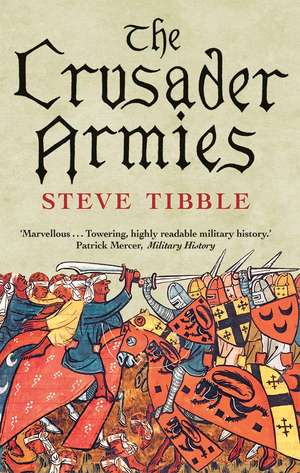
The Crusader Armies: 1099–1187
Autor Steve Tibbleen Limba Engleză Paperback – 30 iun 2020
După parcurgerea acestui volum, cititorul va dobândi o înțelegere nuanțată a mecanismelor militare din spatele primului secol de prezență latină în Levant, fiind capabil să identifice nu doar tacticile de luptă, ci și complexitatea logistică a armatelor cruciate. The Crusader Armies nu este o simplă cronică religioasă, ci o analiză riguroasă a modului în care armatele occidentale și cele musulmane au evoluat reciproc prin adaptare și inovație strategică. Considerăm că forța acestei lucrări rezidă în capacitatea lui Steve Tibble de a integra surse diverse — de la texte musulmane contemporane la dovezi arheologice — pentru a demonstra că aceste forțe erau surprinzător de sofisticate chiar și după standardele moderne.
Suntem de părere că autorul reușește să spargă tiparele istoriografiei clasice prin propunerea unei teze provocatoare: cruciadele au fost influențate masiv de tensiunile dintre societățile sedentare și cele nomade, nu doar de zelul religios. Profesorii și studenții care folosesc Armies of the Crusaders, 1096-1291 de Gabriele Esposito vor aprecia la Steve Tibble profunzimea analizei strategice și modul în care acesta completează perspectiva descriptivă cu una analitică, axată pe cauzalitate socială și politică. Volumul se înscrie organic în opera autorului, rafinând temele explorate în The Crusader Strategy și oferind contextul militar necesar pentru a înțelege structurile descrise în Templars. Textul este susținut de un aparat vizual generos, cu hărți și diagrame care clarifică dinamica frontului, oferind un ritm de lectură alert, deși dens în informație factuală.
Preț: 116.85 lei
Carte disponibilă
Livrare economică 09-23 noiembrie
Livrare express 24-30 octombrie pentru 30.75 lei
Specificații
ISBN-10: 0300253222
Pagini: 424
Ilustrații: 20 color illus. + 21 maps and figs.
Dimensiuni: 127 x 197 x 24 mm
Greutate: 0.48 kg
Editura: Yale University Press
Colecția Yale University Press
De ce să citești această carte
Recomandăm această carte pasionaților de istorie militară și medievaliștilor care caută o perspectivă proaspătă, dincolo de clișeele ideologice. Cititorul câștigă o viziune de ansamblu asupra tehnicilor de asediu, logisticii și diplomației militare din perioada 1099–1187. Este o resursă esențială pentru cei care doresc să înțeleagă cum s-au adaptat ordinele cavalericești la realitățile dure ale Orientului Mijlociu, beneficiind de o cercetare ce include surse arabe adesea ignorate.
Despre autor
Steve Tibble este un istoric de prestigiu, absolvent al Universităților Cambridge și Oxford, specializat în istoria cruciadelor și a ordinelor militare. Activitatea sa academică se concentrează pe demontarea miturilor despre „brutalitatea izolată” a statelor cruciate, preferând să evidențieze planificarea strategică și integrarea lor complexă în peisajul politic al Levantului. Prin lucrări precum Crusader Criminals sau Assassins and Templars, el a explorat diverse fațete ale societății medievale, de la lumea interlopă la organizațiile religioase de elită. Experiența sa în analizarea surselor multiculturale îi permite să ofere o perspectivă echilibrată asupra conflictelor dintre Orient și Occident.
Descriere scurtă
During the Crusades, the Western and Muslim armies developed various highly sophisticated strategies of both attack and defense, which evolved during the course of the battles. In this ambitious new work, Steve Tibble draws on a wide range of Muslim texts and archaeological evidence as well as more commonly cited Western sources to analyze the respective armies’ strategy, adaptation, evolution, and cultural diversity and show just how sophisticated the Crusader armies were even by today’s standards.
In the first comprehensive account of the subject in sixty years, Tibble takes a fresh approach to Templars, Hospitallers, and other key Orders and makes the controversial proposition that the Crusades were driven as much by sedentary versus nomadic tribal concerns as by religious conflict. This fluently written, broad-ranging narrative provides a crucial missing piece in the study of the West’s attempts to colonize the Middle East during the Middle Ages.
Recenzii
“A book that welcomes everyone, regardless of the reader’s background in the subject. . . . Crusade historians like to complain that the general public knows nothing about their scholarship. It is books like this that will change that.”—Thomas F. Madden, Reading Religion
“The Crusader Armies offers more than the obligatory corrections to the historical ignorance of our age. It is a full-scale reassessment of the warfare, armies, and enemies of the Western Crusades in the Middle East. . . . Readable, expertly sourced, and well organized.”—Timothy D. Lusch, Chronicles
“The Crusader Armies: 1099–1187 is a worthy and sound contribution to the literature on its subject. . . . Steve Tibble paints a compelling picture of continual systemic warfare.”—Laurence W. Marvin, Michigan War Studies Review
Selected for Choice’s 2019 Outstanding Academic Titles List
“An extraordinarily vivid and scholarly picture of the clash of arms in the age of the crusades. Tibble demolishes old ideas about crusading warfare with élan.”—John France, author of Perilous Glory
“In this important book which rips away false assumptions and stimulates fresh thinking, Tibble argues that it was climate change on the Asian steppes driving the mass migration of nomadic horsemen which was the determining factor behind the crusades—and not religion nor Western intervention. Remarkable.”—Michael Haag, author of The Tragedy of the Templars
“A fresh and fast-paced study of conflict in the medieval Near East. Tibble challenges us to look anew at crusading warfare and in doing so delivers a compelling, convincing and cleverly-nuanced understanding of this multi-dimensional struggle. An essential read for historians of the Crusades, the Near East and medieval warfare.” Jonathan Phillips, author of The Crusades, 1095–1204
“In this thought-provoking work, Tibble offers a vivid insight into the realities of warfare in twelfth-century Syria and Palestine. He shows how this was a complex world in which attitudes were shaped as much by pragmatism as ideology, and where opportunism was just as important as religious conviction.”—Malcolm Barber, author of The Crusader States