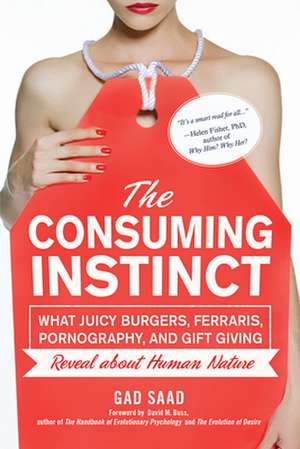
The Consuming Instinct
Autor Gad Saaden Limba Engleză Paperback – 10 sep 2020
Preț: 131.38 lei
Carte disponibilă
Livrare economică 17 noiembrie-01 decembrie
Specificații
ISBN-10: 1633886433
Pagini: 392
Dimensiuni: 152 x 229 x 22 mm
Greutate: 0.66 kg
Editura: Prometheus
V-ar putea interesa
-
 Preț: 142.57 lei
 -
 The Red QueenMatt Ridley-30%Preț: 65.89 lei93.93 lei
 -
 When Everyone Knows That Everyone Knows...Steven PinkerPreț: 137.96 lei
 -
 The Moral Animal: Why We Are The Way We AreRobert Wright-25%Preț: 80.95 lei108.24 lei
 -
 Lecturing Birds on FlyingPablo TrianaPreț: 175.74 lei
 -
 -5%Preț: 59.58 lei62.72 lei
 -
 Human InstinctLord Robert Winston-18%Preț: 76.73 lei93.93 lei
 -
 The Culture CodeClotaire Rapaille-29%Preț: 80.64 lei113.83 lei
 -
 Why We ClickKate MurphyPreț: 178.42 lei
 -
 -10%Preț: 512.41 lei569.34 lei
 -
 Consumer Behavior, Global EditionMichael Solomon-9%Preț: 633.21 lei695.84 lei
 -
 -25%Preț: 91.99 lei122.77 lei
 -
 Preț: 155.31 lei
 -
 Preț: 107.57 lei
 -
 -29%Preț: 75.97 lei106.87 lei
 -
 -19%Preț: 111.02 lei136.91 lei
 -
 MoreishMatt ButtrickPreț: 127.61 lei
 -
 Hacking the Human MindMichaelaaron FlickerPreț: 109.67 lei
 -
 The Sexual EvolutionNathan H. LentsPreț: 145.70 lei
 -
 BuyologyMartin Lindstrom-18%Preț: 70.07 lei85.81 lei
 -
 The One ThingGary KellerPreț: 156.31 lei
 -
 -14%Preț: 60.74 lei70.27 lei
Recenzii
–Psychology Today
"…will appeal to readers interested in the biological basis of human behavior, the age-old debate of nature versus nurture, and especially what makes consumers tick…. clearly essential for marketing professionals, advertisers, and psychologists…"
–Library Journal
"Covering everything from pornography to Wall Street, this thought-provoking title induces readers to take a deep look at how they live."
–Booklist
Descriere
For anyone interested in the biological basis of human behavior or simply in what makes consumers tick—marketing professionals, advertisers, psychology mavens, and consumers themselves—this is a fascinating read.
What do all successful fast-food restaurants have in common?
Why are women more likely to become compulsive shoppers and men more likely to become addicted to pornography?
How does the fashion industry play on our innate need to belong?
Why do men’s testosterone levels rise when they drive a Ferrari or a Porsche?
The answer to all of these intriguing questions is "the consuming instinct," the underlying evolutionary basis for most of our consumer behavior. In this highly informative and entertaining book, the founder of the vibrant new field of evolutionary consumption illuminates the relevance of our biological heritage to our daily lives as consumers. While culture is important, the author shows that innate evolutionary forces deeply influence the foods we eat, the gifts we offer, the cosmetics and clothing styles we choose to make ourselves more attractive to potential mates, and even the cultural products that stimulate our imaginations (such as art, music, and religion). This book demonstrates that most acts of consumption can be mapped onto four key Darwinian drives—namely, survival (we prefer foods high in calories); reproduction (we use products as sexual signals); kin selection (we naturally exchange gifts with family members); and reciprocal altruism (we enjoy offering gifts to close friends). The author further highlights the analogous behaviors that exist between human consumers and a wide range of animals.