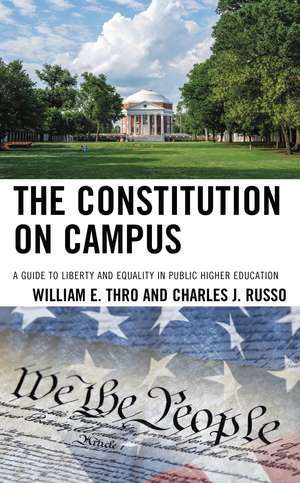
The Constitution on Campus: A Guide to Liberty and Equality in Public Higher Education
Autor William E. Thro, Charles J. Russoen Limba Engleză Hardback – 13 aug 2022
Preț: 367.94 lei
Preț vechi: 462.45 lei
-20%
Puncte Express: 552
Carte tipărită la comandă
Livrare economică 14-28 noiembrie
Livrare prin curier în România Termenul estimat este afișat lângă disponibilitate.
Transport gratuit de la 400.00 lei Plată online sau ramburs, în funcție de opțiunile comenzii.
Retur gratuit în 14 zile Comandă securizată și suport în română.
Specificații
ISBN-13: 9781475856804
ISBN-10: 1475856806
Pagini: 184
Dimensiuni: 159 x 228 x 20 mm
Greutate: 0.44 kg
Editura: Bloomsbury Publishing
Colecția Rowman & Littlefield
Locul publicării:New York, United States
ISBN-10: 1475856806
Pagini: 184
Dimensiuni: 159 x 228 x 20 mm
Greutate: 0.44 kg
Editura: Bloomsbury Publishing
Colecția Rowman & Littlefield
Locul publicării:New York, United States
Cuprins
ACKNOWLEDGEMENTS
INTRODUCTION: NO ANGELS ON CAMPUS: THE IMPORTANCE OF THE CONSTITUTION FOR PUBLIC HIGHER EDUCATION
CHAPTER 1: THE FIXED STAR: THE FREEDOM OF SPEECH
CHAPTER 2: THE FIRST FREEDOM: RELIGIOUS LIBERTY ON CAMPUS
CHAPTER 3: NEITHER KNOWS NOR TOLERATES CLASSES: EQUAL PROTECTION
CHAPTER 4: A FUNDAMENTAL VALUE DETERMINATION: PROCEDURAL DUE PROCESS IN CAMPUS DISCIPLINARY PROCEEDINGS
CHAPTER 5: THE DOUBLE SECURITY: DUAL SOVEREIGNTY AND STATE CONSTITUTIONAL CONSIDERATIONS
CHAPTER 6: THE WILL OF THE PEOPLE, NOT THEIR AGENTS: JUDICIAL ENFORCMENT OF FEDERAL LAW AND IMMUNITY
CONCLUSION: BUT THERE IS US: PUBLIC HIGHER EDUCATION AND HOPE FOR THE CONSTITUTION
BIOGRAPHIES OF THE AUTHORS
APPENDIX I: THE CONSTITUTION OF THE UNITED STATES OF AMERICA
APPENDIX II: ADDITIONAL RESOURCES
INTRODUCTION: NO ANGELS ON CAMPUS: THE IMPORTANCE OF THE CONSTITUTION FOR PUBLIC HIGHER EDUCATION
CHAPTER 1: THE FIXED STAR: THE FREEDOM OF SPEECH
CHAPTER 2: THE FIRST FREEDOM: RELIGIOUS LIBERTY ON CAMPUS
CHAPTER 3: NEITHER KNOWS NOR TOLERATES CLASSES: EQUAL PROTECTION
CHAPTER 4: A FUNDAMENTAL VALUE DETERMINATION: PROCEDURAL DUE PROCESS IN CAMPUS DISCIPLINARY PROCEEDINGS
CHAPTER 5: THE DOUBLE SECURITY: DUAL SOVEREIGNTY AND STATE CONSTITUTIONAL CONSIDERATIONS
CHAPTER 6: THE WILL OF THE PEOPLE, NOT THEIR AGENTS: JUDICIAL ENFORCMENT OF FEDERAL LAW AND IMMUNITY
CONCLUSION: BUT THERE IS US: PUBLIC HIGHER EDUCATION AND HOPE FOR THE CONSTITUTION
BIOGRAPHIES OF THE AUTHORS
APPENDIX I: THE CONSTITUTION OF THE UNITED STATES OF AMERICA
APPENDIX II: ADDITIONAL RESOURCES
Recenzii
College campuses are rapidly changing across America. The modern college and university we see today rapidly have transformed what was once a simple Ivory Tower and a few dorms to become comparable to an everyday city. With great transformation lies even greater challenges. University administrations, state legislatures, and courts across the nation have raced to answer how First Amendment rights should be protected on the modern college campus.
Thro and Russo lend their vast experience and brilliance to present how this daunting question has been answered and transformed higher education law. Importantly, the authors' work can only be described as breathtakingly brilliant due to their ability to ensure people of all levels will understand the need to protect the right once said to be "a reflection of the soul of America."
As an LGBTQ student leader on campus, I was often told that the First Amendment was not meant for people like me. In crafting what is truly a masterpiece, I am thrilled Thro's and Russo's provided institutions and students with this invaluable opportunity to appreciate the Constitution.
From two masters of public higher education law we receive a much-needed tour of the fundamentals of constitutional freedoms and responsibilities at state universities. This book is destined to improve constitutional literacy on campus, particularly among those who have not had the benefit of formal legal training or the vast operational public higher education experience of the authors. The book arrives like cavalry in a John Ford movie, riding in at exactly the moment- as the authors describe-when constitutional norms for public campuses are most under stress, frequently under-appreciated, and at times misunderstood.
The Constitution on Campus: A Guide to Liberty and Equality in Public Higher Education is comprehensive and user-friendly; the authors skillfully address First Amendment freedoms, equal protection and due process rights, state constitutional considerations, and judicial enforcement of federal law and immunity. This book makes a significant contribution to the literature and is a must read for anyone interested in how the U.S. Constitution affects public higher education and all its constituents.
This guide is the north star for anyone who seeks to understand what is and is not constitutionally permissible at a public college or university. Bill and Charlie comprehensively cover how the U.S. Constitution applies in practically every circumstance at a public college or university-from First Amendment considerations such as freedom of speech and academic freedom to the use of race in admissions to the intersection of the U.S. Constitution with anti-discrimination statutes like Title IX. Students, faculty, and staff who are not lawyers finally have a resource to understand the contemporary constitutional landscape because this book is devoid of legalese.
Thro and Russo lend their vast experience and brilliance to present how this daunting question has been answered and transformed higher education law. Importantly, the authors' work can only be described as breathtakingly brilliant due to their ability to ensure people of all levels will understand the need to protect the right once said to be "a reflection of the soul of America."
As an LGBTQ student leader on campus, I was often told that the First Amendment was not meant for people like me. In crafting what is truly a masterpiece, I am thrilled Thro's and Russo's provided institutions and students with this invaluable opportunity to appreciate the Constitution.
From two masters of public higher education law we receive a much-needed tour of the fundamentals of constitutional freedoms and responsibilities at state universities. This book is destined to improve constitutional literacy on campus, particularly among those who have not had the benefit of formal legal training or the vast operational public higher education experience of the authors. The book arrives like cavalry in a John Ford movie, riding in at exactly the moment- as the authors describe-when constitutional norms for public campuses are most under stress, frequently under-appreciated, and at times misunderstood.
The Constitution on Campus: A Guide to Liberty and Equality in Public Higher Education is comprehensive and user-friendly; the authors skillfully address First Amendment freedoms, equal protection and due process rights, state constitutional considerations, and judicial enforcement of federal law and immunity. This book makes a significant contribution to the literature and is a must read for anyone interested in how the U.S. Constitution affects public higher education and all its constituents.
This guide is the north star for anyone who seeks to understand what is and is not constitutionally permissible at a public college or university. Bill and Charlie comprehensively cover how the U.S. Constitution applies in practically every circumstance at a public college or university-from First Amendment considerations such as freedom of speech and academic freedom to the use of race in admissions to the intersection of the U.S. Constitution with anti-discrimination statutes like Title IX. Students, faculty, and staff who are not lawyers finally have a resource to understand the contemporary constitutional landscape because this book is devoid of legalese.
Notă biografică
William E. Thro has served as general counsel of a public land grant research university and public liberal arts school, litigated constitutional issues before the Supreme Court of the United States and the federal appellate courts, taught courses on the Constitution at the undergraduate, and law school levels, and has written extensively on constitutional law in the context of higher education.