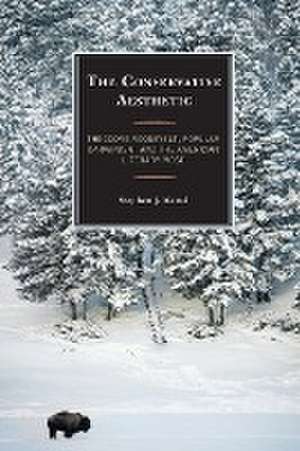
The Conservative Aesthetic: Theodore Roosevelt, Popular Darwinism, and the American Literary West
Autor Stephen J. Mexalen Limba Engleză Paperback – 15 apr 2023
Preț: 260.59 lei
Preț vechi: 352.67 lei
-26%
Puncte Express: 391
Carte tipărită la comandă
Livrare economică 20 noiembrie-04 decembrie
Livrare prin curier în România Termenul estimat este afișat lângă disponibilitate.
Transport gratuit de la 400.00 lei Plată online sau ramburs, în funcție de opțiunile comenzii.
Retur gratuit în 14 zile Comandă securizată și suport în română.
Specificații
ISBN-13: 9781793632630
ISBN-10: 1793632634
Pagini: 364
Dimensiuni: 148 x 226 x 24 mm
Greutate: 0.53 kg
Editura: Bloomsbury Publishing
Colecția Lexington Books
Locul publicării:New York, United States
ISBN-10: 1793632634
Pagini: 364
Dimensiuni: 148 x 226 x 24 mm
Greutate: 0.53 kg
Editura: Bloomsbury Publishing
Colecția Lexington Books
Locul publicării:New York, United States
Cuprins
Introduction: The Old Iron Days
Part I: Gentlemen of the West (1880-1884)
Chapter 1: Roosevelt in the Badlands
Chapter 2: Wister Goes West
Chapter 3: Frederic Remington's Vanishing West
Chapter 4: A Self-Made Man
Chapter 5: Remington and the Art of Scientific Representation
Chapter 6: Wister's Legal Education
Chapter 7: "Buffalo Bill" Cody and the Selling of the West
Part II: The Early History of Conservatism (1689-1880)
Chapter 8: The Nature of Freedom
Chapter 9: Emerson's Great Man Theory of History
Chapter 10: Darwin Comes to America
Chapter 11: The Redeemers, the Socialists, and Conservatism After the Civil War
Part III: Selling a Darwinian West (1884-1890)
Chapter 12: Equal to All Occasions
Chapter 13: Cody and the Queen
Chapter 14: The Cowboy of Dakota
Chapter 15: Remington's Great White West
Chapter 16: Natural Inequality and the Course of Progress
Chapter 17: The Ghost Dance
Part IV: In Search of a Practical History (1890-1895)
Chapter 18: The Johnson County War
Part I: Gentlemen of the West (1880-1884)
Chapter 1: Roosevelt in the Badlands
Chapter 2: Wister Goes West
Chapter 3: Frederic Remington's Vanishing West
Chapter 4: A Self-Made Man
Chapter 5: Remington and the Art of Scientific Representation
Chapter 6: Wister's Legal Education
Chapter 7: "Buffalo Bill" Cody and the Selling of the West
Part II: The Early History of Conservatism (1689-1880)
Chapter 8: The Nature of Freedom
Chapter 9: Emerson's Great Man Theory of History
Chapter 10: Darwin Comes to America
Chapter 11: The Redeemers, the Socialists, and Conservatism After the Civil War
Part III: Selling a Darwinian West (1884-1890)
Chapter 12: Equal to All Occasions
Chapter 13: Cody and the Queen
Chapter 14: The Cowboy of Dakota
Chapter 15: Remington's Great White West
Chapter 16: Natural Inequality and the Course of Progress
Chapter 17: The Ghost Dance
Part IV: In Search of a Practical History (1890-1895)
Chapter 18: The Johnson County War
Recenzii
Mexal fills a gap in this niche study, which looks at the rise in conservatism from a new and different perspective. Rather than focus on the post-WW II political landscape as others have, he argues for the role played by the literary imagination in shaping what he calls the 'conservative aesthetic' that emerged during the late decades of the 19th century. Political figures, especially Theodore Roosevelt, still play a role in Mexal's account, and he examines important literary figures who contributed to the rise of conservatism, prominent among them Ralph Waldo Emerson. But the study is more intellectual history than literary analysis, and Mexal shows how notions such as Darwinism were used to present the American West as the ultimate testing ground by which self-made individuals might distinguish themselves. In so doing, Mexal demonstrates a certain 'natural fitness,' as he puts it, one that flirted with undemocratic ideals such as the natural rule of certain figures over others, and that shaped America in terms of rugged white masculinity. Lucidly written and well argued. Recommended.
How did the aesthetics of a mythic Western ethos shape our past and modern understanding of conservatism? Mexal's eloquently written work answers this timely question. Breaking from histories of conservatism that locate its emergence after WWII, Mexal offers a fresh reading of conservatism as an aesthetic movement, one that was not only born in the political sphere, but in the cultural realms of literature and art. In doing so, he reads known and unknown literatures and histories in fresh and exciting ways, and, in the end, he gives us a study that will be foundational in Western American culture.
The Conservative Aesthetic offers an alternative origin story for modern American conservatism through gathering a set of intersecting stories about Theodore Roosevelt and his circle (including Owen Wister and Frederick Jackson Turner) along with their pungent writings about the American West. Mexal demonstrates that the movement owes a profound imaginative debt to western myth and romance, which the influential men he examines fused with popular understandings of Darwinism. "Telling old stories in new ways," as he aptly puts it, this capacious, exact, deeply researched and yet surprisingly accessible narrative history has much to offer scholars and western enthusiasts alike.
With great narrative skill, Stephen J. Mexal tells an origin story about modern conservatism, which found its aesthetics and sometimes contradictory beliefs about freedom, individualism, and "natural" competition both affirmed and shaped by the landscapes and social conditions of the American West. If we want to understand antidemocratic, racist, and antisocialist tendencies today in our politics, then an important starting point is the one Mexal powerfully illuminates: the encounter with the West by Theodore Roosevelt, Owen Wister, Buffalo Bill, and Frederick Remington. They made the West as an idea conservative and made conservatism feel western.
Stephen Mexal's The Conservative Aesthetic: Theodore Roosevelt, Popular Darwinism, and the American Literary West vividly argues for the recognition of a central foundation of modern conservative ideology in the lives and works of a loosely-affiliated group of 19th-Century writers artists, and western adventurers surrounding Theodore Roosevelt, including Frederic Remington, Owen Wister, Oliver Wendell Holmes, Frederick Jackson Turner, and William Cody. In Mexal's well-crafted readings, "The West" is less a contested historical geography than it is a mythical proving ground that organizes and justifies familiar conservative ideals such as self-reliant masculinity, minimalist government, and a neo-Jeffersonian view of natural aristocracy, even as it nostalgically conceals its investment in the preservation and fortification of white supremacy and gender inequality. Perhaps the most compelling storyline here is Mexal's account of the "slow migration" of Emersonian-style individualism from an anti-establishment concept associated with the political left to a militant axiom of right-wing identity politics-and, in particular, the role of a motivated misreading of Darwin in that ideological migration. While this suggestive book is designed to speak to academic audiences, Mexal's polished, well-crafted prose and lively storytelling style will appeal to a much broader readership.
How did the aesthetics of a mythic Western ethos shape our past and modern understanding of conservatism? Mexal's eloquently written work answers this timely question. Breaking from histories of conservatism that locate its emergence after WWII, Mexal offers a fresh reading of conservatism as an aesthetic movement, one that was not only born in the political sphere, but in the cultural realms of literature and art. In doing so, he reads known and unknown literatures and histories in fresh and exciting ways, and, in the end, he gives us a study that will be foundational in Western American culture.
The Conservative Aesthetic offers an alternative origin story for modern American conservatism through gathering a set of intersecting stories about Theodore Roosevelt and his circle (including Owen Wister and Frederick Jackson Turner) along with their pungent writings about the American West. Mexal demonstrates that the movement owes a profound imaginative debt to western myth and romance, which the influential men he examines fused with popular understandings of Darwinism. "Telling old stories in new ways," as he aptly puts it, this capacious, exact, deeply researched and yet surprisingly accessible narrative history has much to offer scholars and western enthusiasts alike.
With great narrative skill, Stephen J. Mexal tells an origin story about modern conservatism, which found its aesthetics and sometimes contradictory beliefs about freedom, individualism, and "natural" competition both affirmed and shaped by the landscapes and social conditions of the American West. If we want to understand antidemocratic, racist, and antisocialist tendencies today in our politics, then an important starting point is the one Mexal powerfully illuminates: the encounter with the West by Theodore Roosevelt, Owen Wister, Buffalo Bill, and Frederick Remington. They made the West as an idea conservative and made conservatism feel western.
Stephen Mexal's The Conservative Aesthetic: Theodore Roosevelt, Popular Darwinism, and the American Literary West vividly argues for the recognition of a central foundation of modern conservative ideology in the lives and works of a loosely-affiliated group of 19th-Century writers artists, and western adventurers surrounding Theodore Roosevelt, including Frederic Remington, Owen Wister, Oliver Wendell Holmes, Frederick Jackson Turner, and William Cody. In Mexal's well-crafted readings, "The West" is less a contested historical geography than it is a mythical proving ground that organizes and justifies familiar conservative ideals such as self-reliant masculinity, minimalist government, and a neo-Jeffersonian view of natural aristocracy, even as it nostalgically conceals its investment in the preservation and fortification of white supremacy and gender inequality. Perhaps the most compelling storyline here is Mexal's account of the "slow migration" of Emersonian-style individualism from an anti-establishment concept associated with the political left to a militant axiom of right-wing identity politics-and, in particular, the role of a motivated misreading of Darwin in that ideological migration. While this suggestive book is designed to speak to academic audiences, Mexal's polished, well-crafted prose and lively storytelling style will appeal to a much broader readership.