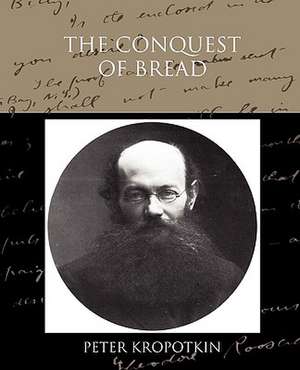
The Conquest of Bread
Autor Peter Kropotkinen Limba Engleză Paperback – 3 aug 2009
Preț: 152.48 lei
Puncte Express: 229
Carte tipărită la comandă
Livrare economică 08-22 decembrie
Livrare prin curier în România Termenul estimat este afișat lângă disponibilitate.
Transport gratuit de la 400.00 lei Plată online sau ramburs, în funcție de opțiunile comenzii.
Retur gratuit în 14 zile Comandă securizată și suport în română.
Specificații
ISBN-13: 9781438523767
ISBN-10: 1438523769
Pagini: 202
Dimensiuni: 191 x 235 x 11 mm
Greutate: 0.39 kg
Editura: BOOK JUNGLE
ISBN-10: 1438523769
Pagini: 202
Dimensiuni: 191 x 235 x 11 mm
Greutate: 0.39 kg
Editura: BOOK JUNGLE
V-ar putea interesa
-
 WeYevgeny Zamyatin-37%Preț: 58.51 lei92.41 lei
 -
 Huis Clos and Other PlaysJean-Paul Sartre-19%Preț: 63.53 lei78.59 lei
 -
 The Origin of the Family, Private Property and the StateFriedrich Engels-19%Preț: 86.22 lei106.47 lei
 -
 Nature and Selected EssaysRalph Waldo Emerson-18%Preț: 77.15 lei93.70 lei
 -
 The Iron HeelJack LondonPreț: 94.34 lei
 -
 AnarchismKropotkin-17%Preț: 88.15 lei105.71 lei
 -
 Preț: 230.39 lei
 -
 ArtemisAndy WeirPreț: 116.14 lei
 -
 -21%Preț: 129.69 lei165.21 lei
 -
 Hard To Be A GodArkady Strugatsky-25%Preț: 59.20 lei79.23 lei
 -
 Erasmus and Luther: The Battle over Free WillClarence H. Miller-16%Preț: 138.03 lei165.25 lei
 -
 Mutual AidPeter KropotkinPreț: 120.32 lei
 -
 Roadside PicnicArkady StrugatskyPreț: 101.33 lei
 -
![The Communist Manifesto [Manifesto of the Communist Party]](https://i1.books-express.ro/bt/9781614273561/the-communist-manifesto-manifesto-of-the-communist-party.jpg) Preț: 34.89 lei
Preț: 34.89 lei -
 CapitalKarl MarxPreț: 50.05 lei
 -
 Human ActsHan KangPreț: 71.62 lei
 -
 Anarcho-Syndicalism: Theory and PracticeRudolf RockerPreț: 68.96 lei
 -
 -17%Preț: 83.84 lei101.27 lei
 -
 Post-scarcity AnarchismMurray BookchinPreț: 105.01 lei
 -
 No Gods No Masters: An Anthology of AnarchismDaniel GuerinPreț: 188.23 lei
 -
 The Ecology Of FreedomMurray BookchinPreț: 151.60 lei
 -
 Le Deuxième Sexe 1Simone de BeauvoirPreț: 114.85 lei
Notă biografică
The fascinating story of a Russian prince-turned-anarchist, Peter Kropotkin (1842-1921). Kropotkin one of the world's first international celebrities. In England, Kropotkin was known as a brilliant scientist, famous for his work on animal and human cooperation, but Kropotkin's fame in continental Europe centered more on his role as a founder and vocal proponent of anarchism. In the United States, he pursued both passions. Tens of thousands of people followed ex-Prince Peter during two speaking tours in America.Kropotkin's path to fame was unexpected and labyrinthine, with asides in prison, breathtaking 50,000-mile journeys through the wastelands of Siberia, and banishment, for one reason or another, from most respectable Western countries of the day. In his homeland of Russia, Peter went from being Czar Alexander II's favored teenage page, to a young man enamored with the theory of evolution, to a convicted felon, jail-breaker and general agitator, eventually being chased halfway around the world by the Russian Secret police for his radical-some might (and did) say enlightened-political views.Both while in jail, and while on the run when he was entertaining and enlightening huge crowds, Kropotkin found the energy and concentration to write books on a dazzling array of topics: evolution and behavior, ethics, the geography of Asia, anarchism, socialism and communism, penal systems, the coming industrial revolution in the East, the French Revolution, and the state of Russian literature. Though seemingly disparate topics, a common thread-the scientific law of mutual aid, which guided the evolution of all life on earth-tied these works together. This law boils down to Kropotkin's deep-seated conviction that what we today would call altruism and cooperation-but what the Prince called mutual aid-was the driving evolutionary force behind all social life, be it in microbes, animals or humans. Today, anthropologists, political scientists, economists and psychologists publish hundreds of studies each year on human cooperation, and researchers in these fields are just beginning to realize that so many of the topics they are investigating were first suggested and promulgated by Peter Kropotkin.
Descriere
Descriere de la o altă ediție sau format:
The Conquest of Bread is Peter Kropotkin's most extensive study of human needs and his outline of the most rational and equitable means of satisfying them. The most important and widely read exposition of anarchist economic theory, its combination of detailed historical analysis and far-reaching utopian vision is a step-by-step guide to social revolution: the concrete means of achieving it and the new world that humanity can create. Writing in a way that he describes as 'moderate in style, but revolutionary in substance,' Kropotkin adeptly translates complex ideas into common language, while rendering the often-amorphous aspirations of social movements into coherent form. Includes an introduction that historically situates and discusses the contemporary relevance of Kropotkin's ideas.
The Conquest of Bread is Peter Kropotkin's most extensive study of human needs and his outline of the most rational and equitable means of satisfying them. The most important and widely read exposition of anarchist economic theory, its combination of detailed historical analysis and far-reaching utopian vision is a step-by-step guide to social revolution: the concrete means of achieving it and the new world that humanity can create. Writing in a way that he describes as 'moderate in style, but revolutionary in substance,' Kropotkin adeptly translates complex ideas into common language, while rendering the often-amorphous aspirations of social movements into coherent form. Includes an introduction that historically situates and discusses the contemporary relevance of Kropotkin's ideas.