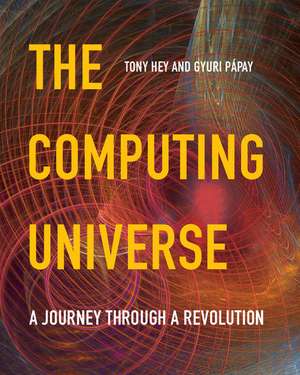
The Computing Universe
Autor Tony Hey, Gyuri Papayen Limba Engleză Paperback – 12 mar 2015
Observăm în The Computing Universe o sinteză remarcabilă realizată de Tony Hey, a cărui experiență la vârful Microsoft Research și colaborarea pentru editarea prelegerilor lui Richard Feynman conferă volumului o autoritate tehnică rară. Tony Hey nu este doar un istoric al tehnologiei, ci un participant activ la ecosistemul digital, coordonând proiecte de eScience și cercetare avansată. Această perspectivă practică se simte în modul în care volumul disecă arhitectura sistemelor moderne, de la hardware la algoritmi complexi. Pe linia practică a lucrării Introduction to the History of Computing, dar cu un focus pronunțat pe fundamentele științifice și pe tranziția către calculul cuantic, această carte se poziționează ca o extensie firească a operei lui Tony Hey. Dacă în The New Quantum Universe autorul explora legile fizicii, aici aplică acea rigoare pentru a explica mecanismele din spatele smartphone-urilor și al inteligenței artificiale. Structura cărții este cronologică și tematică, pornind de la viziunile lui Alan Turing și evoluând spre capitole tehnice despre inginerie software, rețele intergalactice de computere (conceptul lui Licklider) și „partea întunecată” a web-ului. Găsim în cele peste 400 de pagini o documentare vizuală impresionantă, cu aproape 600 de ilustrații color și tabele care transformă conceptele abstracte în diagrame inteligibile. Nu este doar o istorie a dispozitivelor, ci o analiză a modului în care software-ul a modelat societatea, trecând prin era siliciului și anticipând sfârșitul Legii lui Moore. Tonul este unul precis, evitând generalitățile în favoarea explicațiilor despre cum funcționează cu adevărat procesarea limbajului natural sau rețelele neuronale.
Preț: 230.28 lei
Preț vechi: 287.86 lei
-20%
Carte disponibilă
Livrare economică 07-21 noiembrie
Specificații
ISBN-10: 0521150183
Pagini: 414
Ilustrații: 596 colour illus. 20 tables
Dimensiuni: 203 x 254 x 22 mm
Greutate: 0.88 kg
Editura: Cambridge University Press
Locul publicării:New York, United States
V-ar putea interesa
-
 Code: The Hidden Language of Computer Hardware and SoftwareCharles Petzold-20%Preț: 188.58 lei235.72 lei
 -
 Turing's CathedralGeorge Dyson-23%Preț: 83.17 lei108.61 lei
 -
 Computer Science: A Very Short IntroductionSubrata Dasgupta-36%Preț: 47.94 lei75.24 lei
 -
 -20%Preț: 56.65 lei70.95 lei
 -
 The Computer: A Very Short IntroductionDarrel Ince-36%Preț: 48.51 lei75.66 lei
 -
 The Chinese ComputerThomas S. Mullaney-17%Preț: 199.60 lei241.24 lei
 -
 ComputingPaul E. Ceruzzi-16%Preț: 91.70 lei109.36 lei
 -
 A New History of Modern ComputingPaul E. Ceruzzi-24%Preț: 268.72 lei351.66 lei
 -
 Computer Architecture: A Quantitative ApproachJohn L. Hennessy-39%Preț: 534.37 lei882.55 lei
 -
 This Is for EveryoneTim Berners-LeePreț: 122.13 lei
 -
 Science Stories: Coding and ComputersLisa ReganPreț: 74.89 lei
 -
 -20%Preț: 68.43 lei85.50 lei
 -
 -33%Preț: 73.09 lei109.19 lei
 -
 Click, Connect, Compute: Computer Science EssentialsDr Dharini Balasubramaniam-37%Preț: 52.05 lei82.18 lei
 -
 NexusYuval Noah HarariPreț: 94.97 leiRecomandat
 -
 Computer ArchitectureCharles Fox-35%Preț: 302.86 lei467.47 lei
 -
 The Story of ComputingJohn Dermot Turing-20%Preț: 65.93 lei82.42 lei
 -
 The History of the Internet in Byte-Sized ChunksChris Stokel-Walker-29%Preț: 58.59 lei82.40 lei
 -
 The History of the ComputerRachel IgnotofskyPreț: 128.28 lei
 -
 -15%Preț: 576.69 lei678.45 lei
De ce să citești această carte
Recomandăm această carte oricărui pasionat de tehnologie care dorește să înțeleagă arhitectura lumii digitale dincolo de interfața utilizatorului. Cititorul câștigă o perspectivă tehnică solidă asupra modului în care hardware-ul și software-ul au fuzionat pentru a crea realitatea actuală. Este un ghid esențial pentru a înțelege nu doar trecutul informaticii, ci și viitorul dominat de calcul cuantic și AI, explicat de un expert de calibru mondial.
Despre autor
Tony Hey este o figură centrală în lumea cercetării informatice, ocupând funcția de Vicepreședinte la Microsoft Research. Cu peste 150 de lucrări științifice publicate, expertiza sa acoperă fizica particulelor și eScience. Este recunoscut pentru capacitatea de a traduce concepte complexe pentru publicul larg, fiind co-autor al volumelor The New Quantum Universe și Einstein's Mirror. Munca sa de editare pentru Feynman Lectures on Computation demonstrează angajamentul său față de rigoarea academică și educația în domeniul informaticii, elemente care definesc întreaga sa carieră.
Descriere scurtă
Cuprins
Recenzii
'In this lavishly illustrated and refreshingly nonlinear introduction to the people, ideas, machines, and codes that ushered us into the age of computation, Tony Hey and Gyuri Pápay have assembled a comprehensive, authoritative, and nonpartisan account of how we got here, combined with much useful insight into how computers work and what may lie ahead. Although filling a conspicuous need for an introduction to computer science for nonscientists, all scientists - including computer scientists - will find this an illuminating book.' George Dyson, author of Turing's Cathedral: The Origins of the Digital Universe
'Tony Hey and Gyuri Pápay have produced a comprehensive and wonderfully readable guide to the field. The breadth of topics is amazing - from the early history of Babbage and Turing to topics of today, such as botnets and machine learning, to things on the horizon, including quantum computing and synthetic biology. Even an essay on computers in science fiction! There's something here for everyone, from the interested novice to the seasoned computer professional. Each chapter is full of fascinating facts that lend texture and color to the evolution of this change-the-world field.' Ed Lazowska, Bill and Melinda Gates Chair in Computer Science and Engineering, University of Washington, and former Co-Chair, President's Information Technology Advisory Committee
'Tony Hey and Gyuri Pápay have made a major contribution to computing history. This is a must-read for fans of history in any field, and it will absolutely stand the test of time.' John Hollar, CEO, Computer History Museum
'The Computing Universe takes the reader on a panoramic journey through the world of digital computing. Using clear and nontechnical language, it explains the technological breakthroughs, the fundamental concepts, and the future prospects of the digital revolution. It is a work of considerable depth and scholarship, brought to life by many interesting historical vignettes and entertaining anecdotes.' Richard Karp, Turing Award Winner, University of California, Berkeley
'I recommend the book as a highly readable account of the fascinating ideas of computer science and the fascinating people who invented them.' Tony Hoare, Turing Award Winner, Microsoft Research Ltd
'Eloquently presented in a style that assumes little in the way of technical background … this is a celebration of an astonishingly prolific period of technological development, and a book that could act as a gateway for a new generation of innovators and game-changers.' Times Higher Education
'This is a highly engaging book, which will be greatly valued by both computer scientists and the general reader alike. It fills a longstanding lacuna in the literature, ably covering the history and evolution of computers and computing, leading to the modern subject known as computer science. It shows how closely the development of computer science is interleaved with our wider understanding of the world we inhabit. The book will undoubtedly prove to be a source of inspiration for future generations of computer and computational scientists.' Peter Coveney, University College London