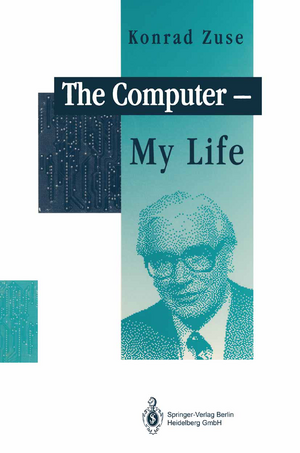
The Computer - My Life
Autor Konrad Zuse Cuvânt înainte de F. L. Bauer Traducere de P. McKenna Cuvânt înainte de H. Zemanek Traducere de J.A. Rossen Limba Engleză Hardback – 28 sep 1993
ACTUALIZAREA: Această ediție în limba engleză (1993) a lucrării The Computer - My Life oferă acces internațional la memoriile lui Konrad Zuse, pionierul care a construit primul calculator funcțional controlat prin program în condiții de război. Subliniem faptul că textul nu este doar o cronică personală, ci un document tehnic ce detaliază tranziția de la mecanisme la electromecanică și apariția primului procesor de proces.
Apreciem rigoarea cu care Konrad Zuse descrie geneza mașinilor Z2, Z3 și Z4. Dacă Konrad Zuse's Early Computers de Raúl Rojas v-a oferit cadrul teoretic și analiza arhitecturală a acestor sisteme, această autobiografie oferă instrumentele practice și contextul decizional din spatele inovațiilor. Notăm cu interes cum autorul explică dezvoltarea „Plankalkül”, un limbaj de programare care a precedat soluțiile software moderne, demonstrând o capacitate analitică remarcabilă în ciuda resurselor limitate din Berlinul anilor '40.
Structura volumului urmează o progresie cronologică și tehnologică clară. Primele capitole documentează studiile și primele invenții, făcând tranziția către miezul tehnic al cărții: dezvoltarea calculatoarelor în timpul celui de-al Doilea Război Mondial și evacuarea modelului Z4 în Göttingen. Ultimele secțiuni analizează aspectele antreprenoriale, de la „Zuse Ingenieurbüro” la integrarea în concernul Siemens, oferind o perspectivă rară asupra industriei de calcul timpurii din Europa. Tonul este unul direct, presărat cu detalii despre colaboratori precum Schreyer și reflecții asupra viitorului informaticii, transformând lectura într-o resursă fundamentală pentru înțelegerea istoriei tehnologiei.
Preț: 398.72 lei
Preț vechi: 498.40 lei
-20%
Carte disponibilă
Livrare economică 14-28 mai
Livrare express 30 aprilie-06 mai pentru 174.99 lei
Specificații
ISBN-10: 3540564535
Pagini: 264
Ilustrații: XIV, 246 p.
Dimensiuni: 155 x 235 x 16 mm
Greutate: 0.57 kg
Ediția:1993
Editura: Springer Berlin, Heidelberg
Colecția Springer
Locul publicării:Berlin, Heidelberg, Germany
V-ar putea interesa
-
 Slide RuleNevil Shute-25%Preț: 57.28 lei76.69 lei
 -
 Turing's CathedralGeorge Dyson-24%Preț: 78.35 lei103.62 lei
 -
 Turing: Pioneer of the Information AgeB. Jack Copeland-20%Preț: 68.15 lei85.49 lei
 -
 The Man from the FutureAnanyo Bhattacharya-19%Preț: 61.29 lei76.06 lei
 -
 The Chinese ComputerThomas S. Mullaney-19%Preț: 186.52 lei230.07 lei
 -
 The Annotated TuringC. Petzold-20%Preț: 149.55 lei186.94 lei
 -
 I, WozSteve Wozniak-27%Preț: 64.95 lei89.34 lei
 -
 This Is for EveryoneTim Berners-LeePreț: 118.41 lei
 -
 Instructions Not Included: How a Team of Women Coded the FutureDebbie Loren Dunn-26%Preț: 76.89 lei104.27 lei
 -
 Machines That Think!Don Brown-21%Preț: 64.19 lei81.56 lei
 -
 -34%Preț: 69.56 lei105.74 lei
 -
 The MANIACBenjamin Labatut-25%Preț: 57.31 lei76.70 lei
 -
 Alan Turing: The Enigma. Film Tie-InAndrew Hodges-28%Preț: 67.28 lei92.90 lei
 -
 Player PianoKurt Vonnegut-19%Preț: 55.76 lei69.16 lei
 -
 Preț: 61.13 lei
 -
 How to Build a SpitfireDavid Price-32%Preț: 124.62 lei183.14 lei
 -
 Twelve Years with HitlerAlbert ZollerPreț: 181.57 lei
 -
 ColossusPaul Gannon-18%Preț: 87.27 lei105.95 lei
 -
 Designing the Computational Image, Imagining Computational DesignDaniel Cardoso Llach-20%Preț: 192.90 lei241.11 lei
 -
 -8%Preț: 540.79 lei587.81 lei
Public țintă
Popular/generalDe ce să citești această carte
Recomandăm această carte inginerilor și istoricilor tehnologiei care doresc să înțeleagă rădăcinile hardware-ului modern direct de la sursă. Cititorul câștigă o perspectivă tehnică asupra modului în care au fost implementate pentru prima dată calculul binar și virgula mobilă. Este un document istoric esențial care demonstrează că inovația de vârf poate apărea chiar și în cele mai potrivnice condiții, oferind lecții valoroase despre perseverență și viziune analitică.
Cuprins
Recenzii
“The book tells the story of an inventor and an entrepreneur. It is refreshing because it allows one to see things outside of the box, beyond the more traditional story, so that he or she can better appreciate key aspects of computing and computation. Furthermore, the book tells the story of a father, a hard worker, and a recognized inventor, including pictures and plenty of anecdotes. … The book is probably the only reliable source about Konrad Zuse’s life and contributions to the world.” (Hector Zenil, ACM Computing Reviews, November, 2011)