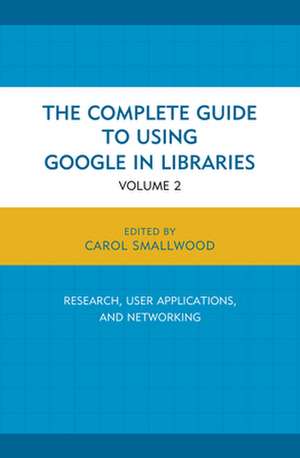
The Complete Guide to Using Google in Libraries: Research, User Applications, and Networking, Volume 2
Autor Carol Smallwooden Limba Engleză Hardback – 6 mar 2015
Google has now developed services far beyond text search. Google software will translate languages and support collaborative writing. The chapters in this book look at many Google services, from music to finance, and describe how they can be used by students and other library users.
Going beyond information resources, there are now successful collaboration services available from Google and others. You can make conference calls with video and shared screens using Google Hangouts,
Writing documents with small numbers of colleagues often involved delays while each author in sequence took over the writing and made edits. Today Google Docs enables multiple people to edit the same document at once. An ingenious use of color lets each participant watch in real time as the other participants edit, and keeps track of who is doing what. If the goal is to create a website rather than to write a report, Google Sites is now one of the most popular platforms. Google is also involved in social networking, with services such as Google+
Other tools view social developments over time and space. The Google Trends service, for example, will show you when and where people are searching for topics. Not surprisingly, searches for "swimwear" peak in June and searches for "snowmobile" peak in January.
The Complete Guide to Using Google in Libraries, Volume 2: Research, User Applications, and Networking has 30 chapters divided into four parts: Research, User Applications, Networking, Searching. The contributors are practitioners who use the services they write about and they provide how-to advice that will help public, school, academic, and special librarians; library consultants, LIS faculty and students, and technology professionals.
Preț: 679.81 lei
Preț vechi: 1005.97 lei
-32%
Puncte Express: 1020
Carte tipărită la comandă
Livrare economică 02-16 noiembrie
Livrare prin curier în România Termenul estimat este afișat lângă disponibilitate.
Transport gratuit pentru acest produs Plată online sau ramburs, în funcție de opțiunile comenzii.
Retur gratuit în 14 zile Comandă securizată și suport în română.
Specificații
ISBN-13: 9781442247864
ISBN-10: 144224786X
Pagini: 332
Ilustrații: 19 BW Photos, 6 Tables
Dimensiuni: 162 x 233 x 29 mm
Greutate: 0.62 kg
Editura: Bloomsbury Publishing
Colecția Rowman & Littlefield
Locul publicării:New York, United States
ISBN-10: 144224786X
Pagini: 332
Ilustrații: 19 BW Photos, 6 Tables
Dimensiuni: 162 x 233 x 29 mm
Greutate: 0.62 kg
Editura: Bloomsbury Publishing
Colecția Rowman & Littlefield
Locul publicării:New York, United States
V-ar putea interesa
-
 The Googlization of EverythingSiva VaidhyanathanPreț: 165.85 lei
 -
 -20%Preț: 111.09 lei138.86 lei
 -
 The Web Ranking ManualTom Mitsoff-20%Preț: 43.91 lei54.89 lei
 -
 Seo Marketing TipsErik L. Devash-20%Preț: 45.89 lei57.36 lei
 -
 Dominate the TopJeffrey Kirk-20%Preț: 98.07 lei122.59 lei
 -
 Seo Starts HerePhilip Cory-20%Preț: 50.41 lei63.00 lei
 -
 -20%Preț: 107.98 lei134.98 lei
 -
 Women on Poetry: Writing, Revising, Publishing and TeachingCarol SmallwoodPreț: 298.96 lei
 -
 The Frugal LibrarianAmerican Library AssociationPreț: 320.79 lei
 -
 Sex on the InternetJody Babydol GibsonPreț: 166.80 lei
 -
 Lily's Odyssey: 20 Tales of Warped ImaginationCarol SmallwoodPreț: 124.05 lei
 -
 How to Get RankedCharly Leetham-20%Preț: 102.09 lei127.61 lei
 -
 Optimize ThisRobert Anspach-20%Preț: 103.39 lei129.24 lei
 -
 FindabilityMR Randy M. Milanovic-20%Preț: 32.66 lei40.83 lei
 -
 -20%Preț: 80.81 lei101.01 lei
 -
 Toreando a GoogleCarreras, Dr Ricardo-20%Preț: 98.63 lei123.29 lei
Cuprins
Preface
Foreword
Acknowledgments
Part I Research
Chapter 1 "Beyond "Good" and "Bad:" Google As a Crucial Component of Information Literacy
Andrew Walsh
Chapter 2 Enhancing Music Collections: YouTube as an Outreach Tool to Share Historic Sheet Music
Steven Pryor, Therese Zoski Dickman, Mary Z. Rose
Chapter 3 Filtering Google Search Results Using Top-Level Domains
John H. Sandy
Chapter 4 Google Digital Literacy Instruction: Richmond Public Library
Natalie Draper
Chapter 5 Google for Music Research: More than Play
Rachel E. Scott and Cody Behles
Chapter 6 Google Translate as a Research Tool
Andrew Wohrley
Chapter 7 Googling for Answers, Grey Literature Sources, and Metrics in the Sciences and Engineering
Giovanna Badia
Chapter 8 Legal Research Using Google Scholar
Ashley Krenelka Chase
Part II User Applications
Chapter 9 Better Images, Better Searchers: Google Images and Visual Literacy in the Sciences and Social Sciences
Melanie Maksin and Kayleigh Bohémier
Chapter 10 Enhancing Information Literacy Instruction with Google Drive
Laksamee Putnam
Chapter 11 Fusion Tables for Librarians and Patrons
Rebecca Freeman
Chapter 12 Google and Transcultural Competence
Alison Hicks
Chapter 13 Google in Special Collections and Archives
Michael Taylor and Jennifer Mitchell
Chapter 14 Public Library Summer Reading Registration on Google Forms
Deloris J. Foxworth and Roseann H. Polashek
Chapter 15 Seeing Libraries Through Google Glasses
Barbara J. Hampton
Chapter 16 YouTube: Advanced Search Strategies and Tools
Julie A. DeCesare
Part III Networking
Chapter 17 Google Tools & Problem-based Instruction: Collaborate, Engage, Assess
Janna Mattson, and Mary Oberlies
Chapter 18 Group Projects Facilitated by Google Collaboration Tools
Michael C. Goates and Gregory M. Nelson
Chapter 19 Real Life Experiences and Narratives
Steven Pryor, Therese Zoski Dickman, Mary Z. Rose
Chapter 20 The Use of Google Sites to Create ePortfolios for Graduate Students as a Means to Promote Reflective Learning in the Development of Dissertation Topics
Jesse Leraas and Susan Huber
Chapter 21 Using Google+ for Networking and Research
Felicia M. Vertrees
Part IV Searching
Chapter 22 Advanced Search Strategies for Google
Teresa U. Berry
Chapter 23 Evaluating the Sources of Search Results
Jennifer Evans
Chapter 24 Free, Easy and Online with Google Sites
John C. Gottfried
Chapter 25 Google Books: Shamed by Snobs, a Resource for the Rest of Us
Susan Whitmer
Chapter 26 Google Drive for Library Users
Sonnet Ireland
Chapter 27 Google Finance
Ashley Faulkner
Chapter 28 Let's Google "Skepticism"; Easy Searches to ExplorePage Rank, Types of Websites, and What Relevance Really Means
Jordan Moore
Chapter 29 Navigating Health Information on Google, Why "I'm Feeling Lucky" isn't Always the Best
Lara Frater
Chapter 30 Underutilized Google Search Tools
Christine Photinos
Bio List
Index
Foreword
Acknowledgments
Part I Research
Chapter 1 "Beyond "Good" and "Bad:" Google As a Crucial Component of Information Literacy
Andrew Walsh
Chapter 2 Enhancing Music Collections: YouTube as an Outreach Tool to Share Historic Sheet Music
Steven Pryor, Therese Zoski Dickman, Mary Z. Rose
Chapter 3 Filtering Google Search Results Using Top-Level Domains
John H. Sandy
Chapter 4 Google Digital Literacy Instruction: Richmond Public Library
Natalie Draper
Chapter 5 Google for Music Research: More than Play
Rachel E. Scott and Cody Behles
Chapter 6 Google Translate as a Research Tool
Andrew Wohrley
Chapter 7 Googling for Answers, Grey Literature Sources, and Metrics in the Sciences and Engineering
Giovanna Badia
Chapter 8 Legal Research Using Google Scholar
Ashley Krenelka Chase
Part II User Applications
Chapter 9 Better Images, Better Searchers: Google Images and Visual Literacy in the Sciences and Social Sciences
Melanie Maksin and Kayleigh Bohémier
Chapter 10 Enhancing Information Literacy Instruction with Google Drive
Laksamee Putnam
Chapter 11 Fusion Tables for Librarians and Patrons
Rebecca Freeman
Chapter 12 Google and Transcultural Competence
Alison Hicks
Chapter 13 Google in Special Collections and Archives
Michael Taylor and Jennifer Mitchell
Chapter 14 Public Library Summer Reading Registration on Google Forms
Deloris J. Foxworth and Roseann H. Polashek
Chapter 15 Seeing Libraries Through Google Glasses
Barbara J. Hampton
Chapter 16 YouTube: Advanced Search Strategies and Tools
Julie A. DeCesare
Part III Networking
Chapter 17 Google Tools & Problem-based Instruction: Collaborate, Engage, Assess
Janna Mattson, and Mary Oberlies
Chapter 18 Group Projects Facilitated by Google Collaboration Tools
Michael C. Goates and Gregory M. Nelson
Chapter 19 Real Life Experiences and Narratives
Steven Pryor, Therese Zoski Dickman, Mary Z. Rose
Chapter 20 The Use of Google Sites to Create ePortfolios for Graduate Students as a Means to Promote Reflective Learning in the Development of Dissertation Topics
Jesse Leraas and Susan Huber
Chapter 21 Using Google+ for Networking and Research
Felicia M. Vertrees
Part IV Searching
Chapter 22 Advanced Search Strategies for Google
Teresa U. Berry
Chapter 23 Evaluating the Sources of Search Results
Jennifer Evans
Chapter 24 Free, Easy and Online with Google Sites
John C. Gottfried
Chapter 25 Google Books: Shamed by Snobs, a Resource for the Rest of Us
Susan Whitmer
Chapter 26 Google Drive for Library Users
Sonnet Ireland
Chapter 27 Google Finance
Ashley Faulkner
Chapter 28 Let's Google "Skepticism"; Easy Searches to ExplorePage Rank, Types of Websites, and What Relevance Really Means
Jordan Moore
Chapter 29 Navigating Health Information on Google, Why "I'm Feeling Lucky" isn't Always the Best
Lara Frater
Chapter 30 Underutilized Google Search Tools
Christine Photinos
Bio List
Index
Recenzii
The Complete Guide to Using Google in Libraries is an edited, two-volume how-toguide to Google tools and services, writtenby library professionals with intimate,hands-on knowledge of their applicationand purpose. Editor Carol Smallwood is aprolific author and editor of library sciencepublications with wide-ranging experiencein school, public, academic, and speciallibraries.. [B]rowsingthe ideas in these two volumes encouragesreaders to think creatively about combiningGoogle tools in ways they may nothave previously considered. This compilationof how-to essays is unique in its widecoverage and specific application to libraryand information professions.. Hampton provides insight on how a related product might alter patrons' perspectives and uses of the library. Given the speed at which technology is changing, readers should take advantage of The Complete Guide to Using Google inLibraries sooner rather than later. Librarians, technologists, and information professionals will gain insight into creatively adapting Google tools and services in new and interesting ways.