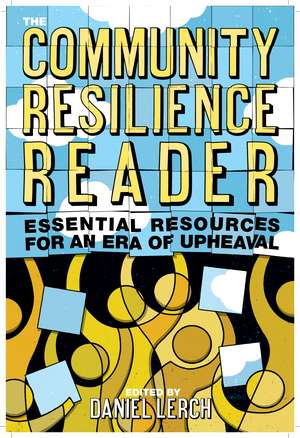
The Community Resilience Reader: Essential Resources for an Era of Upheaval
Editat de Daniel Lerch Contribuţii de Sarah Byrnes, Chuck Collins, Rosemary Cooper, Denise Fairchild, Joshua Farley, Richard Heinberg, Leena Iyengar, Mike Lydon, Asher Miller, Stephanie Mills, William Rees, Margaret Robertson, David Salt, Scott Sawyer, Howard Silverman, William Throop, Brian Walker PhD, Al Weinrub, Rebecca Wodderen Limba Engleză Paperback – 12 oct 2017
Sub coordonarea editorială a lui Daniel Lerch, un specialist dedicat regenerării spațiilor publice, The Community Resilience Reader se prezintă ca un manual de supraviețuire și reconstrucție pentru o epocă a turbulențelor. Ne-a atras atenția modul în care editorul a reușit să armonizeze perspectivele a peste douăzeci de experți — de la analiști politici la designeri urbani — într-un discurs coerent despre vulnerabilitatea și forța comunităților locale. Experiența de lectură este una densă, dar extrem de bine structurată, pornind de la o diagnoză severă a crizelor de mediu și economice în prima parte, pentru a oferi, în a doua jumătate, un set de instrumente pragmatice bazate pe știința rezilienței.
Simțim în aceste pagini o trecere de la teoretizarea sustenabilității de ieri la nevoia de adaptare imediată de azi. Cele 14 ilustrații incluse nu sunt simple adaosuri vizuale, ci ancore care ajută la vizualizarea unor sisteme complexe. Complementar lui [[ECO]systems of Resilience Practices](book), care pune accent pe designul teritorial, lucrarea de față se concentrează mai mult pe factorul uman și pe „alfabetizarea sistemelor”, oferind o perspectivă sociopolitică mai pronunțată. Dacă în The Energy Reader, autorul Richard Heinberg analiza devastarea cauzată de setea de resurse, aici contribuția sa se integrează într-un efort colectiv de a găsi soluții regenerabile.
Reținem că reziliența este prezentată nu ca o stare de fapt, ci ca o capacitate ce trebuie construită activ. Este un volum care nu se mulțumește să descrie colapsul, ci invită la o transformare profundă a modului în care locuim și interacționăm, fiind o resursă esențială pentru cei care caută să înțeleagă mecanismele schimbării într-o lume în continuă prefacere.
Preț: 259.53 lei
Carte disponibilă
Livrare economică 12-26 iunie
Livrare express 28 mai-03 iunie pentru 31.58 lei
Specificații
ISBN-10: 1610918606
Pagini: 336
Ilustrații: 14 illustrations
Dimensiuni: 152 x 229 x 20 mm
Greutate: 0.45 kg
Ediția:None
Editura: Island Press
Colecția Island Press
V-ar putea interesa
-
 -33%Preț: 544.62 lei818.55 lei
 -
 Design for ResilienceStuart Walker-18%Preț: 198.18 lei241.10 lei
 -
 Preț: 155.90 lei
 -
 New Directions in Sustainable DesignAdrian Parr-8%Preț: 453.52 lei492.96 lei
 -
 SanctuaryEmily Rapp BlackPreț: 146.30 lei
 -
 Resilience: Why Things Bounce BackAndrew Zolli-8%Preț: 70.73 lei76.85 lei
 -
 Rifkin, J: Age of ResilienceJeremy RifkinPreț: 205.58 lei
 -
 Permacrisis: A Plan to Fix a Fractured WorldGordon Brown-20%Preț: 62.91 lei78.43 lei
 -
 Sink or Swim: How the world needs to adapt to a changing climateSusannah Fisher-27%Preț: 97.38 lei133.58 lei
 -
 A Liveable Future is PossibleNoam ChomskyPreț: 77.73 lei
 -
 Climate ResilienceKylie FlanaganPreț: 115.06 lei
 -
 Climate Action for Busy PeopleCate Mingoya-LaFortunePreț: 183.76 lei
 -
 LifehouseAdam GreenfieldPreț: 90.78 lei
 -
 -41%Preț: 84.92 lei143.89 lei
 -
 How to Fall in Love with the FutureRob HopkinsPreț: 156.21 lei
 -
 -20%Preț: 57.15 lei71.26 leiRecomandat
 -
 -5%Preț: 291.64 lei306.99 lei
 -
 Preț: 419.74 lei
 -
 Risk and Resilience in the Era of Climate ChangeVinod ThomasPreț: 200.41 lei
 -
 No Straight Road Takes You ThereRebecca SolnitPreț: 87.61 lei
De ce să citești această carte
Această carte este o resursă fundamentală pentru liderii locali, studenții de la urbanism și cetățenii activi care vor să treacă de la îngrijorare la acțiune. Cititorul câștigă o înțelegere clară a modului în care crizele de energie, echitate și mediu sunt interconectate, primind în schimb soluții concrete pentru a construi comunități mai puternice. Este un ghid practic care demonstrează că, deși problemele globale sunt vaste, soluțiile cele mai eficiente încep la nivel de vecinătate.
Despre autor
Daniel Lerch este un expert recunoscut în planificare urbană și sustenabilitate, cu o experiență de peste un deceniu în domeniu. În calitate de manager al programului Post Carbon Cities din cadrul Post Carbon Institute, acesta oferă asistență guvernelor locale pentru a face față provocărilor legate de schimbările climatice și vârful producției de petrol. Este, de asemenea, co-fondator al proiectului The City Repair, o organizație non-profit care sprijină rezidenții în procesul de recuperare și transformare a spațiilor publice. Activitatea sa editorială și civică reflectă un angajament profund față de democratizarea soluțiilor ecologice și consolidarea rezilienței urbane.
Descriere scurtă
The Community Resilience Reader offers a new vision for creating resilience, through essays by leaders in such varied fields as science, policy, community building, and urban design. The Community Resilience Reader combines a fresh look at the challenges humanity faces in the 21st century, the essential tools of resilience science, and the wisdom of activists, scholars, and analysts working with community issues on the ground. It shows that resilience is a process, not a goal; how resilience requires learning to adapt but also preparing to transform; and that resilience starts and ends with the people living in a community. Despite the formidable challenges we face, The Community Resilience Reader shows that building strength and resilience at the community level is not only crucial, but possible.
From Post Carbon Institute, the producers of the award-winning The Post Carbon Reader, The Community Resilience Reader is a valuable resource for students, community leaders, and concerned citizens.
Notă biografică
Cuprins
Daniel Lerch
PART I: Understanding Our Predicament
Chapter 1. Six Foundations for Building Community Resilience
Daniel Lerch
Chapter 2. The Environmental Crisis: The Needs of Humanity Versus the Limits of the Planet
Leena Iyengar
Chapter 3. The Energy Crisis: From Fossil Fuel Abundance to Renewable Energy Constraints
Richard Heinberg
Chapter 4. The Economic Crisis: The Limits of 20th Century Economics and Growth
Joshua Farley
Chapter 5. The Equity Crisis: The True Costs of Extractive Capitalism
Sarah Byrnes and Chuck Collins
Chapter 6. The Roots of Our Crises: Does Human Nature Drive Us Toward Collapse?
William Rees
PART II: Gathering the Needed Tools
Chapter 7. Systems Literacy: A Toolkit for Purposeful Change
Howard Silverman
Chapter 8. A Crash Course in the Science of Sustainability
Margaret Robertson
Chapter 9. A Crash Course in the Science of Resilience
Brian Walker and David Salt
Chapter 10. Pulling It All Together: Resilience, Wisdom, and Beloved Community
Stephanie Mills
PART III: Community Resilience in Action
Chapter 11. Energy Democracy
Denise Fairchild and Al Weinrub
Chapter 12. Building Community Resilience at the Water’s Edge
Rebecca Wodder
Chapter 13. Food System Lessons from Vermont
Scott Sawyer
Chapter 14. Learning Our Way Toward Resilience
William Throop
Chapter 15. Beyond Waste: Sustainable Consumption for Community Resilience
Rosemary Cooper
Chapter 16. Resilient Streets, Resilient Cities
Mike Lydon
Chapter 17. Community Resilience and the Built Environment
Daniel Lerch
Chapter 18. Conclusion: Where to Start
Asher Miller