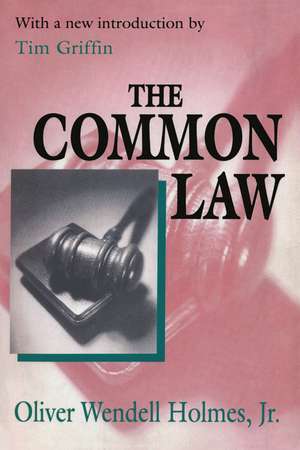
The Common Law
Autor Oliver Wendell Holmes Jr.en Limba Engleză Paperback – 30 noi 2004
At the outset of The Common Law Holmes posits that he is concerned with establishing that the common law can meet the changing needs of society while preserving continuity with the past. A common law judge must be creative, both in determining the society's current needs, and in discerning how best to address these needs in a way that is continuous with past judicial decisions. In this way, the law evolves by moving out of its past, adapting to the needs of the present, and establishing a direction for the future. To Holmes' way of thinking, this approach is superior to imposing order in accordance with a philosophical position or theory because the law would thereby lose the flexibility it requires in responding to the needs and demands of disputing parties as well as society as a whole.
According to Holmes, the social environment--the economic, moral, and political milieu--alters over time. Therefore, in order to remain responsive to this social environment, the law must change as well. But the law is also part of this environment and impacts it. There is, then, a continual reciprocity between the law and the social arrangements in which it is contextualized. And, as with the evolution of species, there is no starting over. Rather, in most cases, a judge takes existing legal concepts and principles, as these have been memorialized in legal precedent, and adapts them, often unconsciously, to fit the requirements of a particular case and present social conditions.
Oliver Wendell Holmes, Jr. (1841-1935) served as chief justice of the Massachusetts Supreme Court and as an associate justice of the U.S. Supreme Court. He was nicknamed the "Great Dissenter" because of his many dissenting opinions. Holmes is also the author of Kent's Commentaries on the Law (1873) and "The Path of the Law" (1897).
Tim Griffin has advanced degrees in philosophy and law, and has taught philosophy and legal theory courses at a number of universities. He is currently a seminarian pursuing ordination to the priesthood in the Episcopal Church.
Preț: 434.34 lei
Puncte Express: 652
Carte disponibilă
Livrare economică 21 octombrie-04 noiembrie
Livrare express 06-10 octombrie pentru 38.80 lei
Livrare prin curier în România Termenul estimat este afișat lângă disponibilitate.
Transport gratuit pentru acest produs Plată online sau ramburs, în funcție de opțiunile comenzii.
Retur gratuit în 14 zile Comandă securizată și suport în română.
Specificații
ISBN-13: 9780765808271
ISBN-10: 0765808277
Pagini: 365
Dimensiuni: 152 x 229 x 24 mm
Greutate: 0.54 kg
Ediția:Revised
Editura: Taylor & Francis
Colecția Routledge
Locul publicării:Oxford, United Kingdom
ISBN-10: 0765808277
Pagini: 365
Dimensiuni: 152 x 229 x 24 mm
Greutate: 0.54 kg
Ediția:Revised
Editura: Taylor & Francis
Colecția Routledge
Locul publicării:Oxford, United Kingdom
V-ar putea interesa
-
 -31%Preț: 696.47 lei1008.81 lei
 -
 -18%Preț: 1252.71 lei1527.70 lei
 -
 Equity and AdministrationP. G. Turner-14%Preț: 748.67 lei870.55 lei
 -
 The US Supreme Court and the Modern Common Law ApproachSimona GrossiPreț: 337.64 lei
 -
 The Autocrat of the Breakfast TableJr. Holmes, Oliver WendellPreț: 133.71 lei
 -
 Causation in NegligenceSarah GreenPreț: 234.55 lei
 -
 The Spirit of the Common LawRoscoe PoundPreț: 473.71 lei
 -
 The Annotated Common Law: With 2010 Foreword and Explanatory NotesOliver Wendell HolmesPreț: 177.59 lei
 -
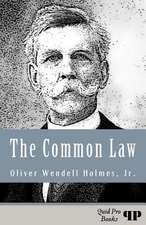 The Common Law (Illustrated): Or the Skimmer of the SeasOliver Wendell HolmesPreț: 103.06 lei
 -
 Van Vollenhoven on Indonesian Adat LawCornelis Van VollenhovenPreț: 405.71 lei
 -
 Law for the Common ManKush KalraPreț: 197.58 lei
Cuprins
Introduction to the Transaction Edition, Preface, LECTURE 1: EARLY FORMS OF LIABILITY, LECTURE 2: THE CRIMINAL LAW, LECTURE 3: TORTS.— TRESPASS AND NEGLIGENCE, LECTURE 4: FRAUD, MALICE, AND INTENT — THE THEORY OF TORTS, LECTURE 5: THE BAILEE AT COMMON LAW, LECTURE 6: POSSESSION, LECTURE 7: CONTRACT. — 1. HISTORY, LECTURE 8: CONTRACT. — 2. ELEMENTS, LECTURE 9: CONTRACT. — 3. VOID AND VOIDABLE, LECTURE 10: SUCCESSIONS. — 1. AFTER DEATH. — 2. INTER VIVOS, LECTURE 11: SUCCESSIONS. — 2. INTER VIVOS, Glossary of Legal Terms, Table of Cases, Year Books and Early Cases, Index
Notă biografică
Oliver Wendell Holmes, Jr. (1841-1935) served as chief justice of the Massachusetts Supreme Court and as an associate justice of the U.S. Supreme Court. He was nicknamed the Great Dissenter because of his many dissenting opinions. Holmes is also the author of Kent's Commentaries on the Law (1873) and The Path of the Law (1897).
Descriere
The Common Law is Oliver Wendell Holmes' most sustained work of jurisprudence