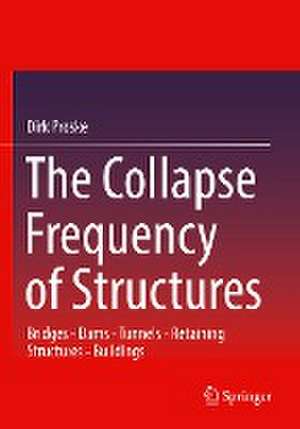
The Collapse Frequency of Structures
Autor Dirk Proskeen Limba Engleză Paperback – 13 mai 2023
Therefore, in this book the collapse frequencies are determined for different types of structures, such as bridges, dams, tunnels, retaining structures and buildings. The collapse frequency, like the failure probability, belongs to stochasticity. Therefore, the observed mean collapse frequencies and the calculated mean failure probabilities are compared. This comparison shows that the collapse frequencies are usually lower than the calculated failure probabilities. In addition, core damage frequencies and probabilities are given to extend the comparison to another technical product.
Preț: 558.87 lei
Preț vechi: 657.50 lei
-15%
Puncte Express: 838
Carte tipărită la comandă
Livrare economică 08-22 iunie
Specificații
ISBN-13: 9783030972493
ISBN-10: 3030972496
Pagini: 160
Ilustrații: XII, 147 p. 71 illus., 62 illus. in color.
Dimensiuni: 168 x 240 x 9 mm
Greutate: 0.28 kg
Ediția:1st ed. 2022
Editura: Springer
Locul publicării:Cham, Switzerland
ISBN-10: 3030972496
Pagini: 160
Ilustrații: XII, 147 p. 71 illus., 62 illus. in color.
Dimensiuni: 168 x 240 x 9 mm
Greutate: 0.28 kg
Ediția:1st ed. 2022
Editura: Springer
Locul publicării:Cham, Switzerland
V-ar putea interesa
-
 StructuresJ. E. GordonPreț: 102.91 lei
 -
 Humble PiMatt Parker-32%Preț: 60.83 lei89.00 lei
 -
 Structural Engineering: A Very Short IntroductionDavid Blockley-29%Preț: 47.65 lei67.47 lei
 -
 -19%Preț: 34.10 lei41.88 lei
 -
 WreckersSimon ParkPreț: 183.14 lei
 -
 FragilitiesFernando Dominguez Rubio-14%Preț: 431.40 lei501.63 lei
 -
 Structural Design for Fire SafetyAndrew H. BuchananPreț: 462.55 lei
 -
 Normal AccidentsCharles PerrowPreț: 270.66 lei
 -
 Risk RevealedPaul EmbrechtsPreț: 300.08 lei
 -
 Funicular Structures: The Art of Building EfficientlyDamon BolhassaniPreț: 352.85 leiRecomandat
 -
 The Failure of Risk ManagementDouglas W. HubbardPreț: 288.48 lei
 -
 Unique Methods for Analyzing Failures and Catastrophic EventsAnthony Sofronas-11%Preț: 623.05 lei700.05 lei
 -
 Probability For DummiesDeborah J RumseyPreț: 112.86 lei
 -
 The Book of NumbersTim Glynne-JonesPreț: 92.39 lei
 -
 Safe DangerBen SwirePreț: 138.05 lei
 -
 The Norm Chronicles: Stories and numbers about dangerDavid Spiegelhalter-20%Preț: 55.38 lei68.93 lei
 -
 Structural SafetyAllan Mann-23%Preț: 656.29 lei852.32 lei
 -
 -23%Preț: 803.04 lei1042.91 lei
 -
 -11%Preț: 394.09 lei442.80 lei
Cuprins
Introduction and Initial Position.- Preliminary Considerations.- Bridges.- Dams.- Tunnel.- Retaining Structures.- Buildings and Structures.- Stadiums.- Wind Turbines.- Nuclear Power Plants.- Concluding Remarks.
Textul de pe ultima copertă
The mathematical verification of the safety of structures can be done by determining the probability of failure or by using safety elements. Observed damages and collapses are usually assessed within the framework of expert reports, which seems reasonable due to the large number of unique structures in the construction industry. However, there should also be an examination of observed safety across all structures.
Therefore, in this book the collapse frequencies are determined for different types of structures, such as bridges, dams, tunnels, retaining structures and buildings. The collapse frequency, like the failure probability, belongs to stochasticity. Therefore, the observed mean collapse frequencies and the calculated mean failure probabilities are compared. This comparison shows that the collapse frequencies are usually lower than the calculated failure probabilities. In addition, core damage frequencies and probabilities are given to extend the comparison toanother technical product.
About the Author:
Prof. (FH) Dr.-Ing. habil. Dirk Proske MSc. studied civil engineering in Dresden and London. He worked at various universities, such as the TU Dresden, the University of Natural Resources and Applied Life Sciences Vienna and the TU Delft. He has also worked for various engineering firms and on various construction sites, including in South Africa and Indonesia. Since 2018, he has been a professor of risk management at the Bern University of Applied Sciences.
Caracteristici
Consideration of failure probability and collapse frequencies Calculation of failure probabilities Comparison of causes, morality and numbers of victims