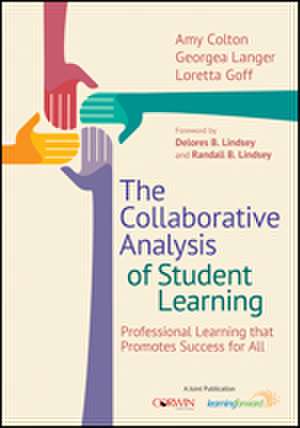
The Collaborative Analysis of Student Learning: Professional Learning that Promotes Success for All
Autor Amy B. Colton, Georgea M. Langer, Loretta Goffen Limba Engleză Paperback – 10 aug 2015
Această nouă ediție a lucrării The Collaborative Analysis of Student Learning aduce o perspectivă actualizată asupra modelului CASL, un cadru de învățare profesională recunoscut pentru eficiența sa în creșterea performanței cadrelor didactice. Remarcăm faptul că autorii Amy B. Colton, Georgea M. Langer și Loretta Goff nu se limitează doar la prezentarea teoretică a colaborării, ci integrează mecanisme concrete pentru alinierea practicilor de clasă la standarde academice complexe, precum Common Core sau Next Generation Science Standards. Găsim în acest volum o adaptare necesară la contextul educațional actual, unde evaluarea profesorilor și obiectivele de dezvoltare profesională sunt strâns legate de rezultatele tangibile ale elevilor.
Suntem de părere că forța acestui text rezidă în structura sa riguroasă. Secțiunea introductivă stabilește fundamentul conceptual al profesorului ca cercetător, în timp ce capitolele ulterioare detaliază beneficiile modelului pentru toți actorii implicați: de la elevi și profesori, până la părinți și organizații școlare. Cartea acoperă aceeași arie tematică precum Collaborative Inquiry for Educators de Jenni Donohoo, însă The Collaborative Analysis of Student Learning oferă o abordare mai aplicată pe analiza produselor muncii elevilor și pe utilizarea acestor date în procesul de evaluare formală a competențelor pedagogice.
Un element distinctiv al acestei ediții este atenția sporită acordată echității educaționale, oferind strategii specifice pentru sprijinirea elevilor diverși din punct de vedere cultural și lingvistic. Prin includerea studiilor realizate din 2004 până în prezent, lucrarea publicată de Corwin (o amprentă a SAGE Publications) devine un instrument indispensabil pentru liderii școlari care doresc să transforme izolarea profesională într-o cultură a colaborării intenționate și a facilitării calificate.
Preț: 306.24 lei
Carte disponibilă
Livrare economică 13-27 mai
Specificații
ISBN-10: 1483358178
Pagini: 328
Dimensiuni: 178 x 254 x 23 mm
Greutate: 0.7 kg
Ediția:1
Editura: SAGE Publications
Colecția Corwin
Locul publicării:Thousand Oaks, United States
V-ar putea interesa
-
 Linking Practice and Theory: The Pedagogy of Realistic Teacher EducationFred A.J. Korthagen-15%Preț: 455.31 lei535.66 lei
 -
 -15%Preț: 306.39 lei359.84 lei
 -
 Get Ready to TeachVerity LushPreț: 110.27 lei
 -
 Preț: 355.88 lei
 -
 Preț: 270.80 lei
 -
 TrainSmart: Effective Trainings Every TimeRich AllenPreț: 270.64 lei
 -
 Preț: 299.17 lei
 -
 Learning and Teaching with Virtual Learning EnvironmentsHelena GillespiePreț: 321.78 lei
 -
 Pedagogy and Practice: Culture and IdentitiesPatricia F MurphyPreț: 419.36 lei
 -
 Preț: 409.05 lei
 -
 Attachment in the ClassroomHeather GeddesPreț: 224.51 lei
De ce să citești această carte
Recomandăm această carte liderilor școlari și cadrelor didactice care doresc să transforme analiza muncii elevilor într-un motor de progres profesional. Cititorul câștigă o metodologie validată prin cercetare pentru implementarea modelului CASL, facilitând o colaborare autentică ce elimină izolarea la catedră. Este o resursă esențială pentru a asigura succesul tuturor elevilor, inclusiv al celor din medii diverse, prin standarde de excelență și investigație structurată.
Descriere scurtă
The Collaborative Analysis of Student Work is a comprehensive guide to implementing a research-based approach to professional learning that drives educator effectiveness and promotes learning for every student. This new edition will be thoroughly updated with special focus on the following:
- how to use the CASL inquiry process to help teachers clarify what it looks like when students reach complex academic standards such as the Common Core and Next Generation Science Standards
- use of CASL in teacher evaluation -use of the CASL inquiry process helps teachers to specify and define their professional learning goals
-how school leaders can play pivotal roles in successful implement of CASL
-how CASL can specifically benefit Culturally and Linguistically Diverse learners
-significant updates to facilitation coverage.
Recenzii
"Research has shown for many years that the isolation of teachers is one of the biggest obstacles to improving teacher effectiveness. This book provides practical insights and recommendations on how teachers can work together to increase their impact on student learning. For educators seeking strategies for improving teaching and learning, this important new book will be an invaluable resource."
Cuprins
SECTION A. CASL: OVERVIEW AND BACKGROUND
1. The Collaborative Analysis of Student Learning: Essential Features and Benefits
Why is the Collaborative Analysis of Student Necessary?
What are the Essential Features of CASL?
A Conceptual Framework: Teacher as Collaborative Inquirer
Structured Inquiry
A Focus on Standards of Excellence
Case-Study for Equitable Responsiveness
Inquiry Over Time
Productive and Intentional Collaboration
Skilled Facilitation And Organizational Support
What are the Benefits of CASL?
Studies of CASL 2004-Present
Benefits to Students
Benefits to Teachers
Commitment to and Confidence in Ability to Promote Student Learning
Cultural Competency
Professional Knowledge
Alignment Among Standards, Assessments, and Instruction
Collaborative Sharing of Expertise
Professional Awareness and Self-Assessment
National Board for Professional Teaching Standards Certification
Benefits to Parents and Organizations
Summary
2. Why CASL Works. The Framework: Teacher as Collaborative Inquirer
A Vision of The Collaborative Inquirer
The Framework: Teacher as a Collaborative Inquirer
Professional Knowledge Base for Teaching
The Collaborative Inquiry Cycle: Constructing Meaning
Share Background
Observe
Analyze and Interpret
Draw On Their Knowledge Base
Dialogue
Reflect
Act
Filtering System
Beliefs
Feelings
Dispositions 0f Collaborative Inquirers
Moral Stance
Collective Responsibility
Cultural Competency
Efficacy
Develop Collaborative Inquirers
Summary
SECTION II. BUILDING A CULTURE FOR COLLABORATIVE INQUIRY
3. Working Agreements and Communication for Collaborative Inquiry
Working Agreements
Communication Skills
Dialogue
Committed Learning
Non-Productive Listening
Judgmental Listening
Autobiographical Listening
Inquisitive Listening
Solution Listening
Pausing
Matching Verbal and Nonverbal Cues
Paraphrasing
Probing
Probing for Clarity
Empowering Probes (Presuppositions)
Probing for Beliefs
Putting Ideas on The Table
Putting It All Together
Summary
4. Leadership and Support
Develop and Uphold a Shared Vision
Apply Both Pressure And Support to Reach The Vision
Promote Teachers’ Curiosity and Collective Responsibility
Analysis of Student Data
Examination Of The Unknown
Review of Relevant Research
Supporting Teachers’ Engagement in CASL
Develop Interest In CASL
Establish Collaborative Teams
Identify The Target Learning Area
Provide Resources
Meeting Expenses
Compensation For Facilitator and Participants
Professional Learning Opportunities and Materials
Provide Incentives and Celebrate Victories
Model A Commitment to Collaborative Inquiry
Summary
5. Facilitation of Collaborative Inquiry
Selection of A Study Group Fracilitator
The Art of Facilitation
The Directive Approach
The Collaborative Approach
The Nondirective Approach
Flexing For Various Purposes
Identify A Teacher’s Assumption
Identify Gaps in Teachers’ Professional Knowledge Base
Facilitating The Flow of Curiosity
Preparation For Facilitation of CASL
Planning With The School Leadership
Teachers’ Expertise and Prior Experience
Contextual Background
Logistics
Composition of Study Groups
Scheduling and Pacing of CASL Sessions
Arranging Space for CASL Sessions
Gathering Necessary Materials
Getting Acquainted with The Teachers
The CASL Session Design and Supportive Tools
Opening Session
Engaging In Professional Learning
Organizing for The Next Session
Group and Individual Documentation
Public Notes of Group Thinking
Individual Notes and Written Reflections
Developing Consistent Use of the Working Agreements and Communication Skills
Growing In Your Facilitation
Start Small
Co-Facilitate
Engage the Leaders
Pursue Additional Learning
Inquire Into the Group’s Learning and Your Role in Facilitating It
Summary
SECTION III. THE FIVE CASL PHASES
The 5 CASL Phases
Adapting The CASL Phases For Local Needs
The CASL Introductory Session
Preparation and Materials
Teacher Learning Outcomes
Agenda
How to Use Chapters 6-9
6. Phase I: Establishing a Focus for CASL Inquiry
Phase I Overview
Phase I Preparation and Materials
Phase I Teacher Learning Outcomes
Guiding A Study Group Through Phase I
Protocol Step 1. Share Background
Protocol Step 2. Observe Patterns In Data
Protocol Step 3. Analyze The Power of the TLA as a Focus for Inquiry
Protocol Step 4. Plan TLA Outcomes and Assessments
Protocol Step 5. Reflect
Assessment Knowledge and Experience
Inconsistent Use of Scoring Criteria (Lack of Reliability)
When A Rubric Is Mandated
No Test Data Available
Teachers New To District Content Outcomes and Curriculum
Summary
Chapter 7. Phase II: Defining Teachers’ Professional Learning Goals
7. Phase II: Defining Teachers’ Professional Learning Goals
Phase II Overview
Phase II Preparation and Materials
Phase II Teacher Learning Outcomes
Professional Knowledge Base
Skills for Collaborative Inquiry
Filters and Dispositions
Guiding A Study Group Through Phase II
Opening The Session
Protocol Step 1. Share Background
Protocol Step 2. Observe Patterns In Initial Assessment Data
Protocol Step 3. Analyze Professional Learning Goals
Protocol Step 4. Plan for Professional Learning
Protocol Step 5. Reflect
Phase II: Adaptations
Curriculum Revision
Lack of Experience with Assessment
Considerable Experience with Assessment
Hesitation to Share Student Work
Limited Time
Multiple Scores For Each Student
Mandated Assessment or Scoring Rubric
Changing the Focus Student
Chapter Summary
8. Phase III: Inquiring Into Teaching For Learning
Phase III Overview
Phase III Preparation and Materials
Group Member Preparation
Materials
Phase III Teacher Learning Outcomes
Professional Knowledge Base
Skills for Collaborative Inquiry
Filters and Dispositions
Guiding A Study Group Through Phase III
Phase II: Adaptations
Chapter Summary
9. Phases IV. Assessing Learning Progress and CASL Phase V. Integrating Learning Into Teachers’ Professional Practice
Phase IV Overview
Phase IV Preparation and Materials
Phase IV Teacher Learning Outcomes
Guiding A Study Group Through Phase IV
Phase IV: Adaptations
Teacher Learning Outcomes
Guiding A Study Group Through Phase V
Chapter Summary
Conclusion
Appendix. Responses To Exercises in Chapters 7-8