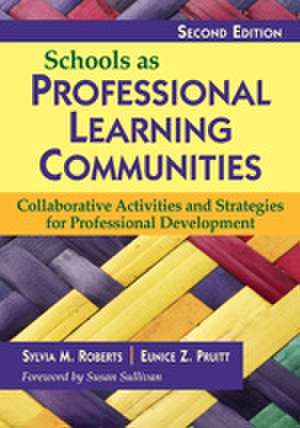
Schools as Professional Learning Communities: Collaborative Activities and Strategies for Professional Development
Editat de Sylvia M. Roberts, Eunice Z. Pruitten Limba Engleză Paperback – 17 noi 2008
Această resursă este concepută ca o referință profesională esențială pentru directorii de școli, formatori și lideri educaționali care doresc să depășească barierele izolării profesionale. Observăm că Schools as Professional Learning Communities se distinge prin pragmatism, oferind un ghid metodologic pentru transformarea personalului didactic într-o comunitate de învățare activă. Ediția a doua vine cu o structură revizuită ce integrează concepte moderne precum e-portofoliile, inteligența emoțională în leadership și mecanismele de coaching, toate subordonate obiectivului de a îmbunătăți rezultatele elevilor.
Analizând cuprinsul, apreciem progresia logică de la fundamentele teoretice ale unei comunități de învățare (PLC) către aplicații practice concrete. Primele capitole definesc caracteristicile acestui model în era responsabilității academice, în timp ce secțiunile ulterioare detaliază pașii pentru construirea unei viziuni comune și a încrederii între colegi. Cartea include secțiuni de tip „Making It Work” și activități specifice pentru fiecare capitol, facilitând implementarea imediată.
Ca alternativă la Building Effective Learning Communities de Susan S. Sullivan pentru cursurile de management educațional, lucrarea de față are avantajul unei abordări mai aplicate, punând accent pe instrumente specifice de lucru, cum ar fi grupurile de studiu și evaluările colaborative ale elevilor. În timp ce alte titluri se concentrează pe cadrul teoretic al standardelor academice, Sylvia M. Roberts și Eunice Z. Pruitt oferă soluții la problema fundamentală a modului în care cadrele didactice pot învăța eficient unele de la altele prin reflecție și observație la clasă.
Preț: 328.63 lei
Carte tipărită la comandă
Livrare economică 06-20 noiembrie
Specificații
ISBN-10: 1412968941
Pagini: 272
Ilustrații: black & white illustrations
Dimensiuni: 178 x 254 x 17 mm
Greutate: 0.56 kg
Ediția:Second Edition
Editura: SAGE Publications
Colecția Corwin
Locul publicării:Thousand Oaks, United States
V-ar putea interesa
-
 Promising Practices in 21st Century Music Teacher EducationMichele Kaschub-19%Preț: 351.45 lei435.70 lei
 -
 Preț: 295.63 lei
 -
 Critical Thinking Skills for Education StudentsLesley-Jane Eales-ReynoldsPreț: 239.44 lei
 -
 The Teacher's JourneyJeffrey A. KottlerPreț: 281.44 lei
 -
 A Guide to Early Years and Primary TeachingDominic WysePreț: 329.83 lei
 -
 Passing the Literacy Skills TestJim JohnsonPreț: 143.40 lei
 -
 Lessons in Teaching Phonics in Primary SchoolsDavid WaughPreț: 507.43 lei
 -
 Lessons in Teaching Reading Comprehension in Primary SchoolsSuzanne HortonPreț: 283.18 lei
 -
 Focus on TeachingJim KnightPreț: 189.62 lei
De ce să citești această carte
Recomandăm această carte liderilor școlari care doresc să înlocuiască ierarhiile rigide cu un model de leadership partajat. Cititorul câștigă acces la un set complet de instrumente testate — de la strategii de comunicare la activități de grup — necesare pentru a construi o cultură a colaborării. Este un ghid practic care transformă teoria comunităților de învățare profesională în acțiuni zilnice ce susțin atât dezvoltarea profesorilor, cât și succesul elevilor.
Despre autor
Sylvia M. Roberts este o figură proeminentă în administrarea și supravegherea educațională, conducând programe de specialitate la City College din New York. Cu o vastă experiență în predarea la nivel de gimnaziu și în consultanță pentru numeroase districte școlare, Roberts îmbină rigoarea academică a cursurilor de masterat cu expertiza practică din teren. Această dublă perspectivă îi permite să coordoneze lucrări care răspund nevoilor reale ale administratorilor școlari, concentrându-se pe transformarea instituțiilor de învățământ prin colaborare și leadership eficient.
Descriere scurtă
Recenzii
"An excellent resource for teacher leaders, administrators, or mentors as a tool for establishing useful collaboration. There are specific examples and tips that can be applied to collaborative groups."
"Roberts and Pruitt offer practical advice to educators who seek to address one of the greatest obstacles to creating effective schools: how to get school staff to collaborate and learn from each other. Their insights and suggestions are smart, useful, and demonstrate a genuine understanding of how schools work."
"The wealth of ideas and information leads readers to make their own deductions and formulate their own vision and mission. This is an important step toward school improvement. The book is also very practical and has excellent examples."
"The case studies, examples, and references to additional sources of information such as Web sites make this an excellent study guide and reference work for leaders who are engaged in the difficult task of building learning communities."
"Provides aspiring educational leaders with the tools they need to build learning communities among school teachers. The activities are not only creative but allow for the development of complex skills critical to leading and transforming contemporary schools. This is a must-read book for those looking for school-based professional development activities and for those preparing leaders to be change agents in the 21st century."
"Roberts and Pruitt have created a guidebook that those in leadership positions can use to successfully implement the learning community model. The activities included skillfully address the issues that teachers and leaders face as they strive to transform their schools into places where learning opportunities for all can be maximized. This book is a storehouse of information with many practical applications and ideas that can be used by those who are engaged in the school improvement process."
Cuprins
Preface
About the Authors
1. The Professional Learning Community: An Overview
Preview of the Chapter
What is a learning community?
What are the characteristics of a learning community?
What is the role of the learning community in an age of accountability?
What are the key elements of the school improvement framework for learning community schools?
How is student achievement affected by the learning community model?
How are teachers affected by the learning community?
How do refelection and reflective practice contribute to the building of learning communities?
Conclusion
Making It Work
Activities
2. Learning Through Shared Leadership
What are the roles of educational leaders in a learning community?
What steps must a principal take to develop a shared mission and vision?
What strategies can educational leaders use to communicate and sustain the vision?
What about emotional intelligence and leadership?
How do principals build the trust that contributes to improved student achievement?
What communication skills do leaders need to successfully lead learning communities?
What do leaders need to know about the change process?
How do you begin the process of building a learning community?
Conclusion
Making It Work
Activities
3. Learning Through Ongoing Professional Development
What are the guiding principles for professional development in learning communities?
What strategies meet the needs of adults as learners?
How can we find enough time for professional development?
How do we assess the effectiveness of professional development?
How do we get started with professional development?
Conclusion
Making It Work
Activities
4. Learning Through Teamwork
How can we overcome barriers to effective teamwork?
What behaviors promote effective teamwork?
What are the stages of group development?
How may conflict among team members be effectively managed?
What are effective ways for teams to make decisions?
How should meetings be conducted to promote team development in learning communities?
Conclusion
Making It Work
Activities
5. Learning Through Study Groups
What is a study group?
What are the purposes and benefits of study groups for a community of learners?
How do you initiate a study group?
How can teacher book study groups be planned and conducted?
Conclusion
Making it Work
6. Learning Through Classroom Observation
What is the purpose of classroom observation?
How does the standards-based walk-through for teachers contribute to a culture of collaborative instruction?
How does conferencing with teachers set the stage for the calssroom observation process?
How does clinical supervision improve learning and foster collaboration?
What about the observation of the differentiated classroom?
Conclusion
Making it Work
Activities
7. Learning Through Collaborative Approaches
How may issues of equity and diversity be addressed in a collaborative learning community?
What is the role of collaboration in the learning community?
How do mentoring and coaching enhance the learning community?
How does collaborative assessment of student work build learning communities?
How may we collaborate with parents in the learning community?
Conclusion
Making It Work
Activities
8. Learning Through Professional Portfolios
What is the role of professional portfolios in the learning community?
What goes into a professional portfolio?
How do you get started developing the portfolio?
How should the portfolio be organized?
What about electronic portfolios?
How may the portfolio be evaluated?
What strategies support the development and use of portfolios in the learning community?
Conclusion
Making it Work
Activities
9. Sustaining the Professional Learning Community
How do we sustain a culture that supports a collaborative approach to improving instructional practice and student outcomes?
How do we sustain the structures that support learning community schools?
What must we do to maintain the focus on continuous student learning that characterizes learning communities?
How do we maintain a focus on the school's mission and shared vision statements that stress student achievement?
What steps must be taken to ensure that shared leadership is sustained in learning community schools?
Conclusion
Making It Work
Activities
References
Index